2 months ago
34
2 months ago
34
The Ghost Train was the only train operating in Sydney on the night of June 9, 1979 thanks to a statewide rail strike. It was the Saturday night of the June long weekend, a firework fiesta known as cracker night. The moon was almost full as four Waverley College boys boarded the ride. Friends since kindergarten; they were inseparable. They played rugby together, sailed on Sydney Harbour together, and two-by-two they went on the rickety old Luna Park ride together that still, cool night, Jonathan Billings and Richard Carroll first, then Michael Johnson and Seamus Rahilly.
Their fifth friend, Jason Holman, a year younger, sometimes felt like a hanger-on; but they were a welcoming crew, even if a year above him in school.
Holman sat alone in his carriage that night, waiting for the operator to push the button for him to advance into the two-and-a-half-minute-long ride.
Entering through “Hell’s Doorway”, passengers were taken along a 180-metre darkened track that featured dancing phosphorescent skeletons, a dragon’s head and Dracula in a graveyard, among other trite terrors.
Holman saw his friends disappear through the flap doors, then his carriage moved forward too. He went in briefly, but, before he knew it, a man – likely a ride attendant – came and whisked him out and placed him over a safety fence out of the ride. He waited.
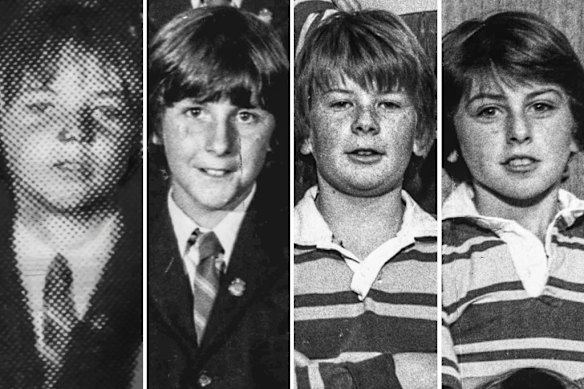
“I started to freak out when smoke started to appear,” he told me. “I kept looking for my mates to come out of the ride. I start watching the carriages and they are coming out on fire. I panicked when the flames got bigger and louder. I was over the fence no more than 10 minutes when there was an explosion and I was forced back by the inferno. I started to cry.
“A mother of another child saw me getting upset. I started watching carriages coming out on fire, looking for my mates. ‘Come with me,’ she said.
“Then she said it more forcefully: ‘You need to come with me.’ And she stayed with me. We started walking briskly towards the entrance.
“By the time I got to the face, I remember the sound of the sirens and seeing the lights of the police cars and the fire brigade driving in beneath the face.”
Peter Little was one of the firemen in one of those fire trucks that drove in through the famous face of the Luna Park entrance that night. “Our siren was blaring so we split the crowd that had gathered there,” he said.
Stationed at The Rocks and at the beginning of his first night shift, Little was just six months out of training college. This was his first fire, his first opportunity to work a fire truck with turntable ladders. He was still learning the ropes. “There were seven of us on that night – our station office was not on duty, but we had a senior officer filling in,” Little recalls.
At 10.14 pm NSW Fire Brigade Headquarters Control in Castlereagh Street received the first call: a fire was burning in the Ghost Train ride at Luna Park. Crews from Crows Nest and Neutral Bay were first to arrive on the scene; they witnessed thick columns of smoke, reaching 100 metres high, coming from the Ghost Train.
“We got there not long after, and another city station, Kent Street, joined us,” Little told me. “I remember driving from Millers Point over the Harbour Bridge and looking out to the left and you could see the fire better. It was a very intense blaze – the smoke was pluming over the Harbour Bridge. I was on the left-hand side of the truck … When you’re junior, you couldn’t sit by the window ... But I remember it vividly as it was my first-ever full fire.”
On arrival, it took crews longer than expected to reach the fire as there was only a single road in and out of the park. Against the sea of people evacuating, it was difficult for crews to enter. Once the crews had a better understanding of the situation, they called for more assistance from firefighters and ambulances.
“I remember there was no water pressure whatsoever,” Little says. “The hydrants were there, but there wasn’t enough water coming out of the hose … It was just a drizzle.
“We had to move the trucks to the edge of the water and drop the suction hoses in to drain water out of Sydney Harbour. The fire was raging. As we got out the first hoses, there was a woman near the ride. I asked if she could move away … She told me, ‘My husband and children are in there.’”
It was Jenny Godson, who lost her husband and two young children in the blaze, and the interaction has haunted Little ever since.
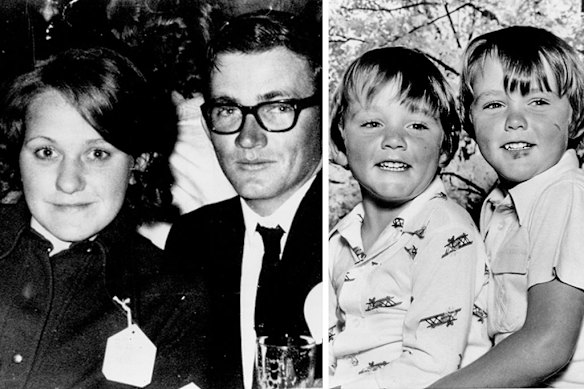
“We started setting up lighting inside because it was dark, and we had to carry generators. The electricity was on still in certain areas, so we had to isolate the power.
“I remember all the wires were burnt, the plastic – we were in danger of being electrocuted. We had to tear sheets of iron at the ride … We couldn’t enter for an hour or so, and it took a while to get enough water to extinguish the fire. Once they got the message there was trouble with the water pressure, they brought in a relay pump – we were pumping from one truck to the other.”
Firefighters worked frantically, using lines of hose at the front of the building along with two turntable ladders positioned at the edges to act as water towers. More fire stations were called in, along with the headquarters’ Breathing Apparatus Van, to help to draft water from the harbour to the turntable ladders and supply additional equipment.
Firefighters were concerned that the fire would spread to the Big Dipper overhead and to the adjoining River Caves, which did occur, destroying the area called Toyland. In time, water from the aerial appliances rigged to the turntable ladders was able to extinguish the outbreak at the Big Dipper.
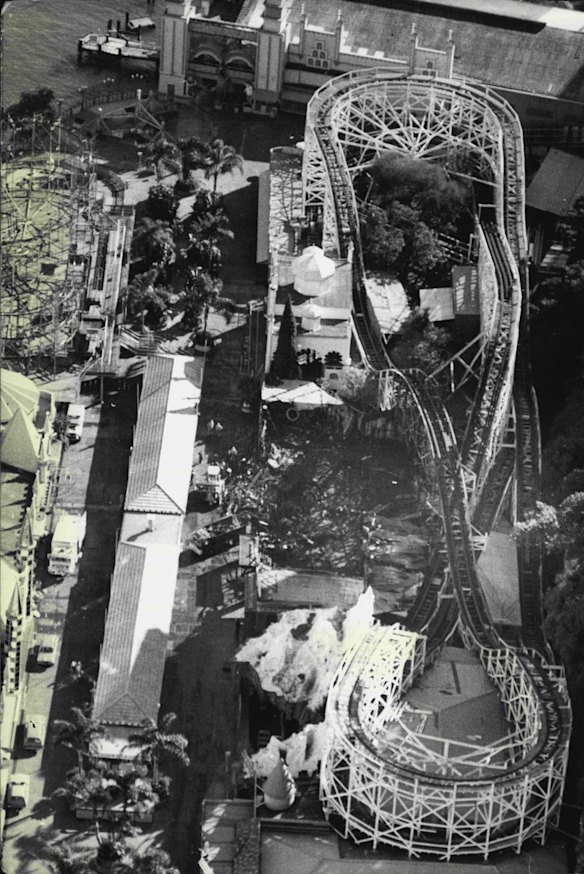
The highly combustible materials used in the construction of the Ghost Train and the absence of a sprinkler system made it difficult for firefighters to save any of its structures, which collapsed in showers of sparks, smoke and burning debris.
At 11.17 pm, just over an hour after the initial reports, the stop message was sent to head office, indicating the fire was out, but crews continued to cool down the mass of hot metal and smouldering timbers. Then they could begin searching inside.
“I was a junior firefighter,” says Little. “But there were more senior people with me. I went inside with one of the senior guys .. He took me in. It was then we started discovering the bodies. It was quite shocking … the boys were all together. There was nothing much left … They were burnt to the bone of their fingers and toes – it was such an intense fire.
“We went inside and wandered further around. The father and two young kids … He had been laying on top of them, trying to use his body to shield them.”
It took crews over six hours to carefully remove the debris and recover the bodies.
“We took photos. There was no damage to the switchboard area. You could tell the damage wasn’t consistent with an electrical fault – most damage will take place where the fire originated. It definitely wasn’t the fuse box or an electrical fault.
“By the next morning they were bringing in cranes to pull the structure apart.”
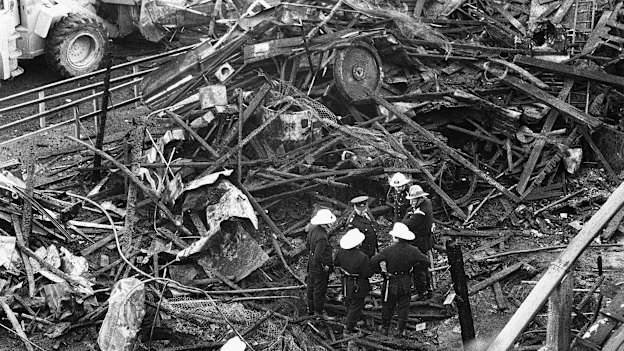
Little’s account supports the report in The Daily Telegraph of June 11, 1979 by Geoff Quayle, who wrote:
Crews from 12 stations fought for about an hour to control the fire, which quickly destroyed the old wooden building. The firemen were hampered by low water pressure from hydrants and were forced to pump water from the Harbour. Fire damaged part of the Big Dipper and the River Caves building.
At first the train controller thought all passengers had been safely brought out, but firemen made their first grim discovery at about 11:30 pm. The bodies of the father and his two young children were huddled in one of the tunnels. The other four children were found in another section. Police believe they left the cars and tried to find their way to safety through the dark smoke-filled tunnels.
Rescuers using floodlights worked through the night to clear the smouldering rubble and search for other victims. A front-end loader shifted tons of charred rubble and police and firemen sifted through the debris piece by piece.
Geoff Farlow was on the Ghost Train that night with a bunch of friends from Ryde High School. “It was in the days when you would just pile into someone’s van and drive somewhere. So eight of us ended up on the Ghost Train at Luna Park.
“We were among the last group to go through on the carriages. When I got on the ride, the guy punching tickets let me go through for free. When we got to the fake fireplace, there was a real fire in it, already about five inches high. It looked like a globe had caught fire in the fireplace from one of the streamers. I know what electricity burning smelt like and that’s what I remember. I always felt the cellophane over the light globe had caught on fire. I also remember turning around and seeing a young family go in – the boys had homemade knitted jumpers on … They were the Godson boys.”
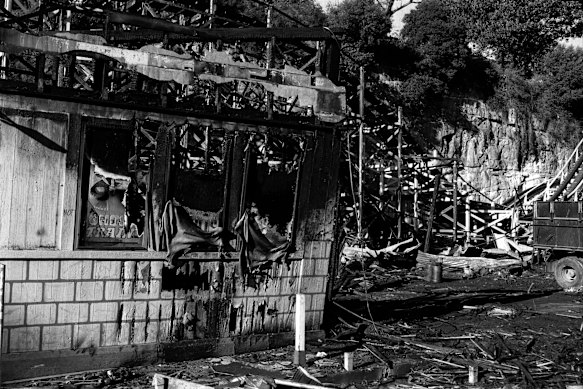
In a small Lavender Bay terrace, a university party was underway when the wailing of sirens began to fill the suburb’s streets. From the balcony, a first-year uni student, Kate McClymont, and her friends could see flames in the park below: “Slipping through the hole in the fence at the top of the park’s site, we headed down to see what was happening. The scene around the Ghost Train was chaotic; firemen were everywhere and onlookers stood by in small, silent groups,” she wrote later of that night. McClymont, who would end up becoming an award-winning investigative reporter for The Sydney Morning Herald, didn’t realise it at the time, but this story would follow her later in her career.
In Roseville, Eddie Devine, the park electrician who had done the wiring of the Ghost Train ride, got a call to come to the park because there had been a dreadful accident. His daughter, Jenni Johnston, told me she remembers overhearing the phone call and listening to the later conversation between her father and mother.
Her father knew the ins and outs of the place. He also loved Luna Park. He said to Jenni’s mother: “I have got to go … Somebody said they could smell cigarette smoke before the fire started. Someone else said bikies had been at the park that night.”
She remembers: “He came home in the early hours of the morning, just devastated. He never talked about it again … But I believe Dad went into a depression then [that] he never quite got out of.”
In the eastern suburbs, Tony Carroll went to pick up his daughter Cate from the cinema. Returning home, he heard about the Luna Park blaze on the news on the car radio. Although concerned about his son Richard, who’d left evening mass that night to go to the amusement park, he decided to keep his course and stay calm. But as he turned into his street, he saw a police car parked out the front of his family home.
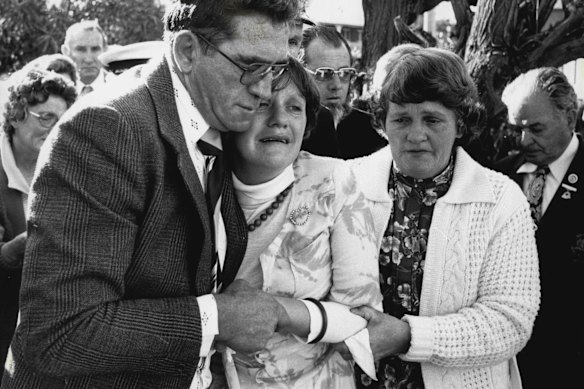
Inside, two policemen had had the melancholy task of informing his wife Mary that Richard was dead. “Can you excuse me,” she said in response to the young officers when they told her; she raced upstairs to vomit in the bathroom, such was her shock. When Tony and Cate came into the house, Cate screamed in disbelief, devastated. The whole family, including her three other brothers, spent a sleepless night huddled together hugging on the stairs. Sobbing.
Around the corner, a police car was approaching Jason Holman’s home. Without his parents being informed, he’d already been taken to North Sydney police station where he was interviewed. Two uniformed police then drove him home, trying to conduct a conversation in which he could not participate: “I remember them driving me over the Harbour Bridge and I put my head back and just watched the stanchions of the bridge overhead.”
When he got home, the uniformed police accompanied him to his front door, where his mother greeted him with a “what have you done” look, thinking he’d got in trouble. Once she realised her error, she embraced her son and attempted to console him. The two of them broke into tears. “Then she didn’t stop crying for 48 hours. She felt so guilty,” Holman recalls.
After about half an hour, he went to the Billings’ house, two doors down, to see Jonathan’s parents, Sid and Irene. He went to Jonathan’s room: “I’m still not sure why, but I got into my mate’s bed, not knowing if he’d died,” he said. He had this misguided hope that he might be woken by Jonathan in the morning and the whole thing would have been a terrible nightmare.
Instead, he was woken by the wailing of Jonathan’s dad, Sid, when the news of his son’s death was confirmed. “Sid just melted with grief,” Holman recalls. “It was the most heartbreaking thing and I will never forget it. I’ve lived in places like Africa and the Caribbean and seen a lot of death. But, because of my connection with Sid and Jonathan … It was a sight and sound that will never leave me.”
Leon Fink, who held the Luna Park lease along with Nathan Spatt, was dining at the Hellenic Club on Elizabeth Street when somebody tracked him down by phone to tell him the terrible news. He went over to Milsons Point.
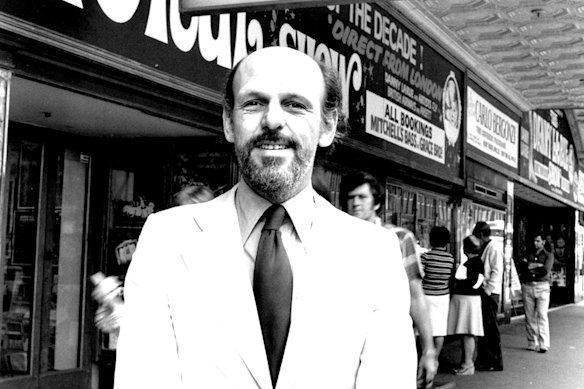
“I was there the whole night. At first, we were starting to be optimistic that nobody had been caught in the fire; but there was that terrible moment when we started getting the feedback – children had died.
“By the time it was just coming into the morning light, the horror dawned on me. It was shattering – totally, totally shattering. We shut the park. The rest is common knowledge.”
For the first time in 44 years, Luna Park’s mouth was permanently shut.
Sydney Morning Herald police reporter Paul Molloy was at home in Mosman when he heard about the fire and jumped in his car and went straight there. He wasn’t allowed beyond the face, but he spent the whole night there, talking to police and firefighters as they came out of the park. He told me: “I knew quickly people had died because I saw the ambulances take bodies. But I remember police jumping straight to the cause being an electrical fault.
“What I remember mostly is the story a fireman told me, that the fire hoses didn’t work. He said when they pulled apart the hoses on-site, they were like pieces of Swiss cheese, there were so many holes in them. They leaked like sieves – which meant the building was well ablaze before they could get any water onto it.
“I filed this in my story, but it was taken out because one of the editors [Alan Peterson] said this would impinge upon any possible inquest – that it would be sub judice.”
His front-page story was edited so that it focused on the Luna Park staff, who allegedly “saved dozens in the blaze” by forming a “human chain” along with patrons “because it was feared that anyone who went in might not be able to find their way out again”.
He told me: “I remember the police just parroted what the fire brigade said. I remember it was a cold night, and it began raining, and I was miserable standing there all on my own. ”
Molloy had covered many stories about the NSW police. “The cops were totally corrupt at that time,” he said.
Tony Carroll went back to Milsons Point with the police who had visited his home in the late hours of June 9. They had wanted him to identify his son’s body, but in the end the police wouldn’t let him or his wife see it. Instead, they identified Richard by the special watch they knew he was wearing and his dental records, which their family dentist had. The couple went to the morgue, but the mortuary attendant would neither let them see their son’s body nor even let them touch the bag his remains were in.
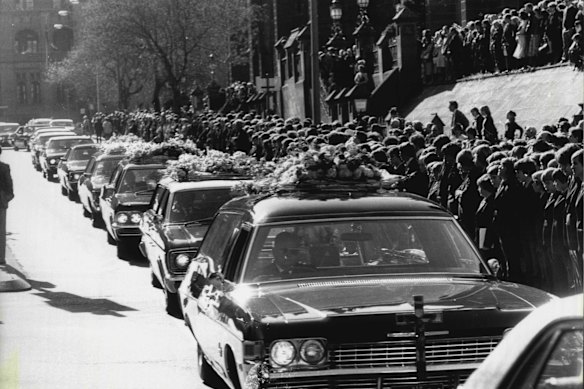
“All I wanted to do was touch him one last time,” remembers Mary. Instead, she went over to Luna Park the Monday morning of the long weekend. By then the Ghost Train was unrecognisable. With indecent haste it had been bulldozed, destroying any potential clues that could have pointed to the truth of what had happened.
Despite protestations from a Park employee, who tried to remove her, Mary went to the exact place where her son had perished, at the flattened baseboard of what was once the ride. She laid a single white camellia that had been blooming in her winter garden.
An initial 1979 inquest into the fire found the cause of the blaze could not be determined, and the coroner made an “open” finding. A 1989 National Crime Authority report later determined this first inquest “substantially ineffective” while allegations of arson and police corruption have fed calls for a second inquest. A NSW Police review of the evidence is with the NSW Coroner, who is yet to rule on opening a fresh inquest.
This is an edited extract of Luna Park: The extraordinary story of the showmen, shysters and schemers who built Sydney’s famous fun park. Out March 3.
Start the day with a summary of the day’s most important and interesting stories, analysis and insights. Sign up for our Morning Edition newsletter.