3 months ago
34
3 months ago
34

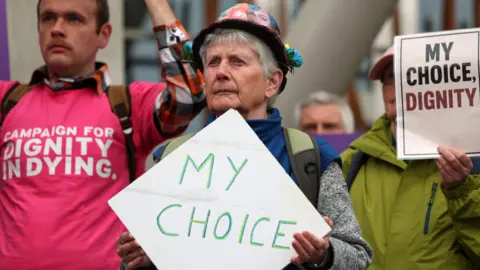 Getty Images
Supporters of a law change on assisted dying demonstrate outside the Scottish Parliament in May last year
MSPs have backed a time limit to the assisted dying legislation, which would mean only people who can be reasonably expected to die within six months would be able to access the service.
Liam McArthur, the MSP who has put forward the bill, had decided to support the proposal, after initially disagreeing.
A final vote on the overall the legislation - which would allow terminally ill, mentally competent adults to seek to end their lives - is expected next week.
McArthur told Holyrood he was "initially not minded" to include a six-month clause, but he added that doing so would bring Scotland into line with assisted dying legislation in other countries - including the Bill being debated at Westminster.
Labour's Daniel Johnson, who proposed the change, had argued that assisted dying should be for those "whose life is measured in months rather than years".
The key line in the amendment which defines the eligibility as someone who can "reasonably be expected to die within six months".
Pam Duncan-Glancy, who is opposed to the Bill, said "any doctor who feels they are able to adequately predict somebody's prognosis in months and years is usually mistaken".
She said: "Until we can improve the precision and accuracy with which we can identify somebody's prognosis it can be meaningless to include a timescale in the Bill."
The debate comes after the National Centre for Social Research found just over four out of five people in Scotland (81%) want to see assisted dying introduced for those diagnosed with a terminal condition.
MSPs also discussed amendments surrounding concerns vulnerable people could be coerced into ending their life.
Jeremy Balfour, an independent MSP for the Lothians, said: "This debate has united MSPs from across the chamber - some who don't even agree on a single other subject.
"As a disabled person, I know very well the risks not just of coercion, but of how society views disabled people, and how we can feel like a burden.
"I'm fortunate in that I have a strong support network around me to protect me from those thoughts, processes and outside influences.
"But for those who don't, I am terrified for them and the impact the passing of this dangerous Bill would have."
Audrey Nicoll, SNP MSP for Aberdeen South and North Kincardine, said: "Many MSPs like me began this process sympathetic to need for a Bill of this nature to be fully debated.
"But as time and debate has worn on, it has become increasingly clear that this Bill is unsafe and unworkable.
"The possibility for coercion of vulnerable individuals cannot be ignored, and nor can the ramifications for healthcare staff who will not be protected.
"This is a monumental decision for MSPs, made more difficult by the extent to which the Bill remains unworkable."
What is happening with the bill?
Holyrood members are making their way through about 300 proposed changes to the Bill, which will be debated in the chamber across three days, starting on Tuesday.
The Scottish Parliament is expected to sit until 22:00 during each session.
Under the current proposals, two independent medical professionals would be required to confirm a person is terminally ill and has mental capacity before assistance could be provided.
McArthur said the legislation had already been subjected to five years of scrutiny and urged MSPs to avoid "kicking the can down the road" when it came to the final vote.
"This is the right Bill at the right time. It's time to give terminally ill Scots that compassionate choice," he said.
"Over the last five years, it has drawn record levels of public consultation and engagement with stakeholders as well as going through a comprehensive parliamentary process.
"MSPs must not hunt for excuses as this issue is certainly not going away."
Politicians are being given a free vote on the bill, meaning they don't need to vote with their party.
Various forms of assisted dying are already legal in the likes of Australia, Canada and New Zealand.
Similar legislation was backed by MPs in 2024, but it has since made slow progress at the House of Commons.
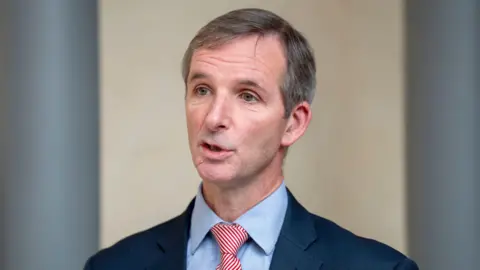 PA Media
The legislation has been proposed by Liberal Democrat MSP Liam McArthur
Supporters and opponents of the Bill have gathered outside the Scottish Parliament ahead of each stage of the process.
Several amendments to the legislation have already been made since it was initially proposed.
Most notably, the minimum age at which people can seek to end their life has been raised from 16 to 18.
Eligible people must also be resident in Scotland for at least 12 months and registered with a Scottish GP.
MSPs will be allowed a free vote on the issue, meaning they will not be whipped by their parties.
First Minister John Swinney said he was concerned "vulnerable people in our society" may come to feel like a "burden" and "feel under pressure to end their lives prematurely".
Scottish Labour leader Anas Sarwar has also said he will vote against it.
And on Monday, Scottish Conservative leader Russell Findlay confirmed he would not vote for the Bill, after supporting it at Stage One.

Both sides in this highly sensitive debate seem reasonably confident of success.
My sense is that supporters of assisted dying are going to have to work extraordinarily hard to hold together the coalition of support the bill secured when it was approved in principle last year.
The reality is that a significant number of those who voted "yes" at that stage still have serious concerns.
A couple have already switched sides and others seem minded to do the same.
One MSP who supported the bill last year told me they are now in a "very skeptical position".
Another that they are more towards "voting against than in favour".
A third said they are "nowhere near decided".
The key issue for many seems to be ensuring the legislation is sufficiently robust to guard against the risk of anyone being coerced into assisted dying.
Another concern is about the level of protection for medics who conscientiously object.
That goes beyond Holyrood's powers and would need to be resolved by UK ministers, if the bill goes through.
My calculations suggest that as few as four MSPs could tip the balance on this issue.
Expect a week of intense and at times emotionally charged debate before the final decision next Tuesday.