Movies to watch this week: Sydney Sweeney’s silly thriller, Brendan Fraser emotional drama and more
3 months ago
13
11.53am
What’s new in cinemas this week
Hello and welcome to this week’s film review wrap – the big movies landing in cinemas this week.
If you want to stay in touch with all the latest movie news from across the globe, as well as reviews, please sure to sign up to our newsletter.
Must-see movies, interviews and all the latest from the world of film delivered to your inbox. Sign up for our Screening Room newsletter.
11.53am
Pretty people do horrible things but Sydney Sweeney’s thriller drifts into parody
By Jake Wilson
The Housemaid ★★½ (MA) 131 minutes
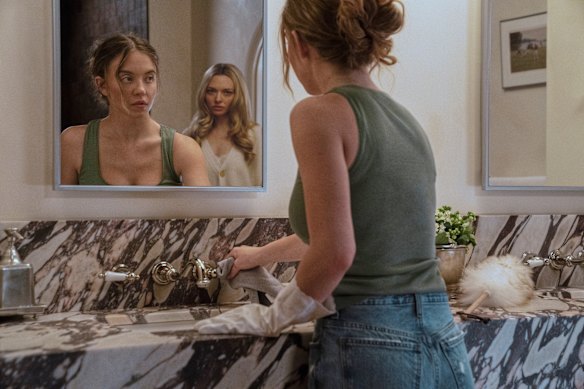
In The Housemaid, Sydney Sweeney is the Cool Girl in jeans who breezes her way into a job at a mansion on the outskirts of New York, and Amanda Seyfried is her chic employer. But neither woman is entirely what she seems, and perhaps the man of the house (Brandon Sklenar), who looks like a daytime soap star, isn’t either.
Freida McFadden’s 2022 novel was a bestseller for a reason, with all the required elements for a stylish battle of wits. But the film adaptation, directed by Paul Feig from a screenplay by Rebecca Sonnenshine, is less a psychological thriller than a heavy parody of one, in the vein of Feig’s 2018 A Simple Favor but with the antic tone less under control.
Sydney Sweeney and Amanda Seyfried in The Housemaid: pretty people doing horrible things.Credit: Lionsgate via AP
Sweeney is here as a movie star rather than doing stylised character work, but Seyfried mugs as she rarely has since Mean Girls, in make-up that suggests a permanent case of pink-eye – and even she is upstaged by Elizabeth Perkins as her mother-in-law, who looks and acts like Cruella De Ville.
Counteracting the silliness is an odd sensuality. Since we can’t be sure of anyone’s real motives till the last moment, we’re encouraged to dwell on the self-evident good looks of all three leads, often in close-up, and the ambiguous charge of what passes between them.
It’s all such nonsense, Feig seems to be thinking, so why not relax and let everyone enjoy the spectacle of pretty people doing horrible things? On this level, The Housemaid delivers the goods.
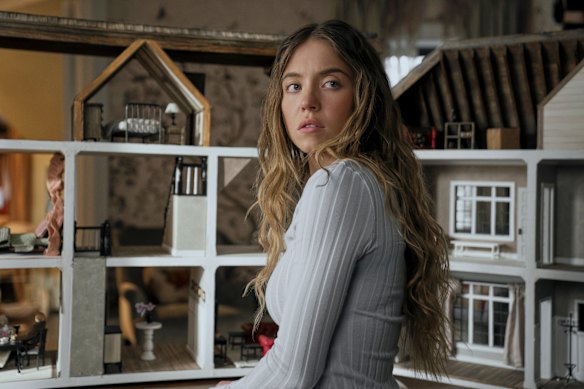
Sydney Sweeney as Millie Calloway in The Housemaid: the Cool Girl in jeans.Credit: Daniel McFadden/Lionsgate via AP
But the refusal to take the thriller mechanics seriously gives the storytelling a laborious quality – and there’s a certain vestigial earnestness, as if we were meant to believe the script had something meaningful to say about class or gender relations, a proposition at least as hard to swallow as anything else.
Moreover, it doesn’t seem impossible that another director could have made something genuinely gripping out of the dynamic between Sweeney and Seyfried, who can seem like opposites but also like versions of the same person, both with large glassy eyes and the knack of using airy incredulity to mask whatever lies beneath.
11.52am
Perfectly cast Brendan Fraser delivers the feels in story of fatherhood
By Sandra Hall
Rental Family ★★★½ (M) 103 minutes
Phillip Vanderploeg (Brendan Fraser), an out-of-work actor living alone in Tokyo, is running out of options when his agent calls with a job offer.
He’s to play one of the mourners at a funeral. He hurries off, arriving late only to see “the corpse” rise from his coffin to smile appreciatively at one particularly heartfelt eulogy.
Shannon Mahina Gorman and Brendan Fraser in Rental Family.Credit: Searchlight Pictures
After it’s over, Phillip learns that he’s just witnessed a mock funeral staged by Rental Family, a company catering to people desperate to fill some gap in their lives. The “corpse”, it seems, wanted something to make him feel better and the funeral rehearsal, with its cast of actors delivering fulsome tributes and producing copious crocodile tears, has been a great cheer-up.
So begins Phillip’s career as Rental Family’s “token white guy”, an occupation that eventually relieves his own melancholy, although there are many complications along the way.
The film’s Japanese director and co-writer, Hikari, a former actress who studied in the US, came upon Japan’s network of “rental family” companies after reading about them in a newspaper. She decided that they sprang out of a pervasive loneliness in Japanese society, a sentiment that Phillip’s colleagues heartily endorse. Consequently, they make a point of avoiding any emotional involvement in the cases they take on. Phillip, however, can’t bring himself to do the same.
Loading
His most serious challenge is Mia (Shannon Mahina Gorman), a bright 10-year-old whose mother, Hitomi, hires him to play Mia’s estranged father, who walked out on them when the girl was a baby. Hitomi reasons that the presence of a father will help her get Mia into the private school she’s chosen. It’s a tough assignment which can only end in tears as Phillip soon realises. He can also see that some of those tears will be his own.
It’s a sweet film with a touching ending and Fraser, with his wide-eyed looks and well-meaning air, is perfect casting but Hikari’s direction is a little too leisurely. It strips out the tension and the film doesn’t work quite as well as it deserves to.
11.52am
Delightful brass band drama puts a smile on the face
By Stephanie Bunbury
My Brother’s Band ★★★★ (M) 103 minutes
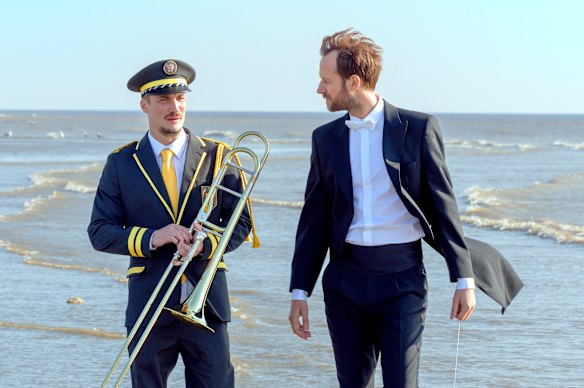
What a sheer delight this film is. It won’t change the world, for sure. Maybe its story of separated brothers reconnecting through music is all a bit too feelgood to feel true. Whatever! Emmanuel Courcol’s Gallic charmer is nevertheless the film we need right now: a story in which people learn to be their best selves; that pays respect to working communities torn apart by the global economy; a story, moreover, centred on a brass band. Because who can resist an oompah-ing trombone, after all? They exist to make us smile.
Benjamin Lavernhe plays Thibaut, a successful conductor in his 40s who suddenly collapses on the podium. He has leukaemia. The only thing that might save him is a bone marrow transplant from a sibling, but Thibaut is adopted. In a series of revelations, snappily conveyed, Thibaut learns he is unrelated to his beloved sister, but that he does have a blood brother out there somewhere, placed in infancy with another family.
By contrast with Thibaut’s comfortable, cultivated upbringing, Jimmy (Pierre Lottin) has grown up in one of the most depressed areas of France, scene of a year-long strike against factory closures ignored by the rest of France. Jimmy is habitually angry with the world; he knows he will soon be out of his own minimum-wage job. His one happy place is the local brass band, where he is the star trombonist.
The discovery of their common love of jazz, the bond that develops between the brothers, an inevitable rift and reconciliation, Jimmy’s growing confidence as a musician and as a man, which allows him to fall in love again: you can see it all coming, but Courcol still manages to surprise us with a stupendous grande finale that makes your heart roll over.
None of this would work without these actors: Lavernhe has a beautiful, mobile face that conveys a sense of mischief in the midst of tragedy, while Lottin’s twitchy machismo gives him a powerful presence. There is heightened emotion in spades here, of course, but no cheap sentiment. A fine Christmas cadeau, indeed.
11.52am
Hot tip for James Bond turns to directing in gritty London story
By Stephanie Bunbury
Urchin ★★★½ (MA15+) 99 minutes
Harris Dickinson has been hovering on the edge of fame since his riveting turn as a model in Ruben Ostlund’s Triangle of Sadness in 2022; since then, he has romanced Nicole Kidman in Babygirl, been cast as John Lennon in Sam Mendes’ forthcoming Fab Four biopic and is currently the hot tip to be the next James Bond. In between, he has written and directed this very creditable debut feature about homeless Londoner Michael, who skims day to day across a sludge of addiction, jail time and missed human connections.
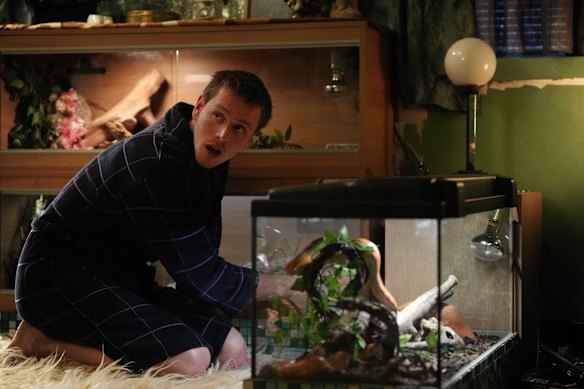
Harris Dickinson makes his directorial debut with Urchin.Credit:
We know nothing about Michael’s background. He makes a phone call when he is arrested, telling someone it’s happened again; we just hear a woman sigh in response. He says he barely went to school, but he is suspiciously articulate. As Michael, Frank Dillane is enigmatic, infuriating, charming, often vile and reliably watchable. An early scene, when he mugs a businessman for his wristwatch, is the story’s anchor; everything else floats free.
What he couldn’t believe, says his victim in a reconciliation meeting a year later, was the violence. Michael doesn’t want to believe it himself, but the memory lurks in him like a poison spring, erupting at random. There are, in fact, a lot of cracks in Michael’s armour of street-smart indifference; a cheesy karaoke song can reduce him to something near tears. Dickinson’s treatment is sympathetic but also clear-eyed; Michael’s humanity includes an inflated sense of grievance that would make anyone sigh.
This back and forth, tick-tocking between episodes of hope and defeat, doesn’t amount to a conventional story arc, but Dickinson – who also appears in the film, playing Michael’s fellow addict Nathan – maintains an unerring pace, kicked along by unpredictable bursts of Alan Myson’s electronic score. Of course, Urchin owes a debt to the British social realist tradition, but there is something altogether stranger going on under its surface. Michael is plagued by visions of sinister violinists and caves where his drugged mind gets lost. Actually, that is when he looks happiest: chemically sated, curled in a foetal position, helplessly waiting to be picked up and loved.
11.51am
Orwell’s words illuminate new threats to freedom
By Stephanie Bunbury
Orwell: 2+2=5 ★★★½ (M) 119 minutes
“How many fingers am I holding up?” demands Winston Smith’s interrogator in a 1956 film version of 1984. There are four, as on most hands. Under torture, Smith tries to agree to five, but it’s not good enough; his tormentor insists he must truly believe the lie as he says it.
Haitian filmmaker Raoul Peck, whose earlier documentary I Am Not Your Negro about writer James Baldwin earned him an Oscar nomination in 2016, draws on George Orwell’s diaries and texts from his novels Animal Farm and 1984, along with images from film adaptations of the two books, to illuminate current threats to life and liberty. One tyranny – real or imaginary – very much resembles another; bonfires of books, whether in 1930s Germany or Trump’s America, burn the same way in any language.
Orwell: 2+2=5, directed and produced by Raoul Peck, about the life of author George Orwell.Credit: Neon
Juxtapositions like these are Peck’s building blocks. The rubble and bodies of civil war Spain cut to similar scenes in Gaza; cinematic renditions of Big Brother dissolve into a discussion of China’s “social credit” surveillance system; Orwell’s recollections – voiced by Damian Lewis – of Eton and his beginnings as “an odious little snob” are placed alongside scenes from a billionaire’s space joyride and a society ball snipped from Lauren Greenfield’s film Generation Wealth. As political critique goes, it’s a mere skim over the obviously bumpy surface of things, but the accumulation of images and excerpts does gather force over two hours to become a convincing roar of protest.
Through it all, we return to Orwell’s measured words and scenes of the remote Hebridean island of Jura, where he would retire to write in between treatments for the tuberculosis that would kill him. All his novels, he said, had a common starting point: “A feeling of partisanship and a sense of injustice.” If Peck’s scattergun scrapbook of our age and its despotic windbags – Narendra Modi, Benjamin Netanyahu, Donald Trump – and often vilified dissidents, such as Edward Snowden, encourages further reading among viewers of Orwell’s steely prose, so much the better. As he wrote in the last diary entry he managed before his lungs gave out: “All that matters has already been written.”

 3 months ago
13
3 months ago
13