2 months ago
7
2 months ago
7
One of the state’s largest housing projects fast-tracked by the government’s signature Housing Delivery Authority had to be significantly wound back after it emerged landowners had not agreed to sell to developers.
As the agency comes under fire for its use of an unauthorised AI tool to assess proposals, documents reveal the Rhodes waterfront development to build 2020 new apartments was pushed through to the next approval stage despite not meeting key criteria that stipulates “land tenure is secure”.
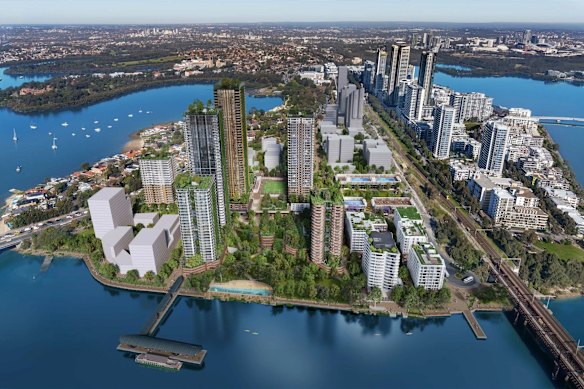
Billbergia’s plan for Rhodes East, depicted in the left of this artist’s impression.Credit: Billbergia
A developer must have “demonstrated ownership or option to purchase for all land to which the proposal applies”, the publicly available criteria says.
Established a year ago to combat sluggish approval times for major residential developments amid the worsening housing crisis, the HDA has placed 289 large-scale projects on an accelerated approval pathway.
However, the HDA’s processes for assessing major projects have come under scrutiny after the agency’s most senior bureaucrat, Aoife Wynter, was stood down in late November over the use of an AI tool developed by her engineer husband.
The government insists the unauthorised software was used only to collate information contained in EOI documents, but Infrastructure NSW board member and respected former public servant Peter Duncan has been appointed to review all HDA assessments, including the Rhodes East proposal.
In mid-February 2025, Billbergia’s Rhodes apartment precinct was one of 11 projects fast-tracked during the first meeting of the HDA. NSW Planning Minister Paul Scully said the recommendations demonstrated the government was committed to delivering more homes.
At the time of its assessment, the Rhodes development was the largest recommended to progress to the state significant stage, which bypasses the local council approval process.
“In just the first meeting, we have the potential for 6400 homes. That is thousands of families, workers and grandparents finding a home,” Scully said at the time.
However, emails provided to the Herald reveal in the days preceding the first February 7 meeting, the authority was grappling with limited staffing and a mountain of work.
“We’ve been completely overwhelmed with the number of EOIs and our small team is working just to get the documentation done – so no contingency,” HDA director of governance and strategy Meagan Cody wrote in an email to planning department colleagues on January 28.
A three-person panel assessed Billbergia’s proposal. Despite the criteria for the HDA’s EOI including ownership or the potential to buy land needed for the project, the apartment precinct included the landholdings of some owners who were oblivious to the proposal until it emerged in media coverage.
Ross Schinella, who runs his coffee roasting group out of two properties on Leeds Street, said Billbergia had previously made inadequate offers to acquire his landholdings. He discovered his lots would be included in the developer’s plans only after the HDA’s recommendations were publicly released.
The HDA recommended the project on the condition there was support from City of Canada Bay Council to lift its dwelling cap of 3000 new homes, which would also be contingent on the commitment or delivery of significant new transport infrastructure.
However, in an email to Wynter on April 7, the council’s senior executive for city planning Monica Cologna noted Billbergia’s proposal included land not secured by the developer and said development would require the council’s dwelling cap to be lifted without the necessary essential infrastructure.
“Concern is raised with the significant variation of this cap without the provision of essential infrastructure required by the state government’s Rhodes Place Strategy,” the council executive wrote.
A council spokeswoman confirmed Cologna met with Wynter and Kate McKinnon, the department’s director of HDA declarations, on April 16.

Ross Schinella and Rob and Margaret Barrie are landowners in Rhodes. Months after a major development application was recommended for fast track planning approval, they discovered their holdings had been included in Billbergia’s proposal.Credit: Steven Siewert
Two months later, the issue remained unresolved. On July 16, a senior planning officer Ryan White emailed a colleague at the HDA flagging the “inconsistency” between the land footprint nominated in Billbergia’s EOI and what was submitted as part of an environmental assessment requirement.
Within days, a briefing note landed on Scully’s desk which warned: “Delaying publishing the order will risk the reputation of the NSW government in running an efficient HDA process and progressing the delivery of housing within the Housing Accord period.”
Shortly after, a revised ministerial order was issued, paring back the footprint of Billbergia’s development.
In response to questions in parliament, Scully said owners’ consent to sell land to a developer was “not required” at the EOI stage, what he characterised as a “preliminary process to reveal potential projects that are typically conceptual”.
On August 22, the minister said he referred the matter to “external probity advisors for further review and advice on the matters raised”.
Loading
Billbergia said in a statement its EOI included lots the developer controlled “as well as other lots, clearly identified as either under negotiation, or currently under the control of others”.
“Billbergia has had ongoing discussions with all landowners in the precinct including with Canada Bay Council for its car park site. The car park site is currently for sale in an open EOI process,” the statement said.
Despite the significantly reduced scope, the yield of 2020 new homes was retained by the government. To compensate for the reduced parcel of land, Billbergia’s revised proposal included building apartment towers from 78 metres to 170 metres high, and a 35 per cent reduction in public space on the foreshore, City of Canada Bay stated in a supplementary agenda ahead of a November 18 council meeting.
The revised parcel of land includes Crown land that does not appear to have been sold to the developer. A department spokeswoman said land tenure was included in the HDA’s EOI criteria as an indicator of the ability for the project to be “assessed and delivered quickly, rather than to confirm landowners’ consent”.
Most Viewed in Politics
Loading