3 months ago
29
3 months ago
29
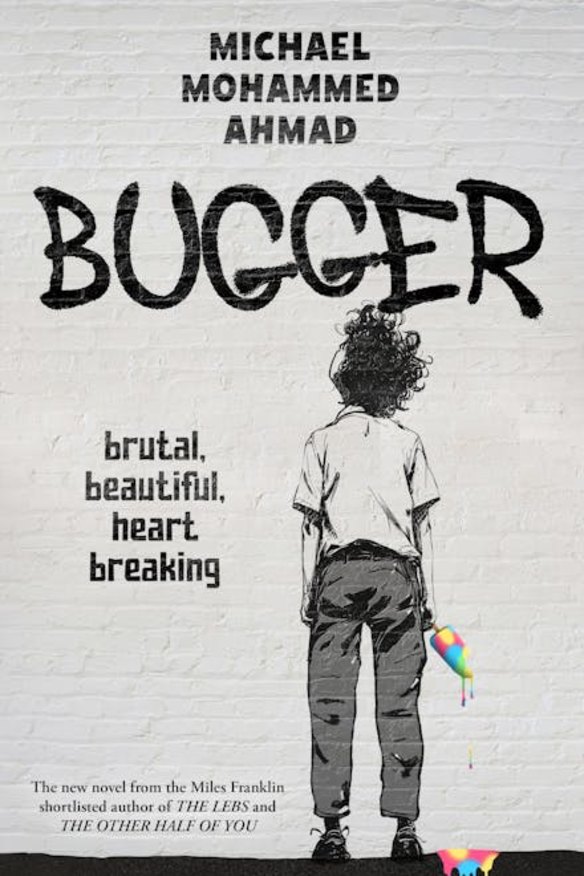
At the conclusion of Michael Mohammed Ahmad’s devastating new novel Bugger, there is an unusual author’s note with the title “Un-Acknowledgements”.
“How cruel of me to ask any decent person to take credit for such a book?” writes Ahmad. “How selfish of me to ask any dignified creature to share its burden?”
If, like me, you happen to be a compulsive end-flicker when opening a new book, you’ll immediately be put on notice that the contents are unusually disturbing and challenging.
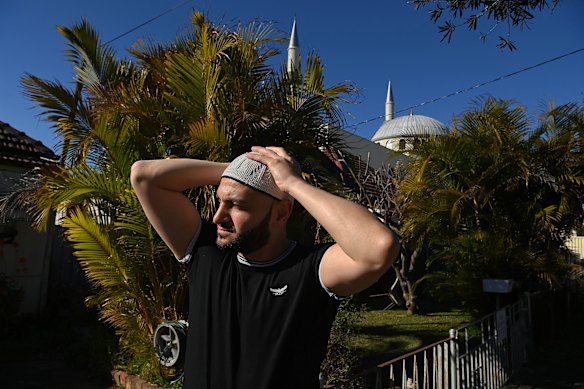
Bugger tells of 24 hours in the life of 10-year-old Hamoodi, told from the youngster’s perspective. As eventually becomes apparent, and is hinted at by the ominous, uncompromising title (the word is explored in various contexts), the book deals with child sexual abuse.
Hamoodi’s story is also deeply informed by Ahmad’s own personal experiences and those of his immediate family.
I open our conversation by asking about that curious paragraph on page 211.
“I wrote maybe about 30 acknowledgements, and every time I wrote them I wept because I was like, who do I want to acknowledge?” says Ahmad. “I was like, I’ve got my seven nieces and nephews, who I absolutely adore.
“And with relatives in my family, aunties and uncles, they did not look after us. They did not protect us. They protected perpetrators and things like this. Not all of them, of course, but a significant portion. Enough for the family to be broken now. And so, when I wrote their names [his nieces’ and nephews’], I thought that was a lovely thought, but I wept at the thought. I couldn’t see myself putting my nieces’ and nephews’ names in this list.”
Ahmad precedes these words with “I’m going to tell you the honest truth, Nick”.
He’ll use that phrase, or variations on it, several times in the course of the interview. Ahmad radiates a commitment to rigorous honesty and a fierce dedication to letting the cards fall as they may.
“I’m a writer, I’m an open book, literally,” Ahmad, the founding director of Sweatshop Literacy Movement, says. “And so I’ve spent my life trying to get writers of colour to be confident enough to speak their truth and not to be writers unless they’re ready to do that.
“They have to write like they’re dead and they have to write willing to review everything, or they shouldn’t waste their time. If you’re not ready, the reader will see that you’re not ready. And then you won’t convince the reader because you haven’t convinced yourself.”
The Tribe, Ahmad’s debut novel, won the Sydney Morning Herald Best Young Novelists award in 2015. Subsequent works The Lebs and The Other Half of You won multiple awards and were both shortlisted for the Miles Franklin Award. That trilogy draws heavily on Ahmed’s own background and experience of growing up Arab-Australian in Sydney in the ’80s, ’90s and beyond, all told through the main character, Bani Adam.
We’re talking at the kitchen table in Ahmad’s pristine duplex home in Birrong where he lives with his wife, Jane, and son, Kahlil, a few kilometres from where he went to school in Punchbowl. Outside it’s a baking south-western Sydney day, and stepping inside the cool of Ahmad’s home is a welcome relief.
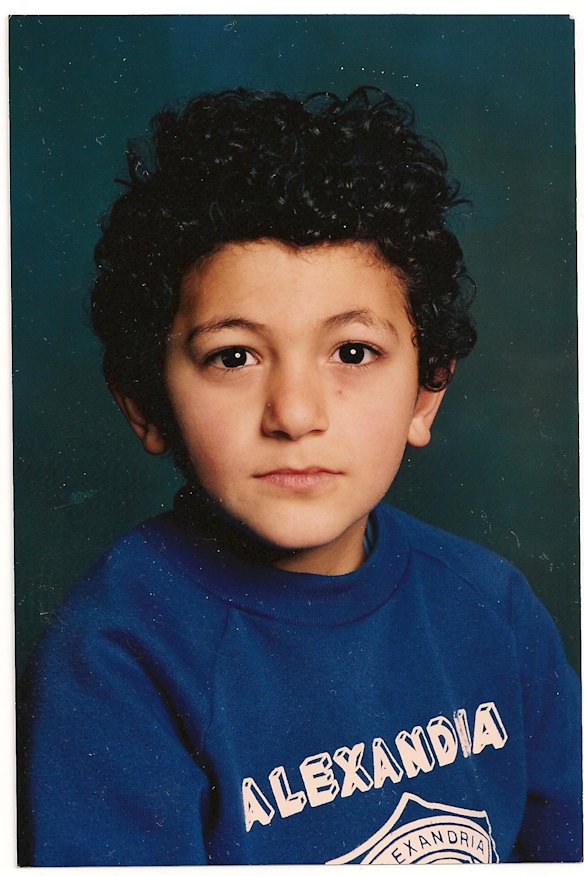
Born in Sydney to Lebanese parents, Ahmad grew up in Lakemba in the Alawite tradition, although he now jokingly refers to himself as a “hippie Muslim”, gesturing to the Koran resting on a stand on a nearby shelf. Next to the holy text he has placed a Christian cross, which he recently found in the street, a discovery he interprets as some sort of sign.
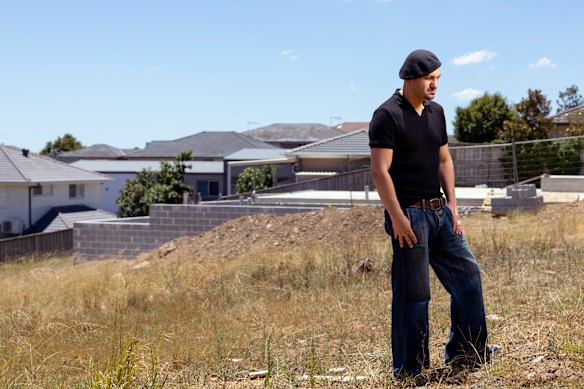
In person Ahmad is small in stature, with a neatly manicured goatee. When we meet he’s wearing a polo shirt, a pair of baggy G-Star jeans and a black beret, which, he explains later, came from the disposal store his father ran when he was growing up.
Bugger is Ahmad’s fourth book. It’s a mark of his commitment to his craft that it comes nearly five years after the publication of The Other Half of You.
“When a writer’s pumping out a new book every 12 months I just think it means you’re not particularly interested in what people have to say, but I am,” he says. “I’m interested in what critics have to say. I’m interested in what journalists have to say. I’m interested in what readers have to say. I’m interested in what editors have to say. I’m interested in what fellow writers have to say. When I release a book I want the world to absorb it, and then I want to learn from what they have to say.
“And I want to use that knowledge to push myself to do something new and experimental and different every single time. So every book I write has taken between four and five years to produce because I’m always reflecting and challenging myself. I absorb every response, and while I might sulk about it privately – I’m fragile – once I take a moment to process it, every bit of feedback I embrace as constructive.”
In a 2018 interview with the Los Angeles Review of Books, Ahmad neatly encapsulated his approach to autofiction.

“Everything I write comes from lived experience,” he said. “This doesn’t mean that everything I write is fact but rather that everything I write is true – true to my identity.”
This provokes the question – one he will inevitably be called upon to answer many times as the literary world absorbs his new work following this first interview – how much of Bugger is an accurate depiction of his own abuse?
The question also shines a spotlight on the ethical and moral responsibilities of the interviewer and the risk of re-traumatising the interviewee by returning to the abuse. I ask Ahmad if it’s OK to go there.
“I’m very comfortable to talk about it in the most intimate way because I pride myself on transparency,” he says.
He chooses to answer the question in two ways.
“The first way, in terms of just the personal experience, is how I recount the narrative in the book,” he says. “Every intimate detail, every bit of ickiness, every phase of the abuse. It unfolds in stages, which is something else I don’t think people realise. When people think about sexual assault in prison in films, it’s like they grab a guy, they anally rape him in the shower and then they’re out, right? But the way it plays out in the book is quite different … There’s like, it’s my turn, now it’s your turn, now I’m going to do this …
“Every element of detail that I put in comes from what I know personally and through my experience, which is why I think it’s actually quite convincing. There has been a first review that’s come out in [trade publication] Books and Publishing and the nicest thing that was said about it is that you don’t doubt the credibility of the author or the narrator. That it’s coming from real knowledge. That’s the best way I can answer the question of how personal it is. The setting is not the setting that I grew up in. The characters are composites of people I know but the intimate detail of the abuse is 100 per cent accurate, based on what I remember.”
‘The number-one reason that tears families apart is because, more often than not, family members side with the perpetrator. And that’s something that happened in my family, that the relatives protected and covered up.’
Michael Mohammed AhmadAhmad says his family has suffered “every kind of tragedy imaginable”. Family members have died from cancer at a young age. There have been deaths from car and motorcycle accidents. Relatives have been killed in violence in the Middle East.
“We’ve even had family members who have lost their lives to organised crime,” he says.
Yet even against the background of this tapestry of loss and grief, sexual abuse is, he says, the very worst calamity that can happen to a family.
“We’ve had every kind of tragedy you can imagine but I want to tell you something. Every tragedy I can describe always brought our family together. It always unified the family. In the immediate aftermath, the grief at home, the grief at the funeral, the grief at the cemetery in the days, the weeks, the months and even in the years later, people are holding each other, they’re feeding each other, they’re checking in on each other.
“But sexual abuse tears a family apart because the fantasy is that [the perpetrator] is the creepy guy in the sewer, the magical guy. And it’s really easy for macho men to say, ‘I’ll kill anyone that harms my daughter’, but they’re not imagining that it’s just a normal guy that’s your brother or your nephew or your dad. The number-one reason that tears families apart is because, more often than not, family members side with the perpetrator. And that’s something that happened in my family, that the relatives protected and covered up.”
Ahmad is clearly well aware of the far-reaching consequences telling his story will have on his family and the wider community.
In particular he took care to brief his five siblings – to whom he has dedicated Bugger – about what he was writing and why. He told them, “It’s not our family – but it’s very familiar”, and received their blessing.
“We are a very amazing group of Arab-Australians who grew up in this country and became the best versions of ourselves,” says Ahmad. “And we decided we were ready to bring up this fight. We were ready to have this conversation. And so it was no longer up to my parents to decide what was best for us.
“They did their best with the resources and tools they had – and they didn’t have many. One uncle asked my dad a couple of months ago, ‘Why are you bringing all this up now? Why are you starting this drama now in the family?’ And my dad said, ‘I’m not starting it. My children are grown up now. They have children. They’ve decided that they’re ready to do this.’”
There is no Hollywood ending to Bugger. The young protagonist’s father doesn’t reappear, there is no justice for Hamoodi’s abuser, who is a close family member.
Ahmad said for a while he did consider a more upbeat conclusion but then left it for the reader to “write the last chapter”.
“I want them to ask themselves, what do you do when a child speaks up?” he says. “And I know a lot of readers, a lot of Australians with good hearts would say, ‘Oh, I’ll take action’.
“It’s easy because they imagine this troll in the sewer that everybody hates. They can’t imagine that it’s someone very close to them, which is most likely the scenario. It’s a spiritual leader that’s very close to the family, or it’s a relative or close family friend. So I want the reader to be left in that point of like, this is a horrible place for a child to be left in, and then ask themselves: when that child comes to you – and we did go to people when we were children – what do you do? What’s the next step for you?”
Bugger is published via Hachette on January 27.
Support is available from the NSW Sexual Violence Helpline (formerly NSW Rape Crisis) 1800 424 017, National Sexual Assault, Domestic Family Violence Counselling Service at 1800RESPECT (1800 737 732) or the Men’s Referral Service on 1300 766 491.
The Booklist is a weekly newsletter for book lovers from Jason Steger. Get it delivered every Friday.