3 months ago
21
3 months ago
21
In May last year, a new company popped up in Hong Kong promising to help Australians flip property.
The company’s sole director lives in Belize – a Central American coastal country known for its reef, its gang violence and a slack international tax regime. His corporate profile suggests he’s a “ghost director” – a nominee who doesn’t actually run the company, and who knows nothing about Australian property.
Not long before this, a related company was set up in Wyoming – another tax haven – under another nominee director. This company provides online property mentoring, also to Australians.
What binds these new, geographically distant businesses is a Sydney businesswoman, her cronies, and a sprawling, ever-morphing attempt to fleece ordinary Australians of their cash.
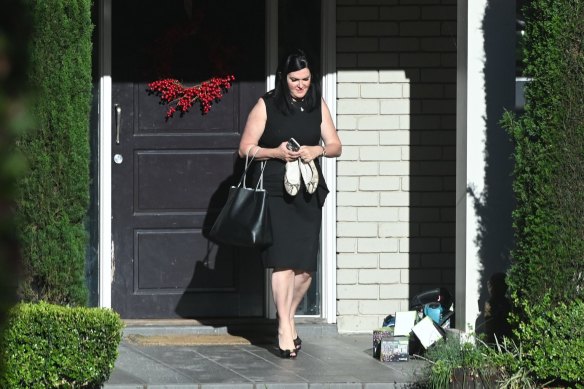
Her name is Dominique Grubisa, and for 13 years, this failed actor, bankrupt and soon-to-be struck-off lawyer used Facebook ads to sell bad advice about property investment.
A Federal Court judge has found her conduct “deliberate and dishonest”. The privacy commissioner said her businesses misused personal information when people were at their lowest ebb. The NSW Civil and Administrative Tribunal found her “not fit and proper” to be a lawyer, recommending she be struck off.
But as Australia’s sluggish regulators finally acted against her, Grubisa closed companies, changed their names and kept selling her dodgy product to a fresh supply of wannabe moguls.
“Ban me if you want, but nothing changes,” she said after one setback. “I keep going.”
She might not be Australia’s most successful scammer, but she’s arguably the most persistent. The recent appearance of new companies offshore suggests, once again, that Grubisa’s long con is morphing.

Standing against her for seven years has been a lone whistleblower. His name is Chris Baker. He used to be a property lawyer, and when he took her on, 600 or more of Grubisa’s victims looked to him for help. In return, she’s dismissed him, hired private investigators to target him and then lied about it.
At times, he has feared for his personal safety.
What Baker wants is simple – for those who police Australia’s legal and financial systems to protect the unwary.
“I just wish to not take calls from acutely suicidal people,” he tells me. “I want the harm stopped. Nothing more.”
Dominique Eva Grubisa, nee Fitzsimons, grew up in a big house in Castlecrag on Sydney’s lower north shore. She was schooled by nuns at the prestigious Monte Sant’ Angelo College, but perhaps her real education was at the knee of her fraudster father.
In 2005, Christopher Ronald Fitzsimons was suspended as a solicitor for misappropriating what reports described as “many millions of dollars of clients’ money” – including from deceased estates and charities.
He’d lost it all on the horses, spending not only his clients’ money, but that of his wife, Maria, and daughter Louisa. Even after he was suspended, he kept banking and betting client cheques.

Fitzsimons tried to blame the TAB, which had installed a computer in his house and enabled him to bet on credit. He sued them and lost. Eventually, he was sentenced to 18 months in prison for fraud. Grubisa’s lawyer mother, Maria, was also struck off for her role in his crimes, but she was never charged.
Dominique grew up fancying herself a thespian. She applied in the 1980s to the National Institute of Dramatic Arts but was rejected. Videotapes of her later property seminars show her claiming an “unkempt, hippy-looking, skinny girl” called Cate Blanchett had stolen her life.
“I believe that, too, was a lie,” Baker says. “From what I can make out, Blanchett didn’t audition for NIDA until 1990, and Grubisa claims she auditioned straight out of school.” That would have made it 1987.
Rejected, young Dominique fell back on the family trade, becoming a solicitor in 1994 and later gaining admission to the bar.
In 2008, Grubisa and husband, Kevin, lost money on the property market. Claiming to have learnt from the experience, in 2012 they started a new business, later named DG Institute, and Grubisa became its sole director.
In promotional literature, Grubisa promised to teach others how to avoid her mistakes – to get rich investing in property and protect hard-earned assets from debtors. Grubisa was the chief executive and frontwoman.
“She was performing the role of a highly successful entrepreneur,” says one of her executives, whom this masthead agreed not to name for legal reasons. “She thought she was someone special, and when she walked down the street everyone knew who she was.”
Husband Kevin was a director, secretary or shareholder of most of the companies in their stable, but Grubisa was the one calling the shots. There was also a sales team and a law firm, DGI Lawyers. In the background, Grubisa’s struck-off parents were dispensing legal advice – her father signing legal and court correspondence under the fake name “Chris Jackson”, her mother named in a later tribunal finding as a “lay associate”.
From 2017, the DG Institute’s sales team was run by a man called Greg Klopper – who has a long history in the property-spruiking industry. Klopper had been named the previous year in a federal parliamentary committee report into investment seminars that “took advantage of retail investors with poor levels of financial literacy and often limited funds by persuading them to invest in high-risk, inappropriate schemes”. There have never been findings against him.
But it was an apt description of Grubisa’s business.
The former senior manager described Klopper trying to get a boiler room culture going. “There was a lot of ra-ra and the whole culture was built on fear.” Salaries were 100 per cent commission, and some staff stayed less than a week.
“It was the most unprofessional place I’ve ever worked at in my 20-odd-year career,” the man says.
He lasted three months.
Since 2012, Grubisa and her businesses have sold two ideas. The first is how ordinary people can build extraordinary wealth through property. The second is a convoluted method to stop any creditor taking their assets if they get into trouble.
In the property program, Real Estate Rescue, would-be tycoons were lured via Facebook ads to free seminars. In fancy hotels, with special guests who were unknowing participants, such as Jamie Durie, Grubisa performed as “Australia’s leading wealth educator”. She promised to teach people how to buy property at 10 to 40 per cent below market value. Witnesses say she was charismatic.
Those impressed by the promise were encouraged to pay $4500 and $7800 per head for the secret sauce – a course, a system and a closed Facebook group. Coaching videos show Grubisa teaching how to target “motivated” sellers – people facing home repossession, bankruptcy, divorce or bereavement, who would be happy to sell property at knockdown prices.
‘Since being stung by her, I’ve stepped back from doing a lot of things.’
Belinda MangrooShe told her clients to be ruthless. “Stay clear of discussing how much this is affecting their family, recent sicknesses, healthcare bills and the like. Your job is to move forward with your plan, not engage in family counselling,” said some of her literature.
“It is the strategy,” says Baker, “of the vulture.”
Says former participant Belinda Mangroo, Grubisa taught clients that they were doing these people a favour.
Key to this was Grubisa’s fictional idea that banks “give no change” – that if a bank sold property in a mortgagee’s sale, it would keep not just the amount it was owed, but everything including the owner’s equity. Offering distressed sellers even a tiny amount for the family home therefore meant they were better off.
“I saw that as risky and dodgy,” Mangroo says, “but somehow, I also believed the idea that we were potentially helping those motivated vendors because they were in a pickle. So it was a win-win.”
Unsurprisingly, in the real world, putting this into practice was difficult. Some Real Estate Rescue clients got in trouble with angry vendors, or were embroiled in lawsuits, Baker says.
“The minute they questioned Grubisa or her staff, people told me they were chucked out of the group and other members were told not to contact them.”
“When I first came across Grubisa, I looked for negative reviews on Facebook but found none,” Mangroo says. “In hindsight, I guess she was spending a lot of time scrubbing them.”
Mangroo never made a transaction – a fact she’s now profoundly grateful for. But she invested almost $15,000 in Grubisa’s products, and for six months was in “hook, line and sinker”.
It left its mark.
“Since being stung by her, I’ve stepped back from doing a lot of things because I doubt myself and I worry,” she says. “It’s been a terrible thing.”
Grubisa’s second key offering was called Master Wealth Control. Her experience as a lawyer, she claimed, allowed her to devise a special structure – a “Vestey trust”, which acted as an “invisible force field” protecting assets against creditors and the government. It included ongoing support “so that you are constantly protected”.
The documents to establish and run these trusts were supplied exclusively by DG Institute at a cost of $6500 to $9200 annually. Only Grubisa could work this magic, she claimed, because: “No one at my level of expertise as a lawyer had ever really looked in detail at that area of law before.”
Much later, the Federal Court found these structures bore no resemblance to “any transaction or structure ever undertaken or implemented by any member of the Vestey family”. They also contained an “obvious flaw … a matter of commonsense which would be readily appreciated by anyone with elementary legal knowledge”.
And they didn’t work.
Says Baker: “I know numerous people who went bankrupt relying on this advice. Among them was a lawyer.”
Those delving more deeply into Grubisa’s world were steered into a third scheme, the Elite Mentoring Program. This was for the inner circle – those seeking extra property advice, access to finance and a more exclusive Facebook group. The price for entry varied from $50,000 at its peak to a “discounted” $20,000.
Baker describes it as “cult-like”.

Becky Thompson was lured in at Grubisa’s free seminar. It became her nightmare.
In 2015, Thompson had been hit by a car. She ended up with a $60,000 payout and an incurable condition that causes multiple seizures a day. In 2022, when she saw a Facebook ad for Grubisa’s course, Thompson was walking with a cane and was racked by seizures.
But the spectacle at the seminar swept her away.
“It’s so slick. The food, the lighting, the music. It’s not like you’re meeting at a budget hotel, they’re huge events,” she says. “And Dominique will mingle among the crowd – it’s all about the self-belief and the quotes, the testimonies given. She’ll meet you one on one. It’s like she’s got this godlike status. She’s like the guru.
“And you start believing: ‘This is something I can do; I can be a property mogul’.”
To Thompson, what underpinned it all was that Grubisa was a barrister. It seemed an instant sign of trustworthiness. She signed up and paid $20,000 – the special discount rate – to join the clique.

Elite Mentoring’s key offering was a “leads list”. Strip-mined from lists in the Family, Supreme and Federal Courts, it included the names and addresses, including Google Maps links, of the homes of people in distress, or details of lawyers handling deceased estates.
Thompson says she was told to find a property using the list and Grubisa’s company would supply finance. The only way to fail, the guru insisted, was if you were lazy – known as “working below the line”.
Thompson’s problems began immediately. The list was useless.
“There were 300 participants hitting a list of 60 people – divorcees and deceased estates and their lawyers. But the lawyers wouldn’t get back to you. Some of the law firms didn’t exist, the email addresses don’t work, phone numbers are disconnected or they’re out of business.”
To Grubisa, these difficulties were just excuses. “She’s very good at making you think you’re crazy,” Thompson says. She became so desperate to land a deal that Grubisa encouraged her to walk the streets knocking on doors to find distressed sellers.
As a younger woman, Thompson had been homeless – so “my motivation is, ‘I never want to live under a bridge again’.” Grubisa knew this, and when Thompson found herself $13,000 short while struggling to pay both her course fees and secure a property, Grubisa “used my fear of homelessness against me”.
“They said, ‘You’re going to live under a bridge again if you don’t pay us this money’.”
Thompson borrowed from a friend. She bought a property – not as an investment but as her home – but left Grubisa’s program. She says she’d spent $40,000 and bought nothing but stress, which worsened her seizures and wrecked her marriage.
“My husband and I separated. We’re still trying to forgive each other. The fact that she nearly made me homeless, stressed my credit rating – and the fact that she got under my radar has perturbed me more than anything,” Thompson says.
“Now, I don’t know who to trust.”
In 2019, about seven years after Dominique Grubisa began selling pipe dreams, Brisbane-based Chris Baker read an online article lionising her property expertise.
A Google search led him to a Facebook page with 1300 disgruntled former acolytes. “I was shocked,” he says.
Baker is motivated by a strong sense that Grubisa must face justice – for all her legal scrapes she has not faced criminal prosecution – and a feeling of responsibility for the hundreds of victims he comforted and counselled. Seven years on, he wishes he’d never begun.

“My intention wasn’t to spend my life looking over my shoulder,” he says. “My intention was to go to the Law Society of NSW, the [Australian Competition and Consumer Commission]. I thought, ‘They’ll do their job and see the harm, and they’ll act’, because I’ve got faith in these organisations.
“I hadn’t seen at the time how failed they were.”
It was 2019 when Baker, on behalf of a client, first complained to the NSW Law Society, which is responsible for regulating legal practice. He said DG Institute was providing unqualified legal advice. The next month, he referred Grubisa’s practices to the ACCC.
Shortly after contacting the society, Baker got calls from men calling themselves “Andre Ronvegas” and “Richard Brenchley”. As he later found out, these were the fake names of private investigators hired by Grubisa’s company.
Baker pressed on. Later that year, he informed the Family Court that Grubisa was misusing its court lists. He went to the Australian Financial Complaints Authority, which forwarded his confidential evidence to Grubisa herself. It later apologised.
As he saw it, those whose job it was to protect consumers were dragging their feet. The ACCC initially decided not to act. It told Baker it was “not always the best agency to deal with particular consumer issues”, referring the case to the Australian Securities and Investments Commission.
Between 2019 and 2021, he sent numerous of Grubisa’s webinars to the law society to demonstrate the claims she was making. He says his messages were not acknowledged.
He took clients’ complaints to the Australian Taxation Office and to ASIC. In 2020, the Family Court referred the apparent misuse of its court lists to the Australian Federal Police. They investigated but it went nowhere.
Baker and two Sydney lawyers went to the NSW police in 2021. He referred Grubisa – whose practising certificate as a lawyer was in Victoria – to the Victorian Legal Services Board.
Meanwhile, Grubisa’s business kept luring people in. She told this masthead in 2020 that complaints were part of a “vendetta” against her, and that regulators had “dismissed or discarded” them.
It took three years – until April 2022 – before ASIC imposed a four-year ban on her being involved with credit and financial services businesses. She had a habit of not telling the truth, it said in a press release, and was “not a fit and proper person to deliver financial services”.
In June that year, the Victorian Legal Services Board – where she had her practising certificate – ruled that she was no longer entitled to practise.
Grubisa responded quickly. She rebranded.
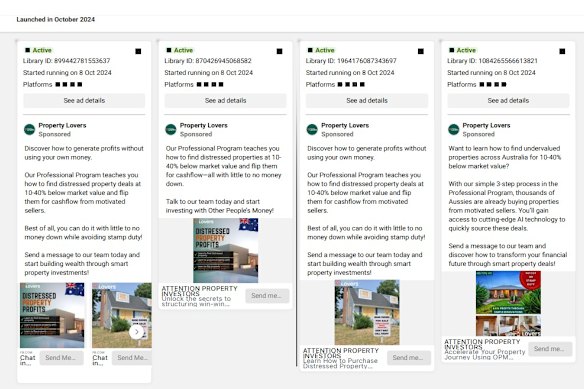
DG Institute morphed into a fresh company, Property Lovers Pty Ltd, and migrated its clients across. DGI Lawyers became Assure Lawyers with a new director. DGI Debt Management and DGI Accounting went into liquidation. Liquidators’ reports questioned whether Grubisa, as director, had breached her duties and if the companies had traded while insolvent. No prosecutions ensued, but ASIC disqualified her from managing companies for 18 months.
Within a couple of days of losing her right to practise as a lawyer, Grubisa was back selling “asset protection”.
Finally, in December 2022, almost three years after Baker began pushing, the ACCC and the Law Society of NSW moved against her.
In March 2024, the ACCC’s case against Grubisa and DG Institute alleging false and misleading conduct made it to the Federal Court. In the hearing, Grubisa did not stand by her “banks give no change” claim – her lawyers argued it was so “absurd” and “nonsense” that none of her clients could have genuinely believed it.
Justice Ian Jackman disagreed. The claim had been “misleading and deceptive” and Grubisa knew it. Her clients, on the whole, did not.
Grubisa’s lawyers also didn’t attempt to defend the asset protection product. They submitted she had “incompetently” and unintentionally prepared the so-called Vestey trust documents and “failed to understand the structure at its most basic level”.
That argument, said Jackman, was hard to swallow.
“While I have not formed a high opinion of Ms Grubisa’s legal competence … that obvious flaw is a matter of commonsense which would be readily appreciated by anyone with elementary legal knowledge,” he wrote.
The judge estimated her asset protection had reaped $9.2 million, while Real Estate Rescue had taken in $8.9 million over just three years up to 2021. Both programs were sold for well over a decade.
Jackman ordered DG Institute offer refunds to more than 2000 customers for the asset protection scheme and pay a $5 million penalty, and for Grubisa to pay $1 million for contravening consumer law. He disqualified her from managing corporations for five years. He also criticised the ACCC for leaving it too late to propose that Grubisa be made personally liable for $14.8 million in compensation. No findings of wrongdoing were made against anyone other than Grubisa and DG Institute – the company of which Grubisa was the “directing mind and will”.
Later that year, the Privacy Commission chief Carly Kind found Grubisa’s “leads list” had been generated through unfair means and ordered Grubisa’s companies stop and apologise. Kind has since told parliament she has grave concerns about compliance. “We continue to dedicate serious time and resources to the Property Lovers matter,” she said. A spokesperson declined to comment further on an “open investigation”.
In October last year, the NSW Civil and Administrative Tribunal recommended Grubisa be struck off the roll of lawyers for professional misconduct. It found she had employed her struck-off parents as lay associates and sooled private investigators onto Chris Baker. Baker criticises the law society, which acted after years of lobbying, for being slow and timid, and not referring serious issues to the police. The society says its legislation forbids it from commenting.
An ACCC spokesperson did not respond to questions about its past actions and would not comment on potential future investigations.
Attempts to reach Grubisa, her former company and associates were unsuccessful.
Last year, Dominique Grubisa applied for bankruptcy, claiming she was living rent-free with family members, was separated from Kevin, had $73 in the bank and debts of $3.44 million, including the court-imposed fines.
She admitted transferring properties and proceeds of a sale together worth $8.9 million to Kevin just a month before the Federal Court judgment. Kevin is not accused of misappropriating funds or any wrongdoing.
In January this year, clients of Property Lovers received a text. The company was moving to a new, technology-assisted platform, enterprisecircle.ai. There you are confronted with the promise that: “Your next level in property flipping starts here.”
Until this week – when this masthead sent questions to the email address supplied – it claimed to be the same program with the same people as Property Lovers’ mentoring program.
“I’m not techy, what if I get stuck?” asked one FAQ last week. The answer was to email [email protected] (sic). And who organises the instruction sessions? Greg Klopper, DG Institute’s former sales manager. An online booking platform showed Property Lovers still offering consultations for “wealthguard” – the rebranded asset protection system. After this masthead sent a list of questions, all those links were deleted. None of the questions emailed to Grubisa, Klopper or the supplied email address received an answer.
In a phone conversation, Klopper said it was an “incorrect assumption” that the new companies were related to Property Lovers, but he declined to add details, saying, “I sense whatever I say will be twisted.”
Company documents for enterprisecircle point to its nominee director in Wyoming.
The broader property business now operates as Proptix.ai. In place of Grubisa, Proptix offers a personal AI mentor, “Sage”, who is “ready 24/7 to guide your property journey and answer every deal question”. At the time of writing, there was an invitation to set up a one-on-one meeting and a link to the Enterprise Circle site. The company behind Proptix is in Hong Kong, and its director is based 15,000 kilometres away, in the treacherous south side of Belize City.
Grubisa – if she’s involved – is not immediately visible. But once again, Facebook ads push a dubious property future, and the breadcrumbs point to Grubisa’s 13-year-long project to exploit the hopeful.
Chris Baker can no longer bear the task he’s embarked on, but he cannot walk away.
“The question is not why I spent so many hours making regulators aware of this. The question is why it took so long for them to act, and why they still haven’t done things they should have done years ago.”
He wants Grubisa and others prosecuted for what he says are serious alleged crimes that regulators should have reported to police.
“She’s ripped people off, she knew what she was doing, and I think she should be in jail.”
Instead, it seems, her business is embarking on its next evolution – this time into the cloud.