3 months ago
18
3 months ago
18
If there is any relief, it is not for long. The alert sounds again at 2:25am. I walk down to the shelter and observe the same drift of young men and women into the room.
Loading
When the all-clear comes at 3:03am, I join almost everyone else in leaving the shelter. But the blue doona man remains on his personal piece of concrete. Only now do I notice he has a thin camping mattress beneath him. Smart move.
I get a little sleep back in my room, but I’m woken by the siren at 4:58am. We do not know the details as we return to the shelter, but Russia has sent Tupolev bombers into the air to prepare to launch missiles. The Kyiv Independent reports that a railway station near the capital has been bombed.
One young woman curls up in a tub chair like a cat, while another unrolls a yoga mat on a wooden bench. A third sits on an office chair and reads her phone. Nobody says a word. The loudest sound in the room is the noise of my pen scratching the paper.
Not everyone goes to a shelter. When I waited at the railway station on my way into Ukraine, I spoke to a young psychologist who told me she checked the news on Telegram before deciding whether to get out of bed when the sirens go off. Many rely on social media to judge how bad an attack might be in their area.
At a medical clinic, however, I spoke to a mother from the Dnipro region who was walking past a hotel with her husband when the building exploded. She lost her husband and is now recovering from the amputation of her lower left leg. Her eyes welled up, and so did mine. Death is random here.
Lviv is in the far west of Ukraine and targeted less often than Kyiv and other cities, but drones and missiles have struck its energy systems, warehouses, universities and apartment buildings.
I am a visitor here, leaving soon, and I don’t think for a moment about the odds of a direct hit. That would be melodramatic and irrational. But everyone around me will need the water, electricity and transport operating in the morning.
And the students in this residence come from all over Ukraine, so they could have families in cities suffering much worse. The anxiety in a bomb shelter can be about the sheer scale of attack. We all know that someone, somewhere, is being killed or wounded.
Loading
”As I write, highly civilised human beings are flying overhead, trying to kill me,” wrote George Orwell during the Blitz.
This quote is on the bingo card for everyone who writes about a bomb shelter. But things are a bit different now.
In this war, human beings are pushing buttons a long way away to deliver death by drone, so it is even more impersonal. And the machines are quickly turning into lethal flying robots.
Some of the students keep coming in, even 30 minutes after the alert. I wonder if their parents were texting them. “Are you in the shelter? Go there!” That is what I would be doing.
Loading
My colleague Rob Harris, who was Europe correspondent before me, wrote beautifully of his thoughts in a shelter in Kyiv earlier this year. My thoughts do not add much to what he wrote. But I feel something needs to be said about the people around me because there are so many like them.
A psychiatrist and professor at this university, Oleh Romanchuk, tells me about the way people learn to cope with the air alerts.
One trick is “strategic sleeping” because the nights are interrupted. He knows people who gather to sing songs during the air alerts. He tells me of a father with five children who made a thermos of tea and loaded the kids into the car in the garage, their safest place, and told them family stories.
Ukrainians share lessons from what works. Romanchuk tells me of a mother who took her daughter into a dark shelter and switched on some music so they could dance to a flashing light from her mobile phone. When the all-clear sounded, her daughter did not want to stop.
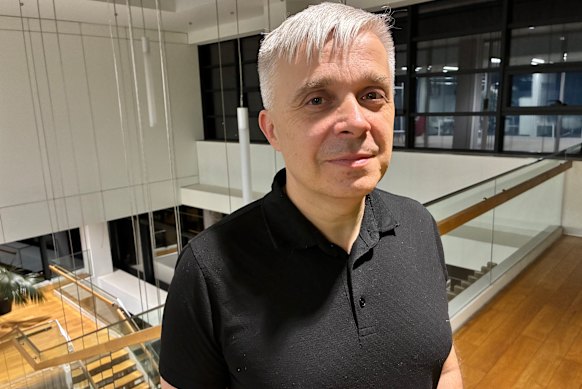
Oleh Romanchuk says people learn to cope with the regualr overnight air alerts, with one trick being “strategic sleeping”.Credit: David Crowe
The alert on this morning never seems to end. It is past 7am, then past 8am, and most of Ukraine is still red on the map. But there is more news about the strikes on rail and energy systems. Some of the students shuffle back to their rooms with their pillows and blankets in their arms.
After a while, I can see only two left. The blue doona man and the woman on the wooden bench. Then it is suddenly 9am and a voice comes over the loudspeaker to mark the minute of silence for those who have fallen in the war. I stand as a clock ticks and a church bell rings in the distance.
The young woman rises from her bench, but the young man appears to sleep on. I’m not judging.
Only at 9.45am do we hear the all-clear. It takes several more hours to see confirmation that Russia launched 653 drones and 51 missiles against Ukraine during the night, damaging railways and energy systems in eight regions including Lviv. Three people are wounded. It is incredible the toll is not greater.
Loading
I’m astounded at the calm of these young people. I think of how hard it would be to sustain this routine, week after week. No young student with their life ahead of them deserves this.
When I see them at breakfast in the cafeteria, they laugh and gather around long tables to share their meals. Outside the shelter, I’ve met several students who tell me of being forced to move because of the war, or being separated from their families, or going abroad and choosing to come back.
I see them in the cafeteria and think the world is in good hands. And then I worry again about their nights.