3 months ago
6
3 months ago
6
Opinion
November 14, 2025 — 5.00am
November 14, 2025 — 5.00am
Consider two contrasting sensations of the past week: Zohran Mamdani’s victory in the mayoral election in New York City, and the admittedly lower-key ascent of One Nation and similarly conservative politicians, culminating in a new poll placing Pauline Hanson, Barnaby Joyce and Andrew Hastie among the most liked politicians in the country, while One Nation polls up to 14 per cent.
Both feel like significant, trend-bucking events, defying the conventional wisdom of the moment. In the US, a socialist Muslim anti-Zionist is meant to be unelectable. In Anthony Albanese’s Australia, political profit is meant to be won in the centre, avowed right-wing politics leading only to the political wilderness.
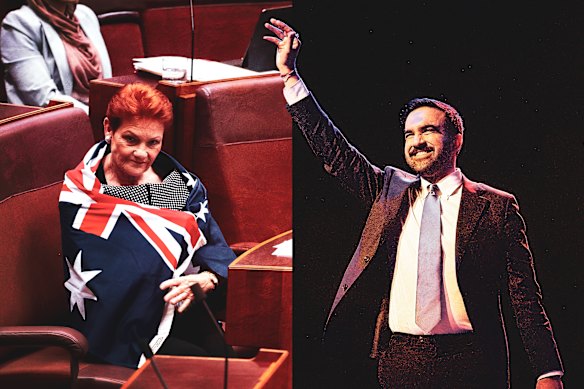
Pauline Hanson’s One Nation has surged in the polls, while socialist Democrat Zohran Mamdani has been elected mayor of New York City.Credit: Nine Publishing
Both cases will invite true believers to hopeful conclusions: that the path to Democrat revival in America is to jolt the establishment sharply to the left, and that the Coalition’s future in Australia lies in right-wing stridency. But what if rather than buck the trend, these events reinforce it? Because if you think of our current political moment as the result of long-term social changes rather than flashes in the pan, each of them makes the most sense as a continuation of those trends, rather than a disruption.
Mamdani, for instance, has proved just how exhausted and alien New Yorkers find the Democrat establishment. While the old school attacked Mamdani on Israel, a third of Jewish New Yorkers voted for him. Partly that signals a serious shift in American attitudes on Israel, but mostly it was because Israel was beside the point. Mamdani ran a sharply focused campaign on the cost of living. Fast and free buses, increasing taxes on the rich, a pilot program for government-priced grocery stores, rent freezes on certain properties – he hammered this program relentlessly.
But for all that, Mamdani won as the Democrat candidate in an election confined to a heavily Democrat city. There’s no real history of New York mayors going on to redefine national politics, and there’s precious little yet to suggest this approach would succeed in, say, a swing state. Yes, Mamdani won some Trump voters, and yes, he finally put the economy front and centre, speaking to voters’ major concerns and fighting on the same patch that has served Trump so well. But it’s a long way from those seeds to winning Ohio.
Loading
Similarly, we’ve seen One Nation spike before. On the eve of this year’s election, polls showed a late One Nation surge at the expense of the Coalition. It was around this time that Peter Dutton began sounding off on Welcomes to Country, having mostly avoided culture war issues during the campaign, in what seemed a last-ditch attempt to arrest the bleeding on his right flank. But as it transpired on the night, the One Nation vote underperformed – notching up 6.4 per cent when some polls had them at 10.5 – and the real bleeding went to Labor. The result was a purging of the Liberal Party from the cities, while the Coalition – mostly in the form of the Nationals – held its ground in rural Australia.
The fact remains that Mamdani and One Nation are prospering on opposite sides of one of the most defining divides in modern politics: city versus country. Our May election showed just how deep that division has become. In America, the effect is even more pronounced. Until the ’90s, rural and urban voters voted similarly; in 2024, Trump won rural America by about 40 points. And yet this same phenomenon is having opposite effect here. In America, it’s destroying the Democrats, handing the Republicans a huge structural advantage in the White House and Congress. In Australia, it’s destroying the Coalition, threatening either to consign it to endless opposition, or to tear it apart entirely.
That’s because we’re different countries, and we have fundamentally different political systems. Australia is one of the most urbanised countries in the world, in which about two-thirds of the population live in a capital city. America is a country of a few massive cities, but many more smaller ones. It has states that are almost entirely rural, but which have numbers in the electoral college system and just as many senators each as California. The result is that the Democrats will never control the Senate unless they make rural inroads. And it means someone like Donald Trump can lose comfortably in America’s cities but still win the popular vote. The same thing in Australia, as we saw in May, means a 55-45 whacking for the Coalition, and approximately zero chance of forming government.
For Mamdani and One Nation to alter that, they would each have to reach across this chasm. Mamdani, of course, as a city politician, has no business testing this. And for One Nation, there’s no sign its gains are urban. Indeed, the true significance of this surge, if it proves to be more than a mirage, is that it only exacerbates the gulf. Until now, the Nationals were largely unchallenged in the bush, meaning that if the Coalition moved more to the centre in search of city seats, the Nationals could probably wear the cost. But if we’re now in a world where there’s a genuine rural contest – where senior Nats are considering defecting, and where the Coalition genuinely fears being raided on its right flank – that calculation changes entirely. This is reportedly why some Liberals recently shifted their position to dumping net zero.
Loading
This changed calculation would be a disaster for the Coalition, leaving it in the impossible position of chasing opposite targets at once. If, as it seems, rural and urban voters really do see the world in increasingly opposite ways, and accordingly want increasingly opposite things from their politicians, that puts the Coalition in a zero-sum world where a rural loss offsets an urban gain. And at a time when polls show the Coalition 1.2 million votes behind even its worst ever election result, what moves will it have left?
Waleed Aly is a broadcaster, author, academic and regular columnist.
The Opinion newsletter is a weekly wrap of views that will challenge, champion and inform your own. Sign up here.
Most Viewed in Politics
Loading