3 months ago
28
3 months ago
28
NATURE
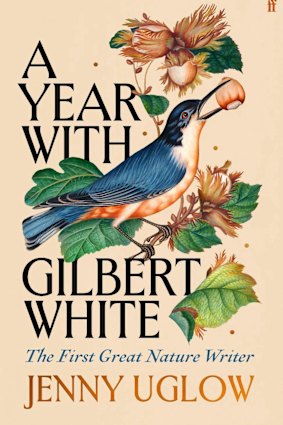
A Year With Gilbert White
Jenny Uglow
Faber, $55
It’s always fascinated me that the initial copies of the book that is often described as the first in the decidedly English genre of “nature writing”, Gilbert White’s Natural History & Antiquities of Selborne, were printed in 1788, the same year as the first English prison ships arrived in Australia.
That the book’s official publishing date was the following year, 1789, the year of the French Revolution, an event that some believe was in part triggered by failed harvests caused by the eruption of the Laki volcano in Iceland, only adds another layer of significance to this small but momentous brace of years at the end of the 18th century.
As naturalist Stephen Moss has pointed out, the parson-naturalist Gilbert White, and admirers of his writings such as poet John Clare, “found a connection between human beings and nature at the very moment when a dislocation between humanity and the natural world was beginning to occur”.
The dislocation is better understood when you consider that White, the lifelong resident and curate of the village of Selborne, England, was born in 1720, only eight years after Thomas Newcomen invented the first practical steam engine 240 kilometres north-east in Dartmouth. Thus, as the decades of White’s fastidiously quiet and observant rural life unfolded, so too did the massive cultural abstraction brought on by the mechanical and technological revolution that has transformed the Earth as we know it.
The pace of change as a result of the industrial revolution was at first quite slow, so that, as James Lovelock once observed, villages like Selborne saw little perceptible change until the late 19th and very early 20th century. This in part explains the lasting importance of White’s book, whose ardent record of ecological intactness in his local patch was predicated upon the potent but as yet subliminal airs of great change. It also explains the absence of any Ruskin-like urgency in White’s style. As yet there was seemingly no ecocidal horizon in his landscape, only fervent curiosity and painstaking local notation, inspired in part by the enormously influential publication of Linnaeus’ classification systems when White was a young man.
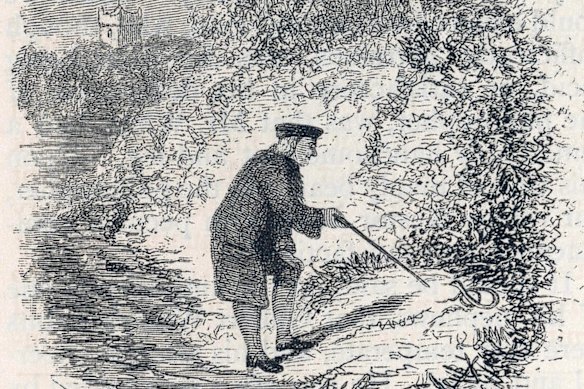
An illustration of Gilbert White shown near his home in Selborne, Hampshire.Credit: Alamy Stock Photo
Now that climate has become the single socio-political predicament shared across all peoples of the globe, albeit unequally, it is hard to ignore the consequences of our inspired ingenuity as a species and the responsibility of power that comes along with it. What was once the province of visionaries is now the metier of realists. And with that understanding comes a renewed appreciation of the value of local observations such as those White so brilliantly turned out in his book, The Natural History.
The value here is unmistakably that White was not flying or sailing all over the world as either an imperialist expansionist or a private carbon-emitting tourist. Instead, he remained in situ, building up a decades-long account of what he had observed in his immediate whereabouts in Selborne. And of course, Selborne, like any hill or valley, river or coast, actually takes more than one generation of close observation and experience to properly know.
Although to us in the southern hemisphere White’s accounts often involve exotic inversions of our own seasonal realities, it is his daily practice of vigilant curiosity that remains relevant. And that is what Jenny Uglow’s A Year With Gilbert White is prescient to focus on. Uglow takes one single year – 1781 – of White’s journal, to structure what might be called a “circadian biography” of White’s life and work.
While she expresses her indebtedness to Richard Mabey’s 1986 biography of White, Uglow takes a more embodied approach here in weaving her own account of White’s lifelong project around the days of a single calendar year. In this way, her book manages to tie our readerly immersion to the daily round of White’s preoccupations, whereby she can illuminate any given day’s observations of say, swallows or sand-martins in 1781, by comparing them with other observations he made in other years, and by expanding on the themes they touch on, including reflections on the resonance of such themes for us now.
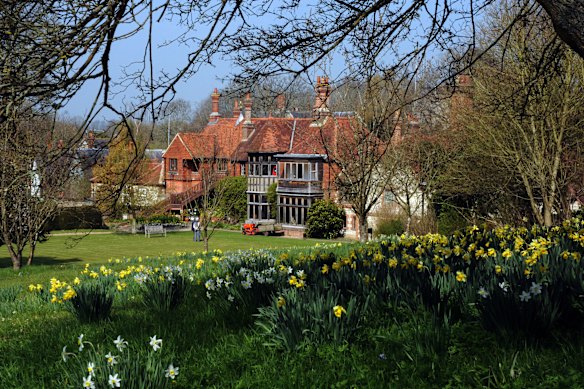
White’s 18th century house and garden in Selborne are open to the public. Credit: Alamy Stock Photo
These unpackings amount not only to a biography of White’s life as a proto-citizen scientist, but also one which, by implication, gently frames the entire ecological glitch of modernity between his time and our own.
When White became aware in the late 1760s that Joseph Banks was about to set sail as the botanist on Captain Cook’s Endeavour, the sheer extent of the proposed journey filled him with alarm. For White, there was well and truly enough to observe and discover at home. This sense of endemic intricacy in the gift he has given us is both familiar to us now and strange.
At times, reading about his world feels a little like travelling to an ur-version of the planet we now know. Uglow’s approach, however, ensures that the resonances of a pre-trashed Earth that we still understand in our animal bodies, and which we yearn for as the natural inheritance of all souls on the Earth, come through in the kind of grounded yet celebratory way that can make a difference to how we live our lives.
The Booklist is a weekly newsletter for book lovers from Jason Steger. Get it delivered every Friday.
Most Viewed in Culture
Loading