3 months ago
17
3 months ago
17
Forget about Sydney’s WestConnex, NorthConnex, the Cross City Tunnel or any other motorway built in the past three decades.
The project director for an upgrade to one of Australia’s busiest motorways reckons the $2.08 billion face-lift for the Warringah Freeway is the toughest road-building job.
“This is twice as hard as the Eastern Distributor because of the complexity,” said Transport for NSW’s Tony Sheppard, a 35-year veteran of road construction.
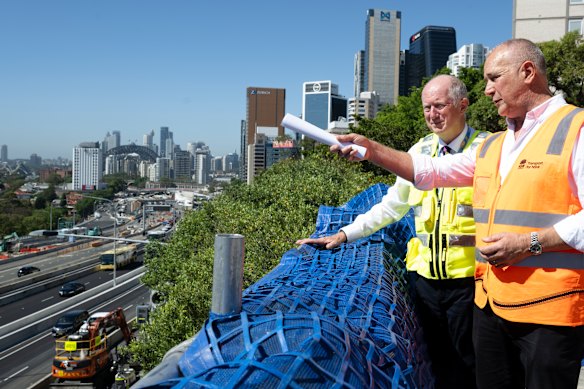
Transport for NSW coordinator general Howard Collins (left) and project director Tony Sheppard looking over the Warringah Freeway at North Sydney.Credit: Janie Barrett
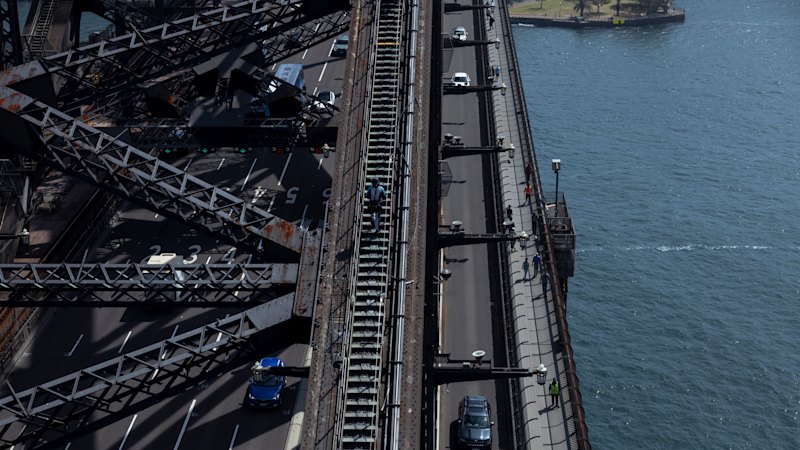
Construction teams have to carry out their work while up to 220,000 vehicles a day use the four-kilometre freeway, funnelled on and off it via the Sydney Harbour Bridge and Harbour Tunnel. Adding to the challenge, the work disrupts residents in homes neighbouring the corridor, especially at night.
If traffic was removed from the equation, Sheppard said the four-year project could have been completed in 18 months.
In a sign of the complexity, the project has topped 20,000 temporary lane closures, whereby cones or barriers are installed to allow roadworks. “It’s like a giant game of three-dimensional Tetris,” Sheppard explained.
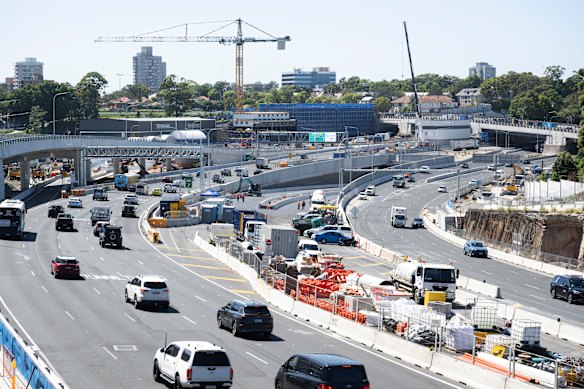
The northern end of the Warringah Freeway. “It’s like a giant game of three-dimensional Tetris.”Credit: Janie Barrett
It is a fine balancing act between the amount of work that can be carried out, delays caused to motorists or disruption to residents. Noise restrictions limit night-work to 10 nights a month, while construction teams avoid work during peak-hour to limit traffic snarls as much as they can.
“It’s obviously more efficient to do your work during the day ... but that stuffs up the traffic. If we do it at night we annoy the residents,” Sheppard said.
If the project team reduces lane closures for work, it can lengthen the months it will take to complete the project to the chagrin of motorists and residents.
The upgrade is necessitated by the construction of the $7.4 billion Western Harbour Tunnel, which will allow motorists to bypass the CBD when it opens in late 2028. The 6.5-kilometre tunnels will link the WestConnex motorway under the inner west to the Warringah Freeway in the north.
The finish line
Motorists and residents alike face one last major period of disruption before the project – fingers crossed – is on the final straight to completion in November next year, six to nine months later than originally planned.
The final big hump of work has been timed to occur over the summer holidays when traffic volumes drop by almost a third. Lanes will be closed for longer to carry out critical works from Boxing Day to just before Australia Day.
The work will involve removing and installing asphalt and concrete across the freeway lanes, which cannot happen during busy commuter periods. About 20 of the 290 traffic configuration changes remain, before the project is completed.
The big change
Despite the hurdles, a ribbon cutting for the upgrade is not in the offing, unlike Sydney’s other mega road projects built in recent decades. “This isn’t a job with a big, sexy ribbon-cutting opening. We progressively open,” Sheppard said.
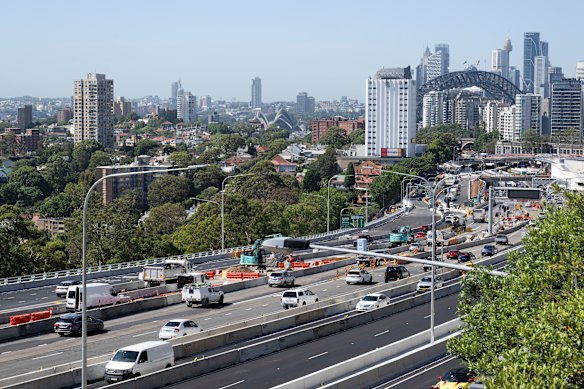
The Warringah Freeway is used by up to 250,000 vehicles a day.Credit: Janie Barrett
As wide as 16 lanes, drivers have long been accustomed to gradually crossing lanes on the Warringah Freeway to get to their destinations. A year from completion, motorists are already noticing that they cannot switch lanes as easily as before. It is what authorities call “channelisation”, which is akin to 200-metre sprinters having to stay in their assigned lanes.
“There’s going to be less mergers, less crossovers,” Sheppard said. “The channelisation is the biggest change.”
Transport for NSW coordinator general Howard Collins said drivers were advised to be conscious of signage and the need to make early decisions to get in the right lane for their exit. “You can’t do this last-minute change of mind to get in one or the other,” he said.
What’s been finished?
A new 46 metre-long underpass to provide motorists dedicated access to the Cahill Expressway was opened in September, and is part of the Mount Street interchange and Alfred Street off-ramp upgrades. Referred to as a “mouse hole”, the underpass beneath Mount Street removes the need for southbound vehicles to weave and merge, directing them onto the Cahill Expressway.
The underpass took two years to build because it had to be done amid traffic, making it and the rest of the Mount Street area one of the most challenging parts of the entire upgrade. “That’s been a genuinely three-dimensional area – small scale but complex,” Sheppard said.
A 187-metre bridge for pedestrians and cyclists over the freeway was opened in August, linking Falcon Street at North Sydney to Merlin Street at Neutral Bay. The 4.8 metre-wide Falcon Street bridge replaces an older crossing.
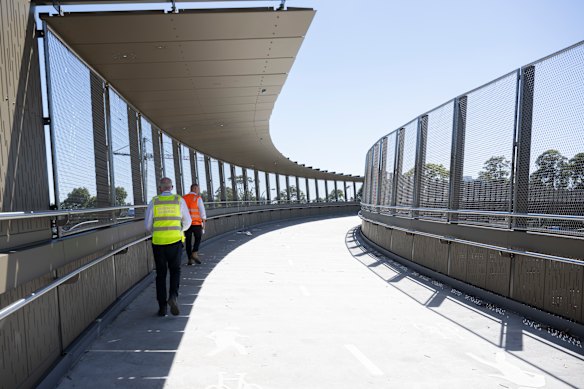
The new Falcon Street bridge for pedestrians and cyclists arcs over the Warringah Freeway.Credit: Janie Barrett
A new shared-user bridge linking Ridge Street to Alfred Street North was also opened late last year, while the existing High Street bridge has been almost doubled in width.
The major additions
A key feature of the upgrade is a dedicated southbound bus lane from Cammeray, which Collins said would “make a huge difference” for public transport commuters. Much of it has been finished, and is due to be solely used by buses in the second quarter of next year.
The main exits and entry points for the Western Harbour Tunnel will be at Cammeray, while there will be a southbound entry to the new under-harbour crossing from Berry Street in North Sydney. The tunnel entrance will arc almost 180 degrees.
Loading
“Those people who want to [get to] the southern end of North Sydney will still use the Harbour Bridge. But people ... going north on the M1 will obviously find … [it] much more useful to use the Western Harbour Tunnel,” Collins said.
“I’m hoping that this 16-lane puzzle has finally been completed at the end of 2026.”
Transport for NSW deputy secretary Raquel Rubalcaba said the project was ultimately about simplifying the biggest traffic bottleneck into central Sydney.
“In an ideal world, you’d close it [to carry out the upgrade], but the city would be in gridlock. We’ve had to work around the constraints and minimise [the disruption],” she said. “It’s like digging with a teaspoon.”
Start the day with a summary of the day’s most important and interesting stories, analysis and insights. Sign up for our Morning Edition newsletter.
Most Viewed in National
Loading