3 months ago
28
3 months ago
28
Warning: The following article contains names and images of Indigenous people who are deceased.
Washington: The largest exhibition of Indigenous Australian art ever shown overseas is beginning to draw crowds in the US capital, weeks after the grand opening was cancelled due to the government shutdown.
Many of the works now on display at the National Gallery of Art (NGA) in Washington, DC, had never previously left Australia. The Stars We Do Not See, drawn from the extensive National Gallery of Victoria (NGV) collection, comprises nearly 200 pieces by more than 130 artists.
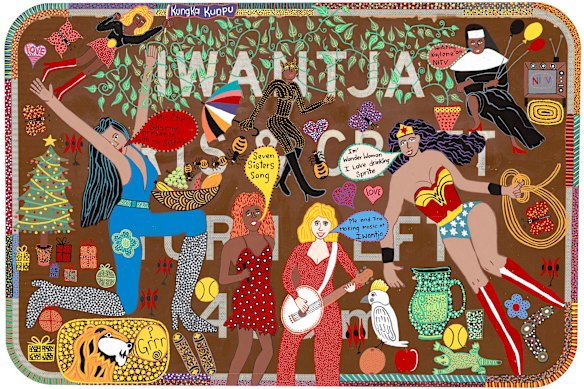
Seven Sisters Song, painted on a road sign, is one of 200 Indigenous Australian artworks on display at the National Gallery of Art.Credit: Courtesy of the National Gallery of Art, Washington
The exhibit showcases art from every corner of the continent, from Arnhem Land to the Tiwi Islands north of Darwin, South Australia’s Indulkana and the remote Punmu community 600 kilometres from Port Hedland.
On a grey Thursday morning, retired art history teacher Judith Gregory caught the train from Wilmington, Delaware, to learn more about an artistic style and form that she, like most Americans, is largely unfamiliar with.
“When I read about this I just wanted to see it,” she said. “It just has a whole other element to it that I’m sure I don’t understand, but it seems to be very spiritual and very organic. I just think visually it’s incredibly exciting.”
NGA director Kaywin Feldman said the two galleries worked on the project for six years, interrupted by COVID-19. She and her team travelled to Australia, visiting Alice Springs, Uluru, Darwin and the Garma Festival.
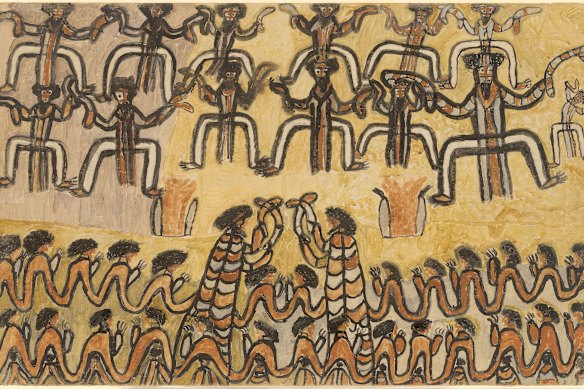
William Barak’s Ceremony, circa 1898, is one of the most significant works featured in the collection.Credit: Courtesy of the National Gallery of Art, Washington
Many of the large works on display are collaborations, including a three-by-five-metre painting of the salt lake Ngayarta Kujarra (Lake Dora) in Western Australia by 12 Punmu women spanning three generations.
“This painting always catches me because I remember being in this small plane flying to Alice Springs from Uluru and going over salt pans,” Feldman said. “It’s a very visceral picture for me.”
The Stars We Do Not See is named in honour of the late Gulumbu Yunupingu, also known as the “Star Lady”, whose stringybark paintings are part of the exhibit.
It was curated by Myles Russell-Cook, a former senior curator at the NGV, now the artistic director and chief executive of the Australian Centre for Contemporary Art.
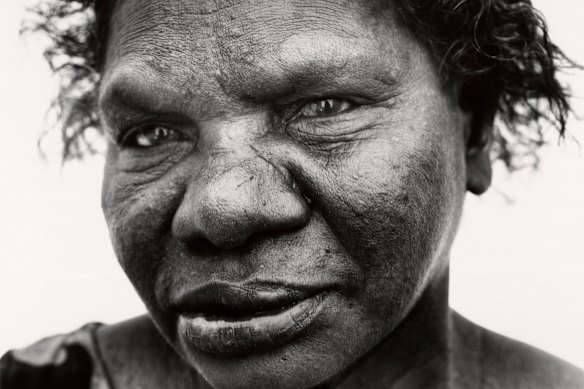
Ricky Maynard’s Wik Elder, Gladys.Credit: Courtesy of the National Gallery of Art, Washington
“Never before has a volume of works of this size and national significance toured internationally,” NGV director Tony Ellwood said.
Among the historically significant works on display – inside a glass case – is the 1875 Notebook of Mr Roderick Kilborn, a book of pen and ink sketches by 19th-century Kwat Kwat artist Tommy McRae.
Loading
McRae met Kilborn, a Canadian-born telegraph master, in the 1860s in Wahgunyah, Victoria. Kilborn became the artist’s “chief patron and supporter”, commissioning drawings and writing about him in the Corowa Free Press. The Notebook is one of two “exceedingly rare” and important McRae sketchbooks the NGV purchased in 2001.
Along with traditional styles and forms of Indigenous art, visitors will also find modern, urban interpretations, including six painted skateboards by young Brisbane/Meanjin artist Claudia Moodoonuthi, or the painted road sign, Seven Sisters Song, by contemporary Indulkana artist Kaylene Whiskey.
The playful, colourful sign features depictions of singers Cher, Tina Turner and Dolly Parton, as well as Wonder Woman, and is among several works in the exhibit that might best be described simply: fun. “It’s also fun for an American audience because they’re all American,” Feldman said.
Loading
The project was not without challenges. Already delayed by the pandemic, it was set to open with fanfare in mid-October, but fell victim to the US government shutdown, which stretched on for a record-breaking 43 days.
Half a dozen couriers from the NGV in Melbourne travelled to Washington and spent about a month helping to install the artworks, which then sat idle for a month while the gallery was shuttered.
Stars will remain in Washington until the start of March, then travel to the Denver Art Museum in Colorado, the Portland Art Museum in Oregon and the Peabody Essex Museum in Massachusetts.
As part of the exchange, the NGA will in 2027 send a showcase of major works from its renowned collection of contemporary American art to the NGV.
“It’s been a really joyful partnership,” Feldman said.
She said the project was partly driven by growing interest in Aboriginal Australian art in the US and around the world.
The NGA is taking indigenous work more seriously, having earlier this year appointed its first curator of Native American art.
Get a note directly from our foreign correspondents on what’s making headlines around the world. Sign up for our weekly What in the World newsletter.
Most Viewed in World
Loading