3 months ago
22
3 months ago
22
Usman Khawaja didn’t decide to retire from international cricket on a whim.
It was the culmination of a couple of years of thoughts, conversations and wider events that crystallised around the third Ashes Test in Adelaide a couple of weeks ago.

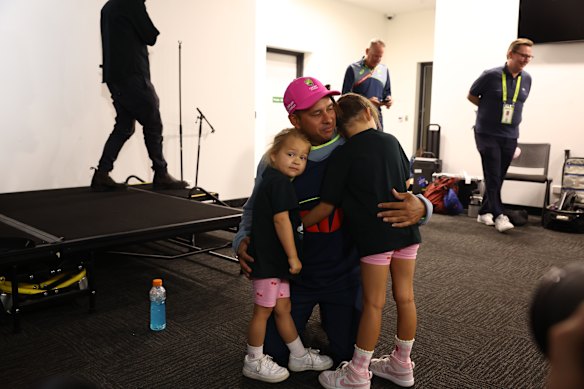
Usman Khawaja with his wife, Rachel, and their daughters Aisha and Ayla.Credit: Getty Images
Having suffered back spasms in Perth then missed the Brisbane Test, Khawaja was ready to go in Adelaide, only to find he did not initially make the cut to play in the decisive game of the series.
Steve Smith’s health problems allowed Khawaja to come back in the team on match morning at Adelaide Oval, meaning he will take part in his 88th and final Test for Australia at the SCG this week, but the earlier selection decision confirmed to the 39-year-old that the time was right.
“Trying to get back to the Brisbane game, trying to play that and not being able to come back sucked,” Khawaja tells this masthead. “But then in Adelaide when I didn’t get picked again - obviously Heady and Weathers were doing well, but I felt like I could’ve easily slotted back into the middle order then. When I wasn’t picked in the middle order that was pretty much it.
“No matter what, I was retiring in Sydney, but that made my decision earlier than I wanted to think about it. I had tried not to think about it, just wanted to play, everyone was talking about a farewell tour but I refused to think about it that way, because there was still an option in my head where I thought I could play further on potentially. That’s how Ron [coach Andrew McDonald] saw it. He kept talking about India [in 2027].
Usman Khawaja during the press conference on January 2.Credit: Dominic Lorrimer
“He knows how strong my record is in the subcontinent, and he’s always thinking ahead. And I appreciated that, but I also didn’t ... it was too far away for me to get there. I didn’t fully close the door on it until Adelaide. If things are like this and I’m 39 years old, then I’m happy to go now.”
Khawaja made a celebrated Test debut at the SCG in January 2011, a bright spot in an otherwise grim Ashes summer for Australia.
But he was dropped and recalled so many times that Khawaja was left to conclude that he did not fit the mould. There were axings in 2011 (twice), 2013 (plus a homework suspension in India), 2016, 2017 (twice), 2019 and then finally, for a day in Adelaide this series.
As often happens, recalls came as a result of others’ misfortune - Travis Head’s positive COVID Test in 2022, for example, when Khawaja marked his return with back-to-back hundreds at the SCG.

Khawaja embraces his father, Tariq. Credit: Getty Images
“I’ve broken down so many barriers, I’ve had to fight so many battles,” he says. “I got dropped a lot early on because I was different, I didn’t really fit into the mould, the 50/50 calls went against me. I’ve no doubt of that.
“I don’t say this with any prejudice because I loved my journey, I’m very grateful for where I am right now, but if my name was John Smith I would’ve got away with a bit more if I’m totally honest. But I wasn’t and I was trying to break that down.”
Loading
As a committed Muslim, Khawaja looks upon his subsequent recall to finish the series as somewhat providential. It had arrived after he made his peace with God that if Perth was to prove his final Test match, he was grateful nonetheless.
“It has to be, right? I know people don’t believe in God, but I believe God does everything, the good and the bad,” Khawaja says. “I pray five times a day every day and have a very close connection with God personally, and for me it wasn’t like ‘please God let me play again, let me finish my career like this’, it was, ‘thank you for everything you’ve given me, I’m very grateful and happy to go out now’.
“I wasn’t expecting to play again and once I didn’t play in Adelaide I thought it’s going to be hard for me to play unless something goes awry, which it did. But the odds of that happening are low, batsmen don’t miss a lot of Test matches. So I was very comfortable. I was in my gratitude state, which I have been for a long time, saying thank you for all the Test matches I’ve played, been able to do a lot of great stuff both inside and outside of cricket.
“I was really just happy to help the team out if they needed me. I never wanted to be a guy who left a series halfway through. No offence to anyone who has, everyone has the right to leave whenever they want, but I tried to avoid that because I knew if something happened to one of the batsmen the series was still alive. So I said I’m happy to be 12th man until the end of the series if that’s the case and I’ll just retire in Sydney.”
Over these past few weeks there has been much said about “farewell” matches or series, and whether Khawaja deserves one. It has rankled him, especially given that internal discussions have been more about getting him to play one more India tour in 2027 rather than pushing him to the exit.
There is something poetic about how Khawaja will finish his Test career having played two distinct halves. Forty-four Tests between 2011 and 2019 when he was in and out of the side, then another 44 Tests over the past four years where he has been a trusted and ever-present member of the team.
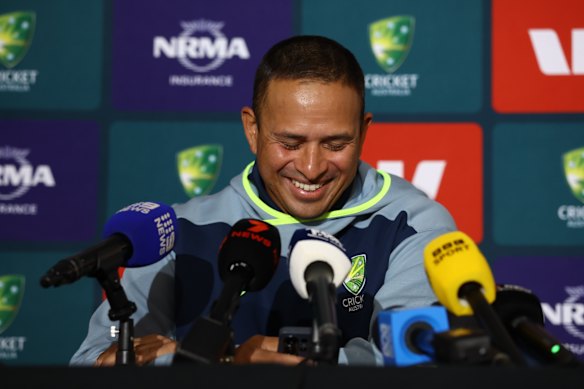
Khawaja announces his retirement. Credit: Dominic Lorrimer
“It really annoyed me that everyone was talking about the farewell tour,” he says. “I didn’t care about that. It wasn’t a case of finishing at the SCG, it was a case of finishing the series and if that’s the last one it’s the last one. To be honest it’s been more so that Andrew McDonald has kept pushing me, too. I could’ve left last summer. Even this year when I haven’t had a great year by my standards, I was still wanted.
“This whole period was always a bonus for me, and I think it’s helped me to play. It took a little bit of stress and pressure off me. I was never holding on, I was always ready to go. Whenever I felt like it was time to go, I was ready to go. Even right until the very end when I spoke to Andrew, he was laughing and going ‘how can we get you to India, what do we need to do?’
“So it was nice to think if I said I was staying on this wasn’t my last match. Pretty positive I would’ve played the next series and gone to South Africa. You obviously need to score runs to be in the team, but it wasn’t a case that I was getting dropped. I’m happy and content that I was still in the team and I’ve left on my own terms rather than being pushed out.”
Providence or not, there will also be something entirely fitting about Khawaja’s final Test match taking place at the SCG. The SCG and the suburbs around it were where Khawaja spent his first few summers in Australia between 1991 and 1995, sparking the love of cricket that still burns brightly whenever he speaks about it.
“The SCG was 10 minutes down the road. I was in absolute awe of the NSW guys. I used to watch Richard Chee Quee when I was younger, not knowing I’d get to play with him one day in grade cricket,” Khawaja says.
“He helped me a lot through those early years of grade cricket and learning how to play with men, when I was just coming in as a 16-year-old, learning the art and getting absolutely nailed by everyone, especially as a little brown kid trying to play a very white game in Sydney.
“We couldn’t afford tickets. My Mum said tickets were about $30 each back then, and that was way too much for us. So we’d wait right until the end of a one-dayer, they’d open the gates and I’d get to see the last five overs or so. We’d run in and watch the last little bit of cricket and that’s all I got. Back then if the game wasn’t sold out on TV they wouldn’t even show it, so I’d be 10 minutes away from the SCG listening to it on the radio. I’ve never lost those memories.
“I watched my first game of cricket in the old Doug Walters Stand, it was disgusting, but luckily with my skin colour I could get away with it in the sun. But we were watching Dean Jones and Mark Waugh batting and my brother would go ‘watch these guys, they’re the best runners between the wickets ever’ and the aura of the Australian team.
“Then to be able to play there, debut there for NSW, debut there for Australia, make my comeback there, in 2022 and hopefully finish there, So much emotion goes into that ground for me, because I grew up literally next to it. It’s a very special place.”
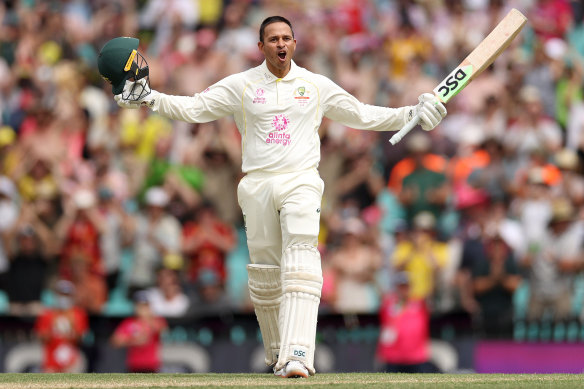
Khawaja celebrating the first of two centuries on his return to the Test side at the SCG in 2022 against England.Credit: Getty Images
Khawaja will finish in esteemed company among Australian top order players. He’s currently 29 runs short of the runs tallied by Mike Hussey, and has more hundreds than the likes of Doug Walters, Ian Chappell or Bill Lawry.
But his defining achievement, more than any runs, centuries or victories, will be in showing it is possible for a south Asian Australian to play the game at the highest level for a long time. In his own, wise-cracking way, Khawaja is to Australian cricket what Jim Brown was to American football or Jackie Robinson to baseball: pathfinders.
“There was a wide narrative among the multicultural community that we can’t represent Australia in cricket, they don’t pick our kind,” he says. “All those narratives that we’re lazy, we’re selfish, we don’t care about the team, we don’t mingle well. All these false racial stereotypes I had to try to break down throughout my career, even up until now.
“The journey’s been so much tougher but I’m so grateful I got to do it because I’ve been able to show people of all backgrounds, it doesn’t matter what ethnicity, what colour or what faith you have, you can play for Australia. You might have to be a little more resilient than the guy next to you, you have to go in there with an open mind and understand that.
“Your journey might not be as easy, but hopefully now I’ve done this journey and been very successful, hopefully the next person will have an easier journey. Then the next person after that will have an easier journey. Then hopefully at some point they’ll have the same journey. That’s the ultimate goal. Seeing is believing, and they’ve seen it now.”
This is not to say that the job is done. Far from it. In the weeks and months after his final Test match, Khawaja will play plenty of golf, spend plenty more time with his young and growing family, and do the odd bit of commentary. But he will also work assiduously at trying to keep that pathway open.
Loading
“I didn’t like the Australian cricket team growing up because I didn’t see myself in the team,” Khawaja says. “I supported the Windies or Pakistan, pretty much anyone but Australia, until the age of 13 when Gilly and Brett Lee won me over with the way they played the game. I decided ‘I love these guys’. They didn’t seem like that older generation.”
“The older generation [of Australians] were the ones racially vilifying me when I was growing up and playing. They were the Dads, the older men who were sledging me as I was going past them, saying racial derogatory things to me. It wasn’t the kids as much, it was the parents. And they looked like the guys who were playing on TV, drinking beer and being hooligans, so I couldn’t support them.
“I’m hoping the next generation is slightly different. We’ve still got a ways to go. I meet so many Indians, Pakistanis, Sri Lankan who still support the mother country. I asked where were you born and they say Australia and I go ‘why don’t you support Australia’ and they’re like ‘ahhh’. That’s the barrier we have to break down. It’s still there, there’s still a stigma attached to the Australian team, which hopefully I’ve started the process of changing.”
Where is the destination? Khawaja points to the United States, and the multiracial nature of the NFL, MLB and NBA in the decades after Brown, Robinson and others.
“They are treated equally. It’s just about how good you are,” Khawaja says. “Shotei Ohtani is from Japan and they don’t care, you’re a gun, get in here. They’ve well and truly broken down those barriers where we haven’t quite yet.
“When I look back it’s not the runs or the wins or anything else, it’s the brown immigrant boy who came from Pakistan in 1991 and got to play for Australia’s greatest sporting team. That’s the greatest achievement I’ve had.”
Most Viewed in Sport
Loading