3 months ago
25
3 months ago
25
Katie RazzallCulture and Media Editor

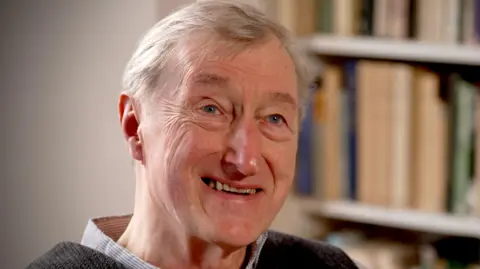 BBC/Adam Walker
Barnes said he didn't want to continue writing novels "if I didn't do it with full conviction"
Julian Barnes is sitting at an ancient electric typewriter in his study in north London.
He turns on the machine, and a sound fills the room.
"A hum that says, 'I'm here when you need me. Just alerting you to the fact that I'm turned on and ready,'" is how the acclaimed novelist describes it.
The typewriter "suits the way that I think as a writer", he adds, and he starts to bash the keys. There's a reassuring clacking as the individual letters hit the blank white page in quick, noisy succession:
The other day I discovered an alarming possibility...
It's the opening line of his new novel, Departure(s).
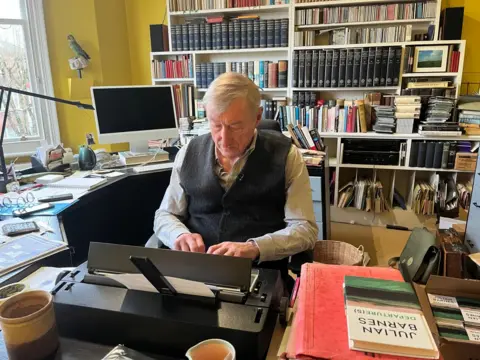 BBC/Roxanne Panthaki
The author in his study, writing on the trusted typewriter on which he would write the first drafts of his novels
Whatever the alarming fictional discovery, more alarming for his loyal fans is the news that Barnes says he will never write another novel.
Departure(s) is to be his last - and is being published just ahead of his 80th birthday.
"You get a sense of having played your tunes," he explains. "As I wrote this book, I both thought, this feels like the last book, and it should be."
Will he miss writing fiction?
"I will miss it, but at the same time it would be foolish to do it if I didn't do it with full conviction... I think it's just a correct decision."
Is Departure(s) a good book to go out on? "I think so, yes," he replies. "I hope so."
Barnes has already published 14 novels, three of which were turned into films. He has been translated into 50 languages and sold 10 million copies of his works across the world.
Since Metroland, his first, was published in 1980, he's scaled the literary heights.
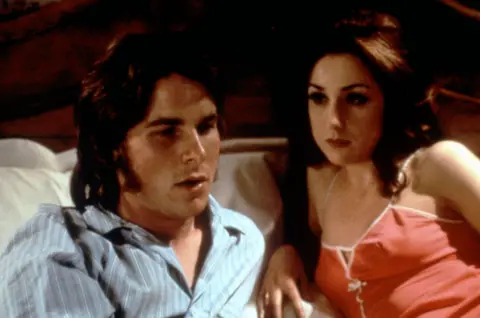 Alamy
Alamy
Barnes's first novel Metroland was made into a film in 1997 with Christian Bale and Elsa Zylberstein
Picked by Granta in 1983 as one of Britain's top 20 young novelists, he stares out of the famous publicity photo alongside Martin Amis, Pat Barker, Rose Tremain, Kazuo Ishiguro and Ian McEwan, among others. (Salman Rushdie was also on the list but couldn't make the photoshoot.)
Granta's once-in-a-decade list is a barometer of Britain's changing literary landscape, and that 1983 photo is a roll-call of some of the greats.
"I was excited to be in a generation of novelists, all under 40, and all being celebrated. It was a strange time because it was a time when fiction suddenly became sexy, and also suddenly money was available."
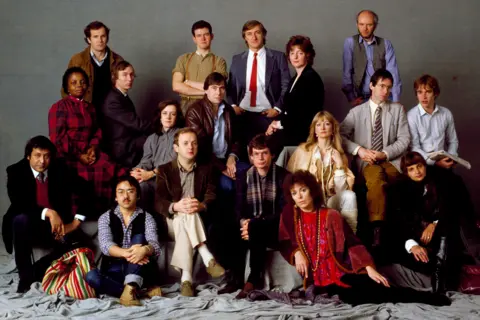 Snowdon/Trunk Archive
Julian Barnes (back centre with red tie) featured on the famous Granta List of the 20 Best of Young British Novelists in 1983 - many of whom were to become household names
Barnes won the Booker Prize in 2011 for his 11th novel, The Sense of An Ending, after being previously shortlisted three times.
His 15th, Departure(s), is classic Barnes in many ways, blurring the lines between what's real and what's not.
Described as part fiction, part memoir and part essay, at its heart is a love story between a couple who part as students and rekindle their relationship years later.
I ask him if they are real people. "That's for me to know and my biographer to find out," Barnes replies, somewhat enigmatically.
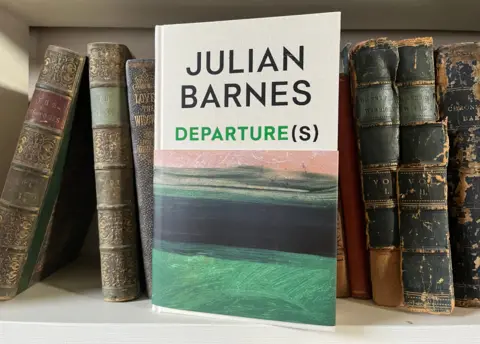 Gagosian/Suzanne Dean
The book cover shows the painting Evening, 1994-1995 by one of Barnes' favourite artists, Howard Hodgkin
The novel is narrated by a writer called Julian who has blood cancer, who lives in north London and whose wife has died of a brain tumour.
"I don't think it's my most autobiographical work... but it's obviously a personal book," he tells me.
The real Julian Barnes does have blood cancer, and in 2008 his first wife, the literary agent Pat Kavanagh, died of a brain tumour just 37 days after being diagnosed.
She represented authors including Joanna Trollope, Robert Harris, Margaret Drabble and, for more than 20 years, Amis.
Barnes says he's "completely at ease" with his own cancer and supports assisted dying, although "that's not related to my cancer".
"My condition is stable and it's kept stable by taking chemo every day of my life."
Later, he tells me: "The phrase I came up with when my wife was dying of brain cancer and I was struggling with sanity was, it's just the universe doing its stuff."
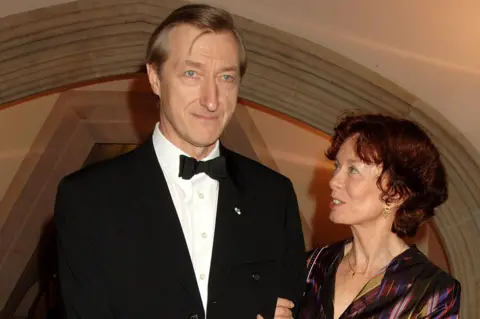 Getty Images
Barnes said after his wife Pat Kavanagh died just 37 days after she was diagnosed with a brain tumour, that he "raged against the dying of her light"
Death has often preoccupied him in his writing. "I have had a lifelong engagement with death, both theoretical and actual, and have written about it many times," he writes in Departure(s).
I want to know why he's so interested in death, and he looks almost as if he can't fathom the question.
"I think we should think about death more," he says.
Until about 10 years ago, in the night he would wake up with a roar and "the notion of oblivion, and I'd be out of the bed, often out onto the landing before I really woke up, shouting 'I'm going to die!'
"What a banal remark," he says, but adds: "That's how I'm constituted. It doesn't mean I don't enjoy life just as much as anyone else.
"In fact, you could argue that if you're aware that it's all going to come to an end suddenly, possibly, or after a long illness, you appreciate more the hours and the minutes that you're going to be alive."
French honour
It's certainly an insight into the mind of an author who really made his name in 1984 with his third novel, Flaubert's Parrot, about a retired doctor obsessed with the renowned French writer behind Madame Bovary.
It showcased Barnes' ability to blend fact and fabrication creatively as well as his literary knowledge of all things French.
In 2017, France even awarded him the prestigious Legion D'Honneur for his contribution to literature and engagement with French culture.
As a young man, Barnes says he was unconfident. He wanted to be a writer but worried, "what have I got to bring to the table?"
It was only after the success of Flaubert's Parrot that he began to put 'writer' on his passport. "It felt bloody marvellous."
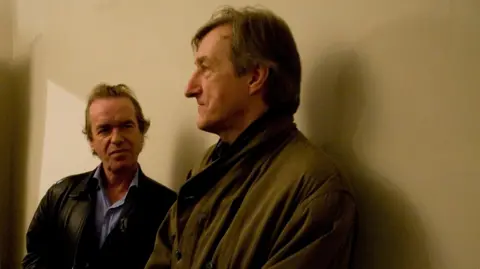 Dafydd Jones
Barnes says he doesn't regret falling out with Martin Amis after he dropped Barnes' wife, Pat Kavanagh as his agent
Famously, Barnes fell out with Amis, who he'd known since they worked together as journalists at the New Statesman in the 1970s, after Amis ditched Kavanagh as his agent. I ask if he regrets the disagreement. "No, not at all," is the firm response.
"He behaved deceitfully towards my wife... While you can forgive a hurt done to yourself, it's much harder to forgive a hurt done to someone you love. So our relationship didn't really entirely recover, but we got back a bit, towards the end of his life."
He is still good friends with McEwan, who rings him while we're filming in his study.
You're sitting with one of Britain's greatest living novelists, and another one happens to call!
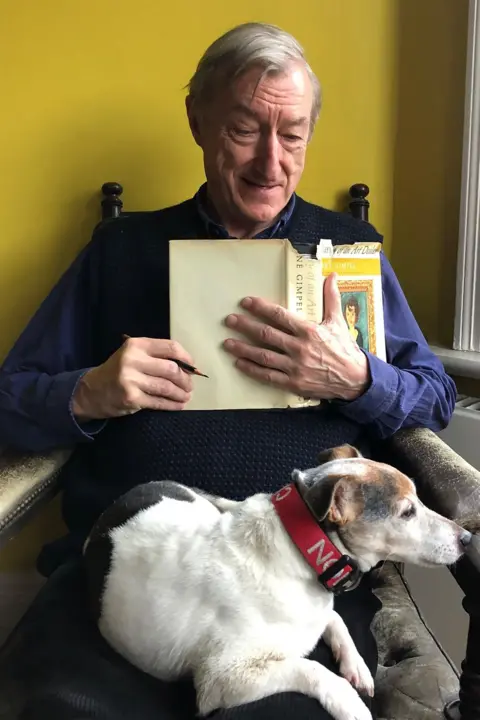 Julian Barnes
The author with his beloved Jack Russell, Jimmy, who features in Departure(s), and who died last year
Even though he is giving up publishing novels, Barnes will continue to write journalism, and tells me "I decline to be pessimistic about the future of the novel", referencing the new and diverse generations of writers being published.
He also backs efforts to ensure writers' works aren't scraped by artificial intelligence without being compensated.
Ahead of the interview, I'd asked an AI chatbot to write an opening paragraph in the style of Julian Barnes. It began:
"He had always believed that memory behaved like a courteous guest - arriving when invited, leaving when ignored - but lately it had begun to loiter, hands in pockets, humming tunelessly in the corners of his mind."
The real author describes it as a combination of plagiarism and banality.
"If I'd written that sentence, 'He'd always believed that memory behaved like a courteous guest', I'd stop there because all the stuff about 'loitering hands in pockets, humming tunelessly in the corners of his mind' is just crass".
Overall, he says the AI paragraph "doesn't make you laugh and it doesn't make you cry. It doesn't move you. It's just a pastiche.
"They need to have some sort of law which says you can't just scrape things and then publish it as an original work."
Analogue methods
Spending time in the company of a man who has been at the heart of British literary culture for nearly 50 years is balm for the soul.
I was first introduced to his writing in the early 1990s when I read A History of the World in 10½ Chapters and was beguiled by its playful retelling of events from unexpected perspectives - the story of Noah's Ark is told by a stowaway woodworm.
So it was a treat to be shown the notebook in which he began Departure(s), filled with his neat handwriting exploring creative ideas and potential dialogue as well as newspaper cuttings that sparked his imagination.
He has always started his novels in notebooks, he says, before typing a first draft on his trusted typewriter, then moving onto a computer.
 BBC/Roxanne Panthaki
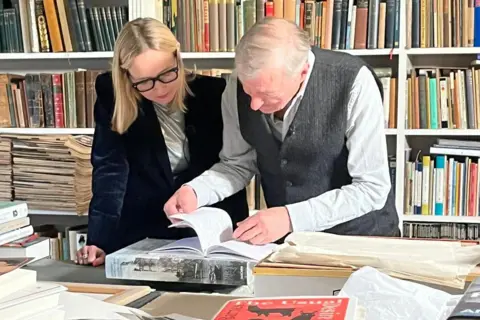
The author showing his very neat notes for his novel Departure (s) to Katie Razzall
I wonder why the book title Departure(s) has the "s" in brackets.
"Because there's one main departure, which is our departure from life, and then there are several others referred to in the books, which are departures from love and so on."
He tells me, with a smile, that "it's a slightly enigmatic, possibly annoying title, but I like it".
In fact, the title feels fitting. His departure is a literary moment.
"I shall miss you," he writes to his readers towards the end of the book. "Your presence has delighted me."
Departure(s) is published on 22 January.