3 months ago
53
3 months ago
53
It has been a long journey for Train Dreams. Following a gruelling pitching process and plenty of hesitation from studios, the ethereal period drama premiered at last year’s Sundance Film Festival where it was finally picked up by a behemoth streamer. From there, the small-scale independent movie picked up major steam, and now it’s about to arrive at its final stop: the Oscars.
“Train Dreams was made with no promise of a future,” says Joel Edgerton, the Australian star of the dreamlike film. “It was an independent film with no distribution, made with love and great care out in the forest in Washington without any sense of where it may end up … But then the wisdom at Netflix saw the power of the human story, as small as it may seem on an otherwise studio scale, and let it flourish. Now, it’s really touched and moved people. It has struck a chord.”
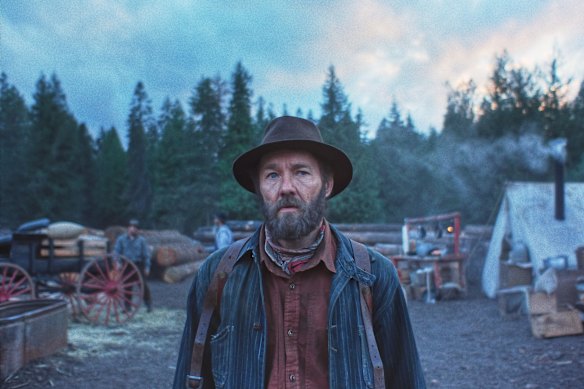
So powerful a chord has Train Dreams struck that it earned four Academy Award nominations (the results of which will be announced during the Oscars ceremony on Monday AEDT): best adapted screenplay, best cinematography, best original song (for Edgerton’s compatriot Nick Cave), and even best picture. This is especially impressive, Edgerton says, because of the current cinema landscape in which smaller movies find it increasingly difficult to secure an audience.
“We’re drifting into this unknown of how technology is going to further affect the business of human-made storytelling,” he says. “Yet, Train Dreams is now sat nestled among some really big-budget, studio-backed films. It’s a success story, whether it wins anything at the Oscars or not.”
Train Dreams′ journey may be coming to a natural end, but another of Edgerton’s projects is just starting to pick up speed. Like Train Dreams, his new film The Plague is also a deeply human art-house story. But that, Edgerton says, is where their similarities end.
Directed by Charlie Polinger and co-produced by Edgerton, The Plague follows a group of 12 and 13-year-old boys at a summer water polo camp in the US. When new boy Ben (Everett Blunck) arrives, he’s quickly told one of his fellow campers has “the plague”, a supposedly hyper-contagious condition that spreads via touch. The message is clear: alienate him like the rest of the group and Ben will be accepted; show him sympathy and Ben will reap the consequences.
What ensues is a toxic mess of psychological warfare, a pre-adolescent battle zone where arbitrary rules and competition reign supreme. Whether the plague is actually real, we’re never told, but it brings to life the never-ending conflict between social acceptance and personal ethics.
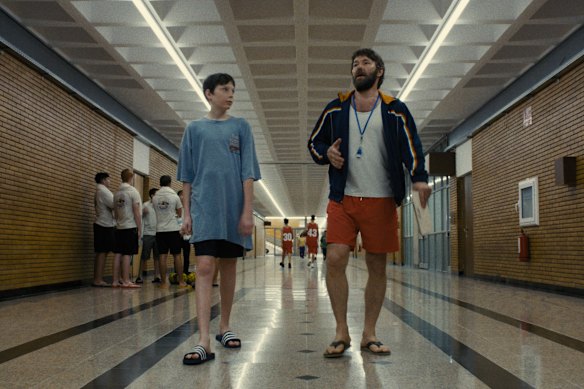
It’s essentially a modern-day Lord of the Flies, or perhaps an adolescent Full Metal Jacket, Edgerton says.
“Charlie, as a writer and director, really got to the heart of this idea that kids’ cruelty isn’t necessarily cruelty for the sake of cruelty. Kids’ cruelty comes from their own governed laws of entertainment and their reaction to boredom,” he says. “Beyond that, children create their own social structure, their own government and laws, and you can’t penetrate that as a grown-up. I found it, in equal measure, heartbreaking and very dangerous.”
Edgerton has explored similar themes before, such as in The Gift, a 2015 pyschological thriller that he directed and starred in. It focused on an adult couple reflecting on the bullying and secrets of their youth. In contrast, The Plague consists of an almost exclusively pre-teen cast. Edgerton is the only adult to appear on screen.

The Sydney-born actor played “Daddy Wags”, the well-intentioned water polo coach who attempts to guide Ben through the emotional and social minefield of puberty. Despite his efforts, his words ultimately ring hollow.
“I don’t know that grown-ups can really offer anything more than Band-Aid solutions to kids as they’re navigating the dangers of growing up and facing the world. We sort of just keep them alive and try to keep them safe, but all the rest of it is a bit out of our reach,” Edgerton says.
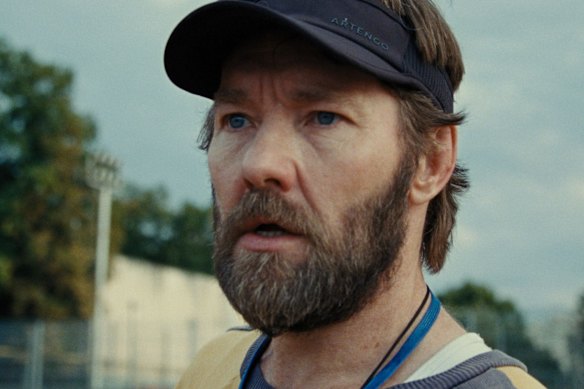
As a parent himself – he welcomed twin daughters in 2021 – he finds this utterly terrifying.
“Where are they going to end up when they’re old enough to go their own way and do their own thing? Right now, my kids are at an age where everywhere they are, one of us has got to be with them. But when [we get to the stage where we’re] sending them off to school – you could be like a baby antelope in your nature, or you could be like a ferocious animal, and you all go and drink from the same watering hole. You’ve got to be equipped to deal with the food chain. That’s how savage school can feel for some people.”
Edgerton is clearly not the only person to ruminate on these concerns. The terror and brutality of puberty, particularly for boys, seems to be front-and-centre, especially following the acclaimed Netflix series Adolescence, which explored the dangers of the “manosphere” for young, impressionable males. More recently there was Adolescence writer Jack Thorne’s take on Lord of the Flies.
It’s rich, potent material because of how unknown pre-teen life is for adults now, Edgerton says.
“There’s more we don’t know than things we do know. They’re on the front line of new technology, of their own understanding of behaviour. They’re on the front line of a new language we don’t understand, their own communication,” he says. “There’s this feeling of teenagers and adolescents … living on their own island that we can’t visit, and there’s something inherently dangerous about it because children are still capable of great violence and great damage.”
Children must learn the limits of the damage they can cause, Edgerton says. They do so by witnessing and participating in it, with many eventually learning to pull back. For others, however – like some in The Plague – they may choose to lean into, even delight in, this capacity to cause harm.
“They’re young men. There’s an unruliness and a danger to that,” he says.
Must-see movies, interviews and all the latest from the world of film delivered to your inbox. Sign up for our Screening Room newsletter.