3 months ago
24
3 months ago
24
We Bury the Dead is a zombie movie with a difference: if you want to see brains being eaten by a ravenous horde, you might need to look elsewhere.
“It’s a vegan-friendly film,” says Daisy Ridley, the English actress who shot to fame as Rey in the final trilogy of Star Wars films (and who is herself a vegan). “No people or animals were harmed.”
Well, that’s not strictly true. Plenty of both come to a grisly end in the sci-fi horror thriller from Australian director Zak Hilditch, a standalone feature that somehow also doubles as a sequel of sorts – or, perhaps more accurately, a companion piece – to his 2013 feature These Final Hours.
That film was all about a bunch of people awaiting the imminent wave of destruction about to make its way to Perth after an asteroid struck the other side of the planet. This one is about a small group of survivors working as a body retrieval unit after a secret American military device has been accidentally deployed off the coast of Tasmania, wiping out half a million people or so and anything else with a pulse.
(A small detail for the nerds: the ending of These Final Hours uncannily prefigures that of Rogue One, which was released three years later. Clearly, The Force is strong in Hilditch.)
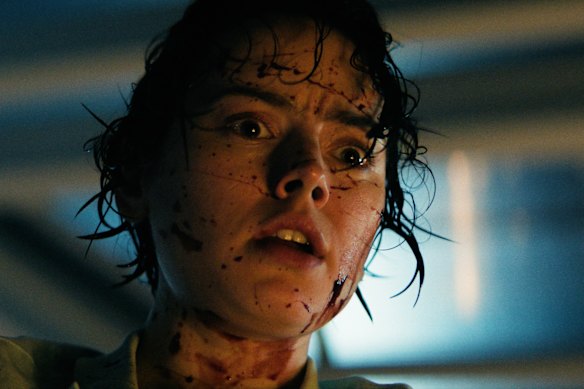
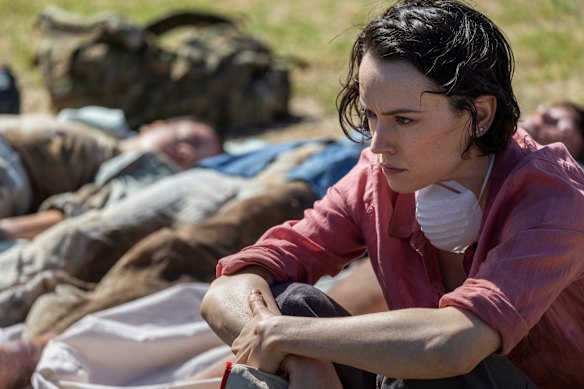
Ridley plays Ava, a physical therapist who signs on for the grisly task of scouring what’s left of the Apple Isle for corpses and, potentially, survivors in the faint hope that it might reunite her with her husband, who had headed south for a work trip.
His last known whereabouts is an eco resort, but in flashbacks we slowly realise the sense of desperation Ava feels isn’t just because she doesn’t know where he is. It’s because they parted on very rocky terms indeed.
“I call this a meditation on grief, the whole thing,” says Ridley. “The way out for Ava is through, and she’s on this physical journey of whether she’s going to find her husband or not, but she’s also reckoning with the grief of what might be about to meet her.”
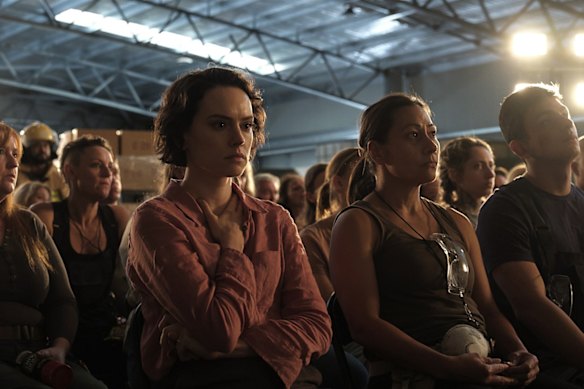
Ridley professes herself a fan of genre films, and zombie films in particular. “I went to see The Bone Temple last week,” she says. “Fantastic. It’s so good. Oh, my God.”
The beauty of the zombie genre is that the ghouls are empty vessels into which filmmakers can pour the meaning of their choice. In George A. Romero’s Living Dead franchise they are avatars of rabid consumerism, of the failure of the counter-culture, of the ravages of the Vietnam War. In World War Z they are a warning about messing with viruses. In The Last of Us they point to our cavalier approach to the environment. In The Walking Dead they are a means to explore tensions between democratic and authoritarian rule in society (a theme that, frankly, could hardly be more relevant right now).
In We Bury the Dead, the creatures who dot the landscape, frozen where they fell when the weapon known as The Pulse was detonated, like victims of an electronic Pompeii, before gradually coming back to half-life, stand for something else entirely.
“It’s this world of in-between that Ava also finds herself in,” says Ridley. “She is not a zombie, but she is between knowing and not knowing, and those zombies, she’s meeting them between here and somewhere else. So they’re really representative of her, and it feels like grief, but also goodbyes, the way we say goodbye and what we leave behind, and how we reckon with what we’ve done.
“She’s meeting these undead, but actually they feel strangely close to her in many ways,” she continues. “She’s reckoning with the grief of the marriage she thought she would have, the life she thought she would have with this man, and the terrible choice that she made in that marriage, and what do you do when you can’t have the conversation that you need to have.”
So, it’s a zombie film as a relationship drama?
“I would say it’s a relationship drama, yeah.”
For Hilditch, the story is deeply and surprisingly personal.
In 2017, he returned to his childhood home in Perth following his mother’s death. Moving from room to room, sorting through her personal effects and deciding what to do with them, “was kind of eerie”, he says. But at the same time “I was glad I had something physical to do like that because it really helped me get over the grief – well, not over it because you never really get over it, but through it.”
He felt there was something universal in that experience of a physical grappling with grief that could make for a piece of cinema. But he also knew he had to make it something other than what he had experienced.
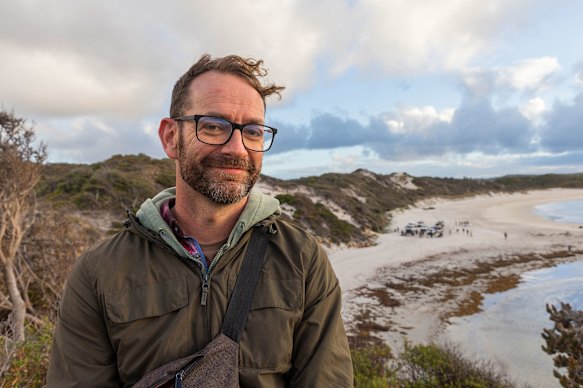
“I’m a very boring guy, so telling my Debbie Downer of a story about packing down my childhood home when my mum died, that’s not very interesting as a movie,” he says. “So I added the security blanket of the creation of an Ava, and a cataclysmic event on an island – these big, broad genre strokes that were the security blanket for me to explore the subject in a way I wanted to.”
In late 2019, he began working on the screenplay while living in Los Angeles with his filmmaker wife Alison James and their one-year-old son. But there wasn’t a single walker to be found in it.
“It was going to be a big American road movie, a cataclysmic event that took out many states and many millions died,” he says. “But the zombies weren’t there.”
When COVID cut the LA sojourn short and sent the family scampering back to WA, Hilditch began rethinking his movie.
“I toyed with the idea of New Zealand but ultimately Tasmania, half a million people, felt like a more realistic thing,” he says. The island state “felt like a very exotic thing”, in no small part because most of the world doesn’t even know where it is. “And it just felt more believable as an event that could, as crazy as it sounds, actually occur one day.”
He wrote draft after draft. And still there were no undead. “I was getting close to something, but there was an element missing, and it was the zombies,” he says. And then came the eureka moment.
“There was one day where I sat there and thought, ‘what if I did a version where some of them started coming back? But why were they coming back?’ And then this idea began overlapping with Ava’s very theme, and I thought ‘Oh, wow, what would that look like?’
“I was almost like an audience member watching my movie, playing with it in a way that I had maybe been too protective of,” he remembers. “I was now having a bit more fun with it, it wasn’t such a dour affair. It added real stakes, it added a bigger genre canvas, and it allowed me to explore this theme of unfinished business and grief in a way that I hadn’t seen coming – and if anything, it was reinforcing Ava’s journey in a way that was more exciting and interesting.”
Interesting enough, certainly, to capture the attention of Ridley.
“Daisy was the very first actress we identified for the part,” says Hilditch. “And within one week of sending it to her people I was Zooming Daisy, and she was saying she was all in.”
It was, he insists, a once-in-a-lifetime kismet moment.
“The most awful part of filmmaking is when you’re ready to go out, you feel confident, it’s time for all these rejections, or no one actually reading it when they said they were going to read it. You can spend years [in that state],” he says. “I’ve got projects that are like that right now. But she loved it, she knew exactly what I was trying to do on the page and was ready to go.”
Having her in place meant he and his producers could raise the budget (sub-$10 million, he says: “To this day, I’ve never made anything in the double digits, but one day. A boy can dream.” ) And it meant he had the centrepiece of the movie, an actor capable of sustaining it through action, reflection, terror and quiet moments of internal struggle.
“A lot of my job was just getting out of Daisy’s way because she’s such an absolute pro who is just living this experience,” says Hilditch. “Even in the quiet moments where she’s not even saying anything, there’s just something about her that draws you in. She absolutely knocks this one out of the park.”
Shooting the film in WA’s Albany (which doubles for Tasmania) was the first time Ridley has worked in Australia, but not the first time she has been here. Her husband, actor Tom Bateman, has made two movies in Australia (including Thai cave rescue drama Thirteen Lives for Ron Howard, on the Gold Coast), and she’s visited her sister, who lives in Melbourne, a couple of times.
And despite her experience working on three of the biggest films in history, it’s not her first time on a low-budget outing.
“I do not know the budget of things generally, but the first thing I did after the last Star Wars film [2019’s The Rise of Skywalker], we made for a million dollars, and I did know the budget because I was a producer on it,” she says.
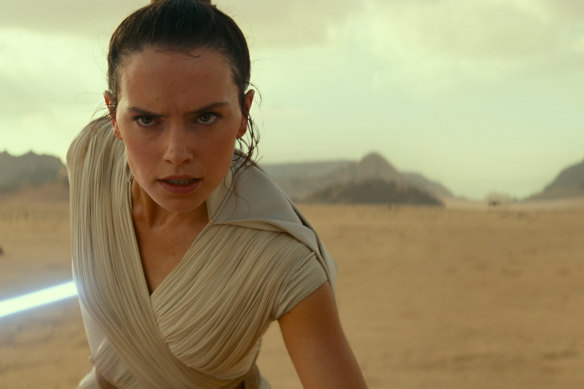
It was the script that attracted her, not the size of her trailer or the quality of the catering (though the food in Albany was, she insists, “absolutely amazing”). “I felt like I really got to explore lots of things with Ava,” she says.
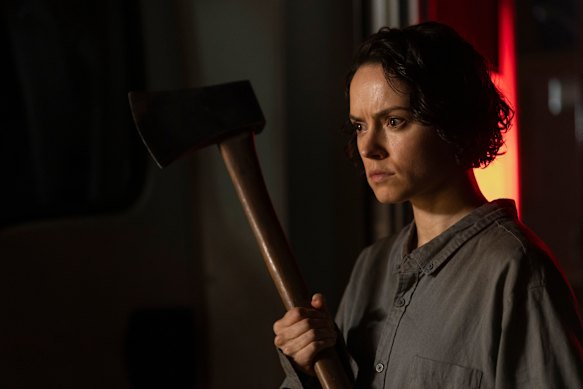
The character is tough and vulnerable, equally capable of wielding an axe against a walker and of moments of deep, quiet introspection. “Because what she’s doing in the body retrieval unit is a means to an end, it’s awful, but she has to become almost immune to what’s going on,” she says. “She’s just having to deal with the next thing, the next thing, the next thing, because she’s taking steps towards trying to find her husband. And then in amongst it, she is dealing with the desperate sadness she’s feeling.”
At any rate, big budget or small, once the actual job starts, it’s all pretty much the same.
“For the most part, film sets are full of people who absolutely love what they do, are obsessed with films and are all coming together under one [umbrella],” says Ridley. “We’re all bringing our own experiences into whatever it is the director is imagining the film will be.
“I find stepping onto a set amazing, regardless of the size or scale of it,” she adds. “It’s just the most wonderful place to be.”
We Bury the Dead is in cinemas from February 5.
Must-see movies, interviews and all the latest from the world of film delivered to your inbox. Sign up for our Screening Room newsletter.