
German leader condemns "renewed Iranian airstrikes" on UAE, says attacks on nuclear facilities threaten "entire region"
Germany's leader Chancellor Friedrich Merz issued a short statement Monday on behalf of the country's government condemning "renewed Iranian airstrikes against the United Arab Emirates and other partners," and calling on Tehran to "enter into serious negotiations with the USA, stop threatening its neighbors, and open the Strait of Hormuz without restrictions."
After a drone strike over the weekend that caused a fire at an Emirati nuclear power plant, which has not been claimed but widely blamed on Iran, Merz said any "attacks on nuclear facilities pose a threat to the safety of people throughout the entire region."
"There must be no further escalation of violence," he said.
Iran says it's pursuing peace "with seriousness," but if attacked again, "will respond with full strength"
Iranian Foreign Ministry spokesman Esmaeil Baqaei said Monday that Tehran is continuing to "pursue diplomacy with seriousness," but that the Islamic Republic "will not be subdued by contradictory behavior and threats from the opposing side."
"We are fully prepared for every scenario," he said, warning that, "in the event of any reckless action we will respond with full strength, and I assure you that our armed forces will definitely have new 'surprises' for the enemy."
Stocks slump, oil prices jump again as markets fear Iran war "re-escalation risks are increasing"
World shares mostly retreated and oil prices jumped Monday after President Trump warned Tehran the "clock is ticking" for a peace deal.
U.S. futures fell and markets in Japan and South Korea pulled back from their records. In early European trading, Britain's FTSE 100 edged up 0.1% to 10,205.31. France's CAC 40 lost 0.9% to 7,883.42, and Germany's DAX dropped 0.1% to 23,925.82.
During Asian trading, Tokyo's Nikkei 225 fell 1% to 60,815.95, a decline led by technology-related stocks. It reached all-time intraday high levels last week above 63,000.
Seoul's Kospi climbed 0.3% to 7,516.04 after trading lower earlier in the day. It crossed the 8,000 mark for the first time on Friday, supported by buying of technology shares driven by the boom in artificial intelligence, but later declined partly on profit-taking by investors.
Hong Kong's Hang Seng lost 1.1% to 25,675.18. The Shanghai Composite index edged 0.1% lower to 4,131.53, after China reported weaker-than-expected economic data for April.
Oil prices rose after Mr. Trump issued his latest warning to Iran in a social media post, saying the regime "better get moving, FAST, or there won't be anything left of them," following a call with Israeli Prime Minister Benjamin Netanyahu.
Brent crude, the international standard, gained 0.7% to $110.05 per barrel early Monday. It was trading at roughly $70 a barrel in late February before the start of the war. Benchmark U.S. crude was trading 1% higher to $106.49 per barrel.
A drone strike over the weekend on a United Arab Emirates' nuclear power plant added to worries over a potential escalation in the conflict.
ING commodities strategists Warren Patterson and Ewa Manthey wrote in a Monday research note that hopes as Mr. Trump visited Beijing last week that China might use its influence over Tehran to "break the deadlock between the U.S. and Iran," were "possibly misplaced."
"If anything, re-escalation risks are increasing," they wrote.
CBS/AP
Iran says it conveyed revised terms for peace deal to U.S., but no discussion yet "regarding nuclear matters"
Iran's government said Monday that indirect diplomacy with the U.S., brokered by Pakistani intermediaries, was "a continuous process" and that it had conveyed its latest positions to Washington as the two sides haggle over terms of a prospective peace deal.
President Trump warned Sunday that "the Clock is Ticking" for Tehran to accept a deal to reopen the Strait of Hormuz and end the war that is now in its 80th day.
"There won't be anything left of them" if Iranian leaders fail to "get moving, FAST" on a peace agreement, Mr. Trump warned.
"Talks and negotiations are a continuous process, not an intermittent one," Iranian Foreign Ministry spokesman Esmaeil Baqaei said Monday.
While Mr. Trump said publicly last week that Tehran's latest proposal had been rejected, Baqaei said Tehran "received from the Pakistani mediator a set of corrective notes and observations from their point of view … which were reviewed over these past days," and he said over the weekend, "our positions were also conveyed to the American side in return."
Baqaei insisted that the talks, from Tehran's standpoint, were focused "on ending the war," and the issue of Iran's "right to [nuclear] enrichment is recognized" as the country is a signatory of the international nuclear non-proliferation treaty.
"We have emphasized that we will not abandon our rights under the Non-Proliferation Treaty," he said. "We have not discussed any details regarding nuclear matters at this stage. At this stage, all focus will be on ending the war."
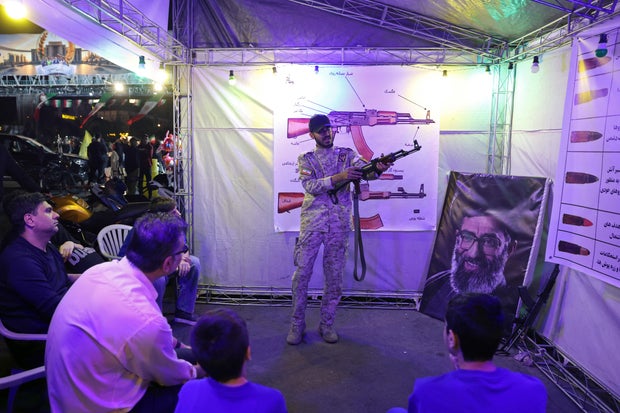 A member of Iran's armed forces teaches civilians how to use an assault rifle during a tutorial in a booth set up in Hafte Tir Square, in Tehran's central business district, May 17, 2026, amid the ongoing U.S.-Israeli war with Iran.
AFP via Getty
A member of Iran's armed forces teaches civilians how to use an assault rifle during a tutorial in a booth set up in Hafte Tir Square, in Tehran's central business district, May 17, 2026, amid the ongoing U.S.-Israeli war with Iran.
AFP via Getty
The Reuters news agency also quoted a Pakistani source as saying Monday that a revised Iranian proposal had been shared with U.S. representatives.
"We don't have much time," the source said, telling Reuters that both sides in the war, "keep changing their goalposts."
Lebanon says Israeli strikes kill 5, including 2 children, as Hezbollah condemns talks
Israeli strikes killed five people including two children in southern Lebanon on Sunday, the Lebanese health ministry said, as Hezbollah called U.S.-brokered talks between the two countries a "dead end."
The Lebanese health ministry published a "preliminary toll" for Israel's strikes on Sunday, with three people killed in the town of Tayr Felsay, including a child, and two killed in the town of Tayr Debba, including another child.
It said 11 people were wounded in those strikes and four more were wounded in strikes in two other southern towns.
The latest exchanges of fire came after envoys from Israel and Lebanon held a third round of negotiations in Washington and agreed to extend the ceasefire, talks that Iran-backed Hezbollah has repeatedly denounced.
"The direct negotiations that the authorities in Lebanon have conducted with the Israeli enemy have ... led them down a dead-end path that will result in nothing but one concession after another," Hezbollah lawmaker Hussein Hajj Hassan said on Sunday.
Trump says "Clock is Ticking" for Iran to agree to a peace deal
President Trump threatened Iran again Sunday as the shaky ceasefire between the two countries continues.
"For Iran, the Clock is Ticking, and they better get moving, FAST, or there won't be anything left of them. TIME IS OF THE ESSENCE!" Mr. Trump wrote on Truth Social.
Screenshots of the post were also shared by the official White House X account.
Iranian foreign minister Abbas Araghchi said Friday that Tehran "cannot trust the Americans at all" and that they are "trying to maintain" the "shaky" ceasefire "to give diplomacy a chance." He described the lack of trust in the U.S. as "the main obstacle to any diplomatic effort."
"Every day brings a different message, sometimes even two different messages in a single day, which deepens mistrust," Aragachi said while speaking at a summit in New Delhi.
Uprising inside Iran still unlikely, former U.S. defense secretary says
Former Defense Secretary Robert Gates said that despite the war in Iran, internal controls in the country "seem very much intact," making it unlikely that a civilian uprising will occur in the near future.
Intense protests related to economic issues broke out in Iran in early 2026, but were harshly quelled. President Trump said tens of thousands of people were killed by the regime. Alleged leaders of those protests have been imprisoned or executed. While Mr. Trump called on the Iranian population to rise up and overthrow its leaders in the early days of Operation Epic Fury, no such efforts have emerged.
"You haven't seen any demonstrations, or very few demonstrations, in the street. People are cowed, they're afraid, and right now they're concerned with how they can eat and live under the current circumstances," Gates said on "Face the Nation with Margaret Brennan."
In an interview that taped Friday and aired Sunday, Gates said that it is possible an uprising will occur after the war ends, but said that protests likely won't lead to regime change.
"What you generally see in regimes like this is not so much a change of regime from the streets, but that the regime itself begins to fracture, and that you have people within the regime who want to take a different tack, and so you have an internal fight for control," Gates said.
Former U.S. defense secretary says U.S. can't "walk away" from Iran war
While diplomatic and military efforts in Iran and the Strait of Hormuz seem to be at a stalemate, the United States can't "walk away" from the conflict, former U.S. Defense Secretary Robert Gates said Sunday.
"I don't think he can walk away," Gates said on "Face the Nation with Margaret Brennan," referring to President Trump. "And no, I don't think the Israelis can settle it. As powerful as they are, they don't have the kind of power the United States has."
In an interview that was taped Friday and aired Sunday, Gates said that while the Trump administration's justifications for the war have shifted, there are a few things "that have been consistent from the very beginning." One main objective, of eliminating Iran's nuclear program, has not been fully achieved, but U.S. and Israeli attacks have "dramatically damaged and set back" the country's efforts to acquire a nuclear weapon, Gates said.
"I don't think that the nuclear program in Iran poses an imminent threat. After all, we bombed it twice," said Gates, who served under former presidents Bush and Obama. Nuclear material has been buried, he said, and the centrifuges that would be needed to enrich it have been "mostly destroyed."
Gates also said that scientists who would have worked on these nuclear projects have been killed. Still, Gates said that likely the only way to completely "bring an end to" Iran's nuclear aspirations "is through a negotiation."
Other stated goals, like eliminating Iran's military capabilities and its ability to support militant groups like Hamas and Hezbollah, have been more successful, Gates said. Still, the Trump administration had "some unrealistic expectations" for when the war might end, Gates said.
"I think it would be hard to say the war is over, I think from either the standpoint of the United States or Israel at this point," Gates said.
Suspicion falls on Iran after drone strike causes fire at UAE nuclear power plant
A drone strike targeted the United Arab Emirates' Barakah nuclear power plant Sunday, setting an electrical generator ablaze on its perimeter and again straining the shaky ceasefire in the Iran war.
No one immediately claimed responsibility for the attack, which caused no radiological release nor injuries, authorities in the UAE's capital, Abu Dhabi, said. However, suspicion immediately fell on Iran, which has been increasingly threatening the UAE over recent days as the country hosted Israeli Iron Dome missile defenses and troops during the war.
The UAE's nuclear regulator said the fire didn't impact the plant safety. "All units are operating as normal," the organization wrote on X.
The UAE statement didn't blame any party for the attack. The Vienna-based International Atomic Energy Agency, the United Nations' nuclear watchdog, said on social media it was "following the situation closely."
The $20 billion Barakah nuclear power plant was built by the UAE with the help of South Korea and went online in 2020. It's the first and only nuclear power plant on the Arabian Peninsula and can provide a quarter of all the energy needs in the UAE. It's also the first commercial nuclear power plant in the Arab world.

















































