
 2 months ago
98
2 months ago
98
For decades, the “tuk-tuk” noise of three-wheeled taxis and vans weaving through Asia’s hazy megacities and bustling towns has been central to their character. It’s a sound so distinctive that it became a nickname for the vehicles themselves. But now a quiet revolution is underway across the developing world: the noisy gas-guzzlers are turning electric.
While Europe and the US have focused on cars, there’s been a big shift in little vehicles across South and South-East Asia. Tuk-tuks or rickshaws, the backbone of the transport system in many areas, are increasingly powered by batteries instead of hydrocarbons. It’s the same with motorbikes.
It’s a gear-change driven by falling manufacturing costs and concerns over energy supply chains – fears which have only risen since the war in Iran. But it also has the potential to transform some of the world’s most polluted cities, from Delhi and Dhaka to Bangkok and Hanoi. Where now there is smog, soon there could be clean air.
“The market is booming now, a decade after it emerged,” says Sunitha Anup, a researcher at the International Council on Clean Transportation. “Climate change is a secondary reason for the shift – the first is cost.”
Nowhere is the change more obvious than on India’s chaotic roads, where rickshaw taxis, rickshaw cargo trucks and even rickshaw waste collectors are ubiquitous. It’s in the vanguard of the so-called “joule economy”.
Globally, around a quarter of three-wheeled vehicles sold in 2025 were battery-powered. But in India this figure hit almost 70 per cent, according to a recent report from the International Energy Agency, up from 20 per cent in 2020. Established manufacturers, ambitious start-ups, policy-makers and everyday consumers are all embracing electric.
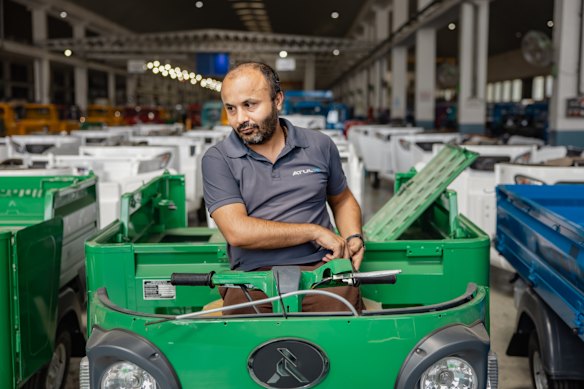
In a factory just off a dusty highway in the western state of Gujarat, Atul Auto’s production line is among those featuring new tuk-tuk models powered by batteries instead of diesel or compressed natural gas (CNG). The Atul Rik Twin is a white three-wheeler with blue accents, considered a “premium” model; the Rik Twin costs roughly 3.7 lakh (about $5600).
“This can go from zero to 30 kilometres per hour in eight seconds, the acceleration is really quite good,” says Divya Chandra, the director of Atul Greentech, a subsidiary of the legacy manufacturer created in 2020 to focus on electric rickshaws.
The vehicle is an update on Atul’s first lithium-battery rickshaw, which launched in 2023. According to a glossy promotional pack, it has a range of 220 kilometres per charge, up from 110 kilometres. It can carry 350 kilograms and has a maximum speed of 45 kilometres per hour.
It’s the sound, rather than the speed or sharp -corners, that marks out the Atul Rik Twin from traditional tuk-tuks. The EV is eerily quiet. The rhythmic “tuk-tuk-tuk-tuk”, which gave name to the three-wheelers in parts of South-East Asia, is gone.
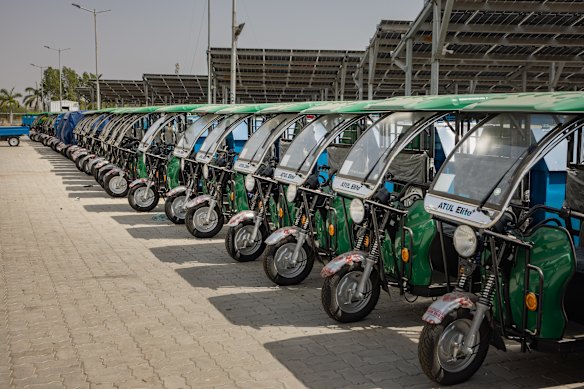
It makes sense that India’s electric road revolution is being fuelled by smaller vehicles like this. As countries develop, there’s a standard shift in the “mobility ladder” from walking to motorbikes to cars – and India, like many developing economies, is still dominated by two- and three-wheelers.
“The Asian market is more about two- and three-wheelers, and less about four,” says Rahul Maity, an EV consultant at JMK Research & Analytics, based in Delhi. “I think because of that, in Asian countries it’s easier to turn electric. The upfront vehicle price becomes very massive for a car, but you don’t have to invest so much for two- and three-wheelers.”
In India, a battery-powered rickshaw costs between $1900 and $6600 depending on the model and technology. In all, 2.3 million EVs were sold in the country in 2025, and 92 per cent of these were mopeds and rickshaws – the workhorses of India’s transport -system for both people and goods.
While the transition has the potential to help tackle the smog choking many of the country’s cities, at its core it “is all about economics”, says Tushar Gandhi, convenor of the India Battery Swapping Association. “When it comes to movement in India, economics takes centre stage, then the environment.”
In the past five years, he adds, battery costs have fallen so that the total cost of running an electric vehicle is cheaper than running a CNG or petrol rickshaw. Atul, for instance, estimates that it costs just 0.50 rupees (less than one cent) per kilometre to recharge one of their electric three-wheelers, compared to 2.50 rupees (about four cents) for petrol. “Nothing can be a lower [price] than electric,” says Chandra. “The total cost of ownership is unbeatable with the electric vehicles, and if you see the rising fuel prices and big queues at gas stations these days – that has pushed interest higher.”
Charging infrastructure has improved, too. Although drivers can charge batteries via a three-pin plug at home, fast-chargers are popping up across major cities – where quick commerce apps are also buying fleets of electric vehicles for deliveries.
Delhi, Mumbai and Bangalore have also seen a boom in battery swapping schemes, with some 3500 sites where drivers can drop off one battery and pick up a fully charged replacement. This also reduces the upfront cost of rickshaws, as the drivers technically do not own the battery, which is the most expensive part of the vehicle.
“Still, the upfront cost parity has still not been reached,” says Anup. “Many people still find it expensive to buy an electric model compared to a CNG or petrol model, so subsidies remain important.”
The government is pushing uptake – not because of the smog choking cities including Delhi and Mumbai, but amid concerns about India’s heavy dependence on fuel imports. More than 85 per cent of crude oil and roughly 50 per cent of liquified natural gas (LNG) comes from abroad, and the country has been hit hard by the closure of the Strait of Hormuz. So hard that it has placed export restrictions on sugar so that it can be used to create fuel.
“There was the pandemic, and now [fuel costs] have become a major issue since the war broke out [in Iran],” said Gandhi.
The drive to electric in India was initially messy, dominated by small manufacturers importing low-quality, ready to assemble kits from China that were not street-legal. That all changed in 2015, when the national parliament legalised battery-powered rickshaws. A spate of policy incentives to boost uptake has followed: showroom discounts and tax holidays, as well as government -investment in fast-charging stations and a push to electrify state-owned transport fleets such as buses.
But there’s also been a strong focus on domestic manufacturing, as part of PM Narendra Modi’s flagship Make In India campaign, including cashback schemes for factories building components in India and high import duties on fully assembled EVs from overseas.
“There have been incentives designed to help the overall EV ecosystem since 2015,” says Maity. “But the government updated the flagship FAME scheme [to boost electric vehicle supply] in 2019, and since then, EV adoption has escalated very much.”
As well as start-ups such as Euler Motors, YC Electric and Kinetic Green, which focus solely on -electric, legacy companies including Bajaj Auto, Piaggio Vehicles and Mahindra & Mahindra have turned to battery-powered rickshaws.
“Now we see quite a healthy competition, with -increased players,” says Maity. “The market is very huge, so I don’t think there will be one particular [company] who will dominate.”
This thriving ecosystem extends far beyond India. According to the latest report from the International Energy Agency, the switch to electric vehicles accelerated last year – especially in emerging markets, which have the potential to leapfrog the West in electrification. Sales in 2025 doubled across South-East Asia, where Chinese brands largely dominate. In countries including Thailand, Indonesia and Malaysia, more than 75 per cent of sales are from companies such as BYD and Wuling.
The exception is Vietnam, where domestic companies including VinFast and Pega are surging. The electric motorbike market saw sales doubling to around 735,000 in 2025, and plans for low-emission zones in Hanoi and Ho Chi Minh City are likely to push more consumers to switch.
‘Big investors have a commitment to make the earth green with EVs … they’re making the balance sheet green.’
Divya Chandra, director of Atul GreentechElsewhere, electric car sales jumped by 75 per cent across Latin America and 40 per cent in the Middle East. In Africa the market is smaller, but electric motorbike sales have exploded from fewer than 1000 at the start of the decade to roughly 70,000 in 2025 – with Uganda and Kenya seeing the most rapid growth.
“We can now conclude with near absolute certainty that the electrification of transport is unstoppable and will happen even faster than earlier expected,” Ambrose Evans-Pritchard, the UK Telegraph’s international business editor, wrote in early June.
Atul Auto is among the traditional companies embracing change in India, with roughly a third of the 38,000 rickshaws it sold last year electric. A mid-sized player nationally, it is by far the largest manufacturer in Gujarat – an arid, business-friendly state where both Mahatma Gandhi and PM Modi were born.
“In 2018, it got to the point with government announcements that we thought, for our existence as a company, we had to have electric vehicles because they were pushing so hard,” Atul Greentech’s Chandra says ahead of a tour of the factory floor – a chaotic whirr of clashing metal, welding sparks and paint fumes. “But it wasn’t until 2020 that we decided to focus on making EVs, as the battery prices had reduced and supply chains were more stable.”
Like most of the world, the company still imports its lithium-ion cells and semi-conductors from China – when I visit, Chandra is fresh from an enormous battery expo that had more than 350,000 attendees in Shenzhen. This element of the supply chain is his biggest concern. “It brings a lot of complexity to the supply chain and pricing, especially as geopolitical situations keep changing country’s relationships in a way that impacts global trade,” he says.
The other challenge is “typically Indian”: ensuring the products can withstand punishing heat, monsoon rains, being overpacked with people – and surges in the power grid.
Still, Chandra envisages a future where 100 per cent of Atul Auto’s rickshaws are electric.
“Big investors have a commitment to make the earth green with EVs – I’m not sure if they’re making the earth green, but they’re making the balance sheet green, that’s for sure,” he says, laughing as the air-con works hard to cool his small office. Temperatures outside have just surpassed 40 degrees.
“India is the largest three-wheeler market in the world,” he adds. “I would say the future is not bright, but extra bright. It’s so bright you cannot see it!”
This is an edited extract of a story first published in The Telegraph (UK).
Read more from Good Weekend:
- Elijah was 10 when his friend typed ‘porn’ into a search engine. He was afraid – but unable to look away
- Melbourne is poised to become our biggest, most liveable city. (Just don’t mention debt. Or crime)
- How Luke Bateman became Australia’s most unlikely book influencer
- Socceroos’ secret weapon no more: The explosive rise of Nestory Irankunda
Get the best of Good Weekend delivered to your inbox every Saturday morning. Sign up for our newsletter.

















































