
 4 months ago
72
4 months ago
72
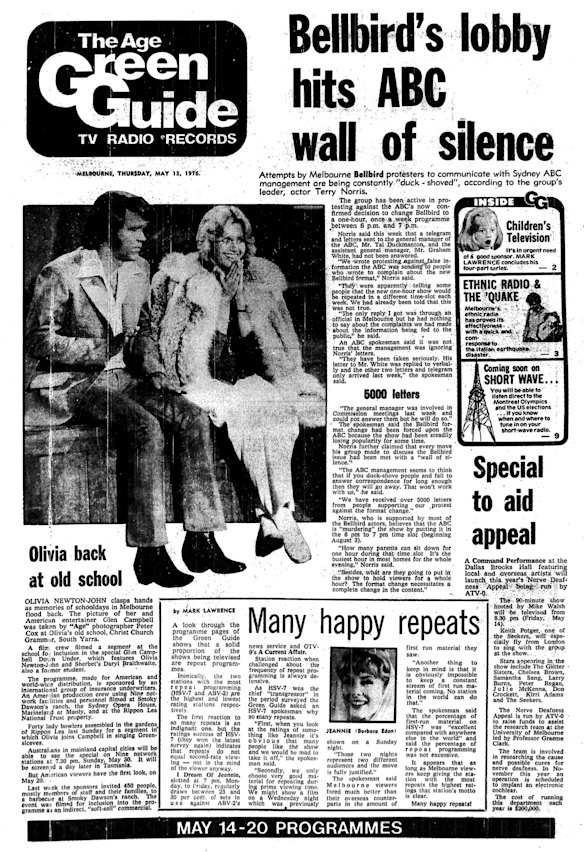
It launched on Thursday, May 13, 1976, a banner on the front page of The Age announcing “the bigger lift-out TV-radio green guide gives you news, reviews, record notes and an easy-to-read guide to ALL TV and radio programmes.” It was a slender 16-page section, heavy with ads for hi-fi equipment.
One of the cover stories reported on protests to the ABC’s Sydney management about proposed changes to the popular local drama, Bellbird. And, back then, “ALL” the TV programs meant daily listings for the four free-to-air channels – SBS TV didn’t appear until 1980 – which all shut down for the night before or soon after midnight.
In those days, households customarily gathered around a single TV set in a loungeroom, debating over whether they’d watch shows such as Countdown, M*A*S*H, and Starsky and Hutch. Parents tried to get the kids to bed before the racy antics on Number 96.
Everything was “appointment viewing” and had to be watched as it went to air: miss it and it was gone, unless you happened to stumble on a repeat. Video recorders started to trickle into homes in the late ’70s, but widespread adoption didn’t take hold until the early ’80s. Pay-TV, with its liberating recording options, didn’t arrive until 1995; streaming was a concept so remote they that it might’ve seemed more appropriate for a fanciful sequence on the futuristic kids’ cartoon The Jetsons. Netflix didn’t lead the charge on that revolution until 2015.
The Age’s new stand-alone section was coloured green for easy identification and could be readily removed from the paper to save for reference through the week. And it became an institution, a familiar feature on thousands of coffee tables. It set the agenda for the week’s viewing and listening, whether you happened to agree with the assessments of its writers or not. Many didn’t and they had no hesitation about expressing their views, along with a myriad of other opinions about TV and radio, in the robust forum that became the Letters column.
Full disclosure: My initial professional association with GG came through my employment at a rival camp. In the late ’80s, I edited the Gold Guide, a Monday TV and radio liftout in The Herald, now a long-defunct afternoon paper published on the other side of Melbourne’s CBD from The Age. Despite the grand name, it was yellow and proved a short-lived stab at grabbing some of GG’s glory in terms of readership, industry clout and advertising dollars.
Green Guide, which in its prime ballooned to more than 40 pages, was the heavyweight in this arena, a force in its field that had earned a devoted following, boosting Thursday’s sales to the paper’s second strongest of the week after Saturday.
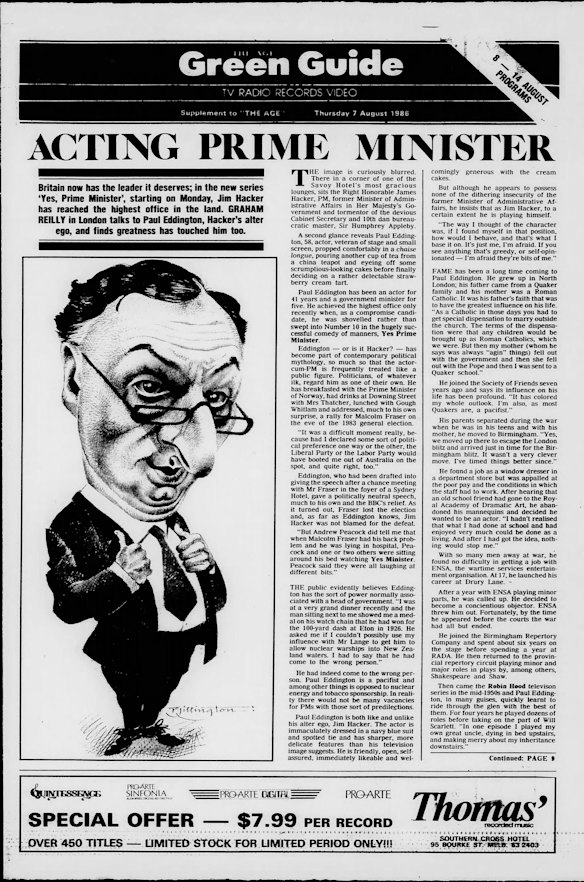
My Gold Guide fling enabled me to see how comprehensively Green Guide covered its terrain. Later, through the vagaries of a career in the media – with newspapers launching, merging and expiring, and sections being introduced with great fanfare only to be quietly abandoned – I joined Green Guide as an editor and staff writer.
Not something that, as an avid TV watcher through my student days, I’d ever anticipated. Ironically, my parents fretted that the considerable time their daughter spent glued to the telly would lead to nothing productive.
Reading the Green Guide was a weekly ritual. I’d begin with the TV previews, a compact spread focusing on one show each day, then dutifully mark the notables on the daily listing so they wouldn’t be missed. The listings would also detail the drawcard Sunday night movies and the midday movies, a weekday treat presented by Ivan Hutchinson.
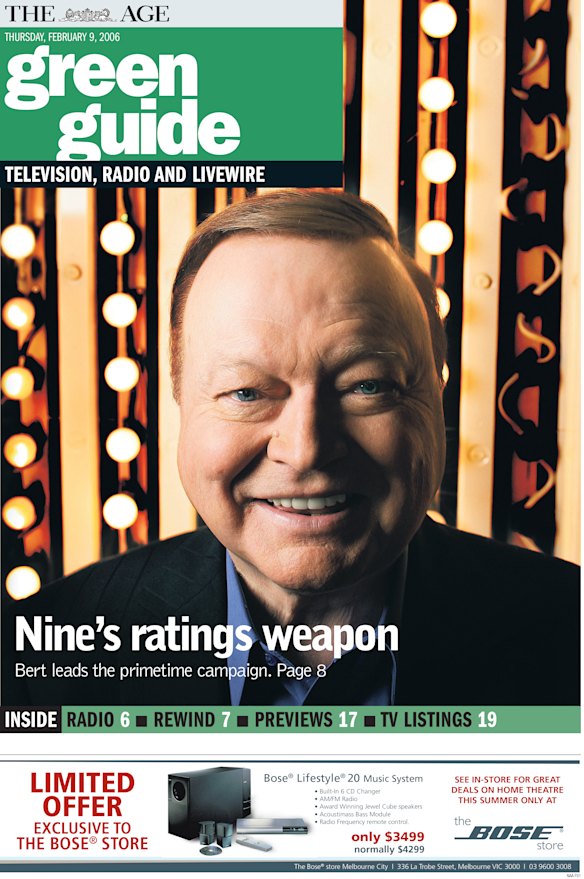
The cover stories and feature articles about TV and radio offered a catalogue and a pulse of the times. Profiles of personalities including Jana Wendt, Bert Newton, Lisa McCune and Ray Martin. Reports on local and imported series from Bodyline, Blue Heeelers, The Comedy Company and Kath & Kim to The Simpsons, Seinfeld and The Bill. Accounts of industry trends and events, like the breakfast battle between Today and Sunrise, and the challenges facing kids’ TV.
Then came the columns. Newsy ones about behind-the-scenes industry activities and scuttlebutt, at various times titled GG Teletopics, Out of View and Networking. Reflective assessments on past viewing with titles such as Medium Cool and Rewind, forerunners of today’s Hindsight. A Ratings report surveyed the tussles on free-TV at a time when such contests were of significant concern to the industry and readers. Record – and later CD – reviews covered pop and rock as well as jazz, opera and classical releases.
There was a hardware section, at one stage appearing as the liftout Livewire, geared toward consumer goods – cameras, turntables and later computers – and featuring information about new releases, groovy gadgets and reviews.
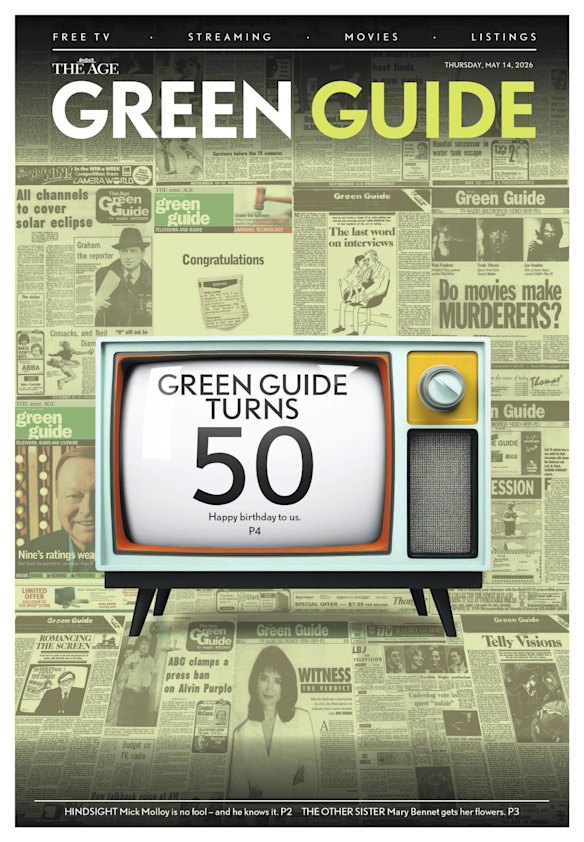
Happy birthday Green Guide!
When I first came to Melbourne to make it big in TV, my dream was to be mentioned in the Green Guide. A letter, a review, something. Anything. My early appearances in Jimeoin’s TV show and Full Frontal on Channel Seven got me nothing. Then I got my own series called The Micallef P(r)ogram(me) on the ABC and got a few reviews. Nice ones, too. Then some letters. Many favourable. Then I hit the big time with my own chat show, Micallef Tonight, on Channel Nine. I got a cover. I’d made it. This was it. The big time! Then the show got axed after only 13 episodes and I didn’t work again for two years. I have never trusted the Green Guide since. Shaun Micallef
I remember my first “cover” in the Green Guide. It was me sitting on Sam Newman’s shoulders taking a “mark” at the MCG. To me, it meant The Footy Show had made it. Dr Hook might have wanted to be on the cover of Rolling Stone, but in Melbourne media it was the cover of the Green Guide! Eddie McGuire
I used to love reading the letters of viewers that didn’t get what I was doing on Hard Quiz. I remember one writer complained that the host of Hard Quiz was constantly rude to the contestants and should be replaced by someone nice like Sammy J. I suspect Sammy J wrote the letter. Tom Gleeson
And there was the phenomenon of the Letters page, reflecting just how enthusiastically readers engaged with TV and radio, as well as with the GG itself. For decades, letters came via snail-mail, many handwritten, some personally delivered to the newspaper’s ground-floor reception desk.
The letter writers were dedicated – some might say blinkered – in their devotion to the ABC and SBS. Grammar and style eagles, they were poised to swoop on lax language or lazy – or, heaven forbid, Americanised – pronunciation. A change in a presenter’s – particularly a female presenter’s – hairstyle, or an unusual wardrobe choice, wouldn’t escape often-stern assessment.
GG readers were vocal about the frequency and intrusiveness of ad breaks, the unwelcome incursion of ads on to SBS, and the commercial channels’ practice of running programs later than scheduled. Another persistent bugbear was that some prized imports, such as The Sopranos and Buffy the Vampire Slayer, were erratically scheduled and dumped in late-night slots, only to vanish mid-season without explanation.
The letters offer a revealing account of viewer frustration with network practices, the “managed dissatisfaction” that Netflix founder Ted Sarandos identified when he saw the potential for his service.
Over the decades, radio receded in prominence, its program listings diminishing until they were brief and basically unreadable. Eventually, as radio stations started promoting their wares on their websites, GG’s listings disappeared entirely.
It’s a cliché to say that times have changed, but clichés become clichés because they hold some truth. Over the last half century, the TV landscape has dramatically expanded from four free channels that ceased transmission around midnight. It’s undergone seismic shifts, with everything from the influx of “infotainment” and reality TV to the arrival of subscription services and streamers.
Times have changed and so has the Green Guide, but it lives on and cheers to that. Happy 50th, Green Guide. If this was a wedding anniversary, it would be golden.

















































