3 months ago
29
3 months ago
29
With record crowds at the Australian Open year-on-year, how does the juggernaut keep growing – and going?
We spoke to the brains behind the tournament’s evolution from international sporting event to a happy marriage of tennis, socialising, celebration and food to find out.
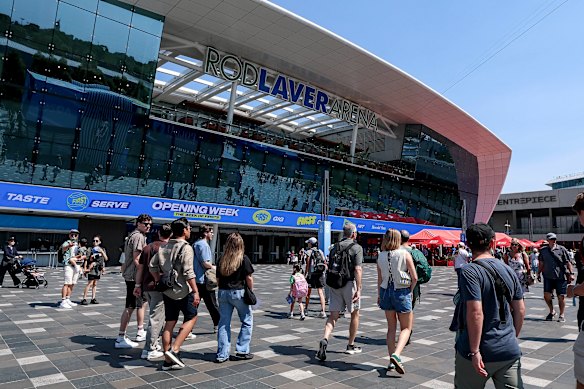
Tennis fans roam outside Rod Laver Arena on the first day of Opening Week at the 2026 Australian Open.Credit: Eddie Jim
Who looks after the tournament’s social media?
Brie Stewart, director of content, leads a team of 50 social media professionals who look after the Australian Open’s social media accounts – the posts you see on Instagram, TikTok and X.
“Every year, you have to throw the plan out,” she says.
“The event actually guides the plan.”
The team builds working relationships with players from the very top of the rankings, to wildcards and qualifiers, meeting them at other grand slams and tournaments such as the United Cup and Brisbane International.
“Our job is to make people fall in love with their personalities, as much as it is to fall in love with their tennis … they’re really quite comfortable [on camera].”
Loading
With a singles main draw of more than 250 matches across 15 days, after an opening week of 224 qualifying matches, plus doubles and wheelchair matches, the team divides and conquers to capture, for instance, Jannik Sinner and Holger Rune’s breathtaking 37-shot rally; an on-court proposal to Roger Federer; an umpire asking Novak Djokovic and Carlos Alcaraz fans to pipe down; or Alexander Zverev crashing out when an umpire called a let after a feather flew on court.
Then there are the media events, fan reactions, and sprinkles of celebrity-spotting. Remember Benson Boone cosplaying as an Australian Open staff member? Learner Tien’s celebratory pizza after defeating Daniil Medvedev? Or the astonished faces of Jackie Chan, Liam Hemsworth, and K-pop stars Mark Lee, of NCT, and Sana Minatozaki of TWICE?
It was Stewart’s team who put them on your feed.
Who brought Shake Shack to Australia?
Every grand slam has a signature taste: strawberries and cream at Wimbledon, the Honey Deuce cocktail at the US Open.
According to Fern Barrett, head of product growth and innovation, it’s the Peach Melbourne ice cream and Lemon Ace cocktail for the Australian Open.
“Obviously, yellow means ‘happy’,” says Barrett of the Lemon Ace, a nod to retired superstar Roger Federer’s “Happy Slam” nickname for the tournament.
“Last year, we sold over 100,000 of these. And I think this year, with hopefully record crowds again, we’ll see that even continue to grow.”
Barrett has been curating the culinary line-up for Australian Opens since 2020, and she emphasises the importance of not only catering to a range of budgets and taste buds, but also offering distinctive vibes in each area at the precinct.
Think deck chairs and “relaxed food offerings” at Garden Square, the debut of Shake Shack at the youth-centric TOPCOURT, or “an epicentre” to “have a bit of a party” at Grand Slam Oval.
Who looks after the tournament’s trophies?
“We had to keep it a massive secret not just from Ash [Barty], but from her team as well … It was one of those iconic Australian Open moments,” says Ross La Rosa, head of precinct operations, looking back on the moment Evonne Goolagong Cawley surprised Barty at her 2022 victory.
La Rosa’s team works behind the scenes on some of the Australian Open’s most defining on-court moments, but safety is always at the top of his mind.
Working across security, accreditation, traffic management, and coordinating with law enforcement and police (the Australian Open breaks its own crowd records every year), opening week is also the busiest week for security – and visitors and players aren’t the only group they look after.
“Both Norman and Daphne are … quite busy,” La Rosa says of the tournament’s men’s and women’s trophies. “They’re very historical, very delicate. And we want to make sure they last for many, many more years.”
Who decides the VIP list at the Australian Open?
Like many young tennis fans, when public relations consultant Luke Dennehy was a child he wanted to be a ball kid. But he “couldn’t throw”.
Before becoming a familiar face among the Australian Open’s VIP guests, Dennehy’s 30-year journey at the tournament began with a scoreboard operator gig at 16, and later writing down match results on a whiteboard in the media centre.
“I used to get them wrong because they actually weren’t digital,” he admitted.
Fast forward past a 17-year run covering tennis as a journalist, he’s back at the Open with a few celebrity memories. As part of his job hosting the tournament’s VIPs, he escorted Tyra Banks through the “walk of champions”, catered to Elle Macpherson’s love for a “detailed runsheet”, was kissed on the cheek by Rebel Wilson and has a bottle of wine from Will Ferrell.
More recently, he escorted celebrities such as AFL star Bailey Smith on his way to the 2026 one-point slam this week.
Over the years, though, he’s noticed a growing emphasis on celebrities with big followings. The VIP list he curates, sometimes in coordination with the tournament’s partner brands, has branched out from Western celebrities to include influencers and international celebrities.
And this year, he hopes Taylor Swift and Travis Kelce are on it.
Who leads and looks after the chair umpires?
Cheryl Jenkins was the first female chief umpire at the Australian Open (and third internationally), and hasn’t spent a year away from the tournament since 1993.
Hailing from a family of umpires (her father, two older brothers, and sister were umpires), she was a ball kid, and played a bit of tennis – “at least, grade 9 school champion”.
Leading the tournament’s chair umpires is no easy feat. For about a month, her team of chair umpires often make tough calls on court, and face public scrutiny – but Jenkins says there’s a culture of looking after each other, and looking after themselves.
“We’re actually a bit lucky in Australia that, come our middle weekend of the Australian Open, we actually bring down a sports psychologist that’s available to all our officials.”
She hopes to set an example for women who want to do it all.
“When I came into the role [of chief umpire], my children were still quite young … Yes, we can do this. We can juggle motherhood, we can juggle working and travelling,” Jenkins says.
News, results and expert analysis from the weekend of sport are sent every Monday. Sign up for our Sport newsletter.