3 months ago
31
3 months ago
31
It looks like you, it sounds like you, it moves like you. And it can get you your degree
On the screen, it looks just like you. It has your looks, your voice and even your mannerisms. But it’s not you; it’s an AI deepfake created to undertake exams, tutorials and other course requirements before you – the real you – are awarded your degree.
This is of major concern for universities, particularly for degrees done remotely, says the lead author of a newly released briefing paper on fully online degrees.
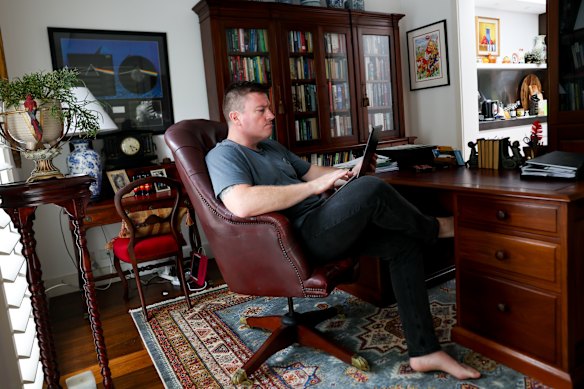
Ryan Morony, 42, says studying online was “quite full on” at the start but ultimately allowed him to balance his responsibilities. Credit: Edwina Pickles
“Essentially, fully online degrees mean students will potentially never set foot on campus so we have very few touchpoints. Fully online [courses] are typically offered asynchronously – student and teacher never in the same place, there’s never a Zoom call at a specific time or place, so there’s never a live dialogue,” Curtin University’s Professor Mollie Dollinger said.
This creates a much higher risk of cheating via deepfake.
“People go to great lengths at times,” she said.
“There is now software where students can upload likeness, voice, mannerisms and make an avatar – it looks like the student but is actually AI.”
Traditional cheating – including paying someone to do an assessment or the entirety of the course – is still used, but the rise of generative AI “gives another option than hiring someone”, Dollinger said.
Previously secure means of online assessments such as oral interviews are no longer foolproof, thanks to the rise of AI.
“Adding an in-person element is a great option,” she said, noting that is not possible or practical for all courses.
Instead, universities can develop longer-term relationships with students for more assurance of learning, Dollinger said.
The risks of cheating, she said, must be weighed against the necessity of remote degrees to Australia’s 330,000-odd online students, many of whom could not access university via a traditional in-person learning model.
One aim of the Universities Accord is to achieve participation parity, reflecting the demographics of Australian society, in higher education by 2050.
“The only way that can happen through online learning,” Dollinger said.
Dollinger said that fully online degrees, often subject to perceptions that they are not as rigorous or comprehensive, can offer the same quality of education.
Loading
“When done well, they can be just as good. They rarely get the resourcing to help become as high quality [as in-person degrees].”
Ryan Morony, 42, graduated from the University of NSW in August with a master’s in cybersecurity that he completed fully online. Juggling his three children, single parenting and a full-time job meant that attending university in person was impossible for him.
“It wouldn’t have worked at all,” he said.
Despite the lack of social life – something he says is definitely more relevant to younger students – Morony said he thinks studying online is better than in person.
“You’re running your own race. For me, it was quite obvious that if I was to have success, I had to plan it. Your external influences are limited.”
Start the day with a summary of the day’s most important and interesting stories, analysis and insights. Sign up for our Morning Edition newsletter.
Most Viewed in National
Loading