3 months ago
27
3 months ago
27
On Monday morning last, a letter landed in Anthony Albanese’s Parliament House in-tray that quietly helped detonate weeks of internal denial.
It was organised by James Merlino, a former Victorian deputy premier, and endorsed by Labor loyalists — former premiers and ministers, union leaders, business figures, party organisers and young activists. Many were Jewish. Many were not.
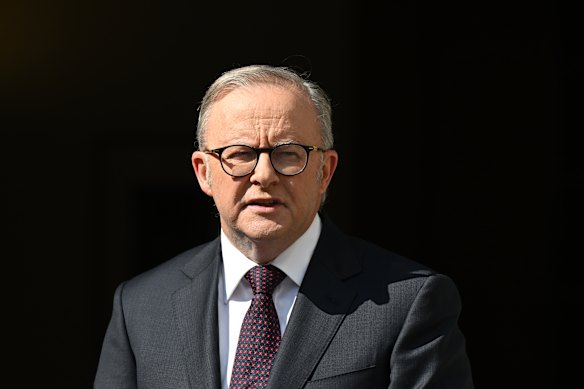
Prime Minister Anthony Albanese calling a royal commission on Thursday after three weeks of public and private pressure. Credit: AAP
All framed their appeal not as a public rebuke, but as a private intervention from within the Labor family. Many of those who signed the letter had campaigned for his government’s re-election last May.
“We believe there is overwhelming community support to do this,” the letter says asking for a Commonwealth royal commission. “The horror of the Bondi terrorist attack has impacted people across the country. It is more than a Jewish-centric issue; it is of vital importance to all Australians.”
Anti-Jewish hatred, the signatories warned, had created the “intellectual and conceptual pre-conditions” for violence and now threatened social cohesion itself. Antisemitism had been normalised — culturally, institutionally and online — and that normalisation was no longer theoretical. It was producing real-world attacks. More policing and security funding, they said, treated the symptoms, not the cause. Only a national inquiry had the authority to investigate the problem properly and recommend whole-of-society solutions.
Merlino added a telling caveat. This would not be a media statement, it would not be circulated. Signatories had been asked to respect the integrity of the approach as a “friendly outreach” to the leader of the ALP and his government.
Many were young Labor activists — “part of the future of our great party”.
It was a signal Albanese could not ignore. Pressure was no longer coming only from Jewish leaders, grieving families or the opposition. It was coming from Labor’s own ranks.
Loading
By then, the prime minister was already cornered by events. The previous week, his government had still been saying, hand on heart, that a federal royal commission into antisemitism would be a terrible idea — slow, inflammatory and liable to “platform the worst voices”.
Home Affairs Minister Tony Burke warned it would worsen social tensions. Albanese said unnamed experts had privately counselled against it.
NSW Premier Chris Minns had announced a state-based inquiry, exposing, in many critics’ minds, a glaring absence of Commonwealth leadership and transforming what had been a policy dispute into a test of authority. The opposition pounced. The families of the 15 people killed at Bondi Beach on December 14 intensified their pleas. Legal figures, business leaders, sports stars and former Labor heavyweights joined them.
Albanese had been taking calls and counsel from many of his predecessors for weeks, both in The Lodge and within Labor. None had or would be going public, but they all had different advice. Among them, Paul Keating and Malcolm Turnbull, sources close to discussions say, had advised caution for differing reasons. Others had said, respectfully, to just get on and call it.
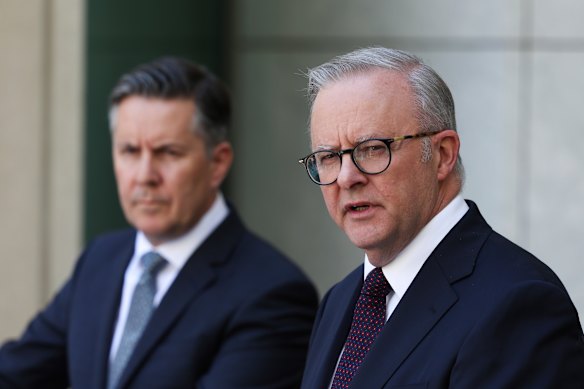
Health Minister Mark Butler and Prime Minister Anthony Albanese.Credit: Alex Ellinghausen
Close ally and Left-faction colleague Mark Butler, whose Jewish ancestors migrated to Australia in the 1870s, was viewed by that community as an important and trusted conduit to the PM to help reinforce their message behind the scenes.
But the Merlino letter crystallised what many inside the government already feared: the ground had shifted. Caucus was restless and increasingly annoyed that they didn’t have a voice internally. More MPs were now threatening to speak out. Even some cabinet members believed the decision-making circle was too small.
Albanese was, in the opinion of some involved behind the scenes, already shifting his views over that weekend. The change in language from ministers, such as Treasurer Jim Chalmers and Butler that said calls “came from a good place” indicated the door was now ajar. But Albanese was still surrounded by key figures within his office and in cabinet, adamant that giving in to what they viewed as a right-wing News Corp campaign run by their enemies would end badly.
Some worried that a broad royal commission would spiral into an examination of immigration policy across generations, universities and the ABC, protest movements and online activism — and that Australia’s large Muslim community, concentrated in Labor-held electorates, would feel unfairly blamed for the actions of two men.
Albanese had been stung by fierce public criticism and rattled at the level of venom directed towards him.
Loading
“He was walking around like a ghost for days,” one Labor insider said. “He was shocked at the event, as we all were, and really then upset at what was directed at him.
“He was really off his game for a while and not processing things properly. I think he was advised badly. Too many ‘yes men’ surround him.”
Those not in the inner circle of decision-makers were beginning to grow restless at Albanese’s approach. Caucus members at home in their electorates were not necessarily being swamped by constituent complaints but they were being engaged in conversations about his decisiveness. They were concerned their views were not being canvassed and that the government was in a state of paralysis.
As he told a press conference at Parliament House on Thursday, it was the series of private meetings that followed with the families of the dead and survivors still in hospital that would lead him to dump his opposition. Those as well as the sheer weight of numbers of ordinary and non-political Australians who had expressed their views.
Those close to Albanese say that series of meetings moved him greatly and helped clarify the message that the Jewish community no longer felt safe in their homes, at work, at school or in their place of worship.
“I’ve sat down with these Australians, together with leaders in the Jewish community and I’ve shed tears with them,” he said.
”I want to thank people for those honest and open-hearted conversations. This is what Australia needs ... to heal, to learn, to come together in a spirit of national unity and to go forward knowing that just like people who gathered that night on Bondi Beach were committing to, that light will prevail over darkness.“
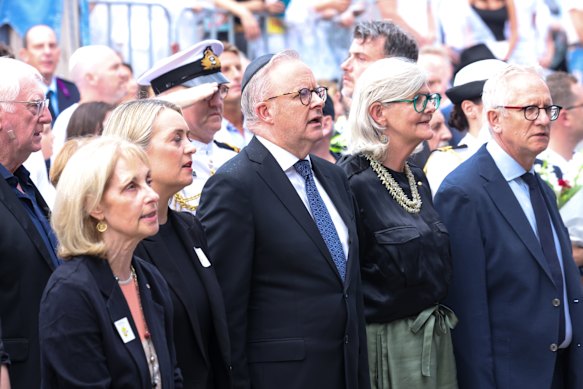
Prime Minister Anthony Albanese at the Bondi Beach vigil on December 21 with antisemitism envoy Jillian Segal, his wife Jodie Heydon and Governor-General Samantha Mostyn. Credit: Edwina Pickles
Still, he dug in during the final hours, telling Jewish leaders point-blank he would not roll over on the appointment of former High Court judge Virginia Bell, in the face of criticism from some Jewish leaders. He’d told them, sources familiar with discussions said, that he’d ceded ground on a federal inquiry, he’d gift them their requested terms of reference, but it was Bell or bust.
Josh Burns, a Victorian Labor MP, had been telling those in the Jewish community urging him to speak publicly for weeks that he would have more luck working inside the tent than out of it. On Friday morning, he told his constituents in Macnamara, which takes in large swathes of Melbourne’s Jewish community, just what sort of role he’d played.
“Many of you have asked me to join the hundreds of good-willed Australians who have called for this publicly. But it’s my job to represent my community and to influence change from within. And that is what I set out to do,” he wrote on social media.
Burns said his private conversations with the prime minister had included “hard truths”.
“He did not look away. But gave me time to put forward the views of our community,” he said.
While many within Albanese’s cabinet and the broader parliamentary ranks are relieved he has finally ended the self-inflicted pain, they believe the royal commission will further test his leadership.
Some are angry that he declared, in the media, that he was thinking about it all along, all the while sending his ministers out to reject it publicly. Others believed he should just say sorry and admit he got it wrong.
They point to his behaviour under the studio lights of the ABC’s 7.30 on Thursday evening, where stand-in host Michael Rowland was unsparing.
“Why did it take you so long to read the national room on a federal royal commission?” Rowland asked.
Albanese bristled. It had been “just 25 days”, he said, since the “travesty of the antisemitic terrorist attack at Bondi Beach”.
In that time, he reeled off the government’s actions: the Richardson review into security failures, increased funding for agencies, strengthened antisemitism envoy recommendations, draft hate laws, and an offer of full Commonwealth co-operation with the NSW inquiry. The implication was that the government had been active, deliberate and serious.
Rowland pushed harder. If the government had been working on the terms of reference for a federal royal commission “for some weeks”, why not say so earlier? Why allow families and communities to believe the door was closed?
Albanese reached for process. In a “24-hour media cycle”, he said, governments could either let themselves be driven by headlines or proceed in an “orderly, considered” way with proper consultation.
Loading
Rowland was unmoved. Families of the victims, he said, had begged the prime minister a week earlier to establish a federal royal commission. Shouldn’t that have been the moment to at least acknowledge one was under consideration — to spare them further anguish?
Albanese said a “half-hearted announcement” — without a commissioner, timeframes or terms of reference — would have fuelled speculation rather than eased it. Then Rowland went to the jugular.
“This is a backflip,” he said. Was the prime minister worried people would see him as a weak leader — following public pressure rather than leading?
Albanese’s answer revealed how he had come to frame the retreat. Leadership, he said, was not about digging in. It was about listening. Democracies worked best when governments adjusted their positions in response to community sentiment.
“What people want in their leader,” he said, “is someone who will listen.”
Albanese on breakfast TV the next morning said the royal commission had been called in “record time”, although Turnbull called the Royal Commission into the Protection and Detention of Children in the Northern Territory on July 26, 2016, the day after ABC’s Four Corners had aired an investigation into the use of spit hoods and restraints in juvenile detention.
He refused to apologise to Jewish families forced to campaign for a royal commission after government delays, but he told Sunrise he was “sorry for their grief”.
But soon the inquiry will overtake the politics. The terms of reference delivered are expansive. Bell has only a year to examine antisemitism, radicalisation, protest movements, online incitement, institutional responses and national security failures.
Jewish leaders want her to connect the dots between rhetoric and violence. Others want the focus on policing and intelligence gaps. Civil libertarians fear overreach and collective blame.
Loading
All of that tension now sits with Bell — and with a prime minister who arrived at this point late.
Politically, the royal commission neutralises an issue that had been bleeding support, galvanising the opposition and reopening wounds from the Voice referendum.
But it allows Albanese to say he listened. What it cannot erase though, some of his allies fear, is the impression left by weeks of resistance: that it took the intervention from families of the dead, hundreds of prominent Australians, several bruising press conferences and a letter from Labor’s own elders to force his hand.