3 hours ago
3
3 hours ago
3
Just in time for Halloween, the Reserve Bank and Treasurer Jim Chalmers have been delivered an inflation nightmare.
And, like any nightmare, what is scary is in the eye of the beholder.
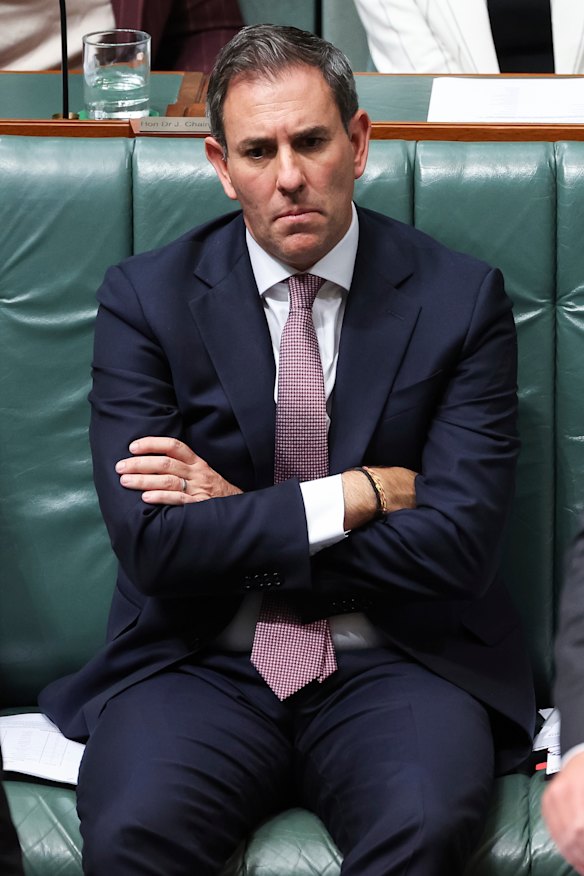
Treasurer Jim Chalmers has been handed an inflation nightmare.Credit: Alex Ellinghausen
For Chalmers, the blood-curdling questions range from the government’s economic policy agenda to the political imperative of ensuring cost-of-living pressures remain in check. For the Reserve, the terrifying issue is how it will deal with a trade-off between bringing inflation under control and jobs.
The September quarter inflation results, no matter your political poison, were poor.
Headline inflation – the rate most people experience every day – climbed back over 3 per cent due to the largest quarterly jump in prices in two-and-a-half years.
Loading
Part of it was due to the end of electricity subsidies. But the numbers proved inflation pressures are broad and growing.
Some elements of the result can be explained away.
Lamb prices, which in March last year were falling at an annual rate of 17 per cent, have now climbed by 10 per cent over the past 12 months. That’s got nothing to do with interest rate settings or government policy and everything to do with farmers rebuilding their mobs.
The same for soaring chocolate and coffee prices (a global problem) and eggs (the cull of the national flock to deal with avian flu).
But in areas such as housing and government policy, years of industry failure are combining in an inflationary way.
The cost of new homes climbed by 1.1 per cent in the quarter, with home builders reducing their promotional offers that had been helping to bring down costs. With governments (finally) doing more to encourage new construction, demand is interacting with supply and delivering the obvious result – a lift in building inflation.
Local councils did not help by delivering the biggest quarterly increase in property rates and charges in more than a decade. They lifted by 8.4 per cent in Brisbane, the largest quarterly jump there since 1998.
Childcare costs are re-accelerating, in part due to deliberate government policy to lift wages for the sector’s poorly paid staff.
Loading
The measure of underlying inflation, the numbers that keep the Reserve Bank and governor Michele Bullock awake at night, is the real story. It jumped by a full percentage point, taking the annual rate back to 3 per cent.
Underlying inflation is calculated by cutting out the biggest increases and decreases. There were so few drops in prices through the September quarter that the Bureau of Statistics had to cut a number of goods that experienced price increases.
The political and economic terrors brought on by the figures were highlighted by the fact that Chalmers did not front the media to explain them, opting instead to hide behind a press release and take his chances against shadow treasurer Ted O’Brien in question time.
Politically, the numbers should be used by Chalmers to argue the case that the government has to go much harder on the policy front, to lift productivity and keep downward pressures on prices.
He is already picking up some of the ideas of the August economic roundtable, but the inflation pulse, on top of the nation’s moribund economic growth profile and the heavy reliance on public sector employment, means the time for caution is over.
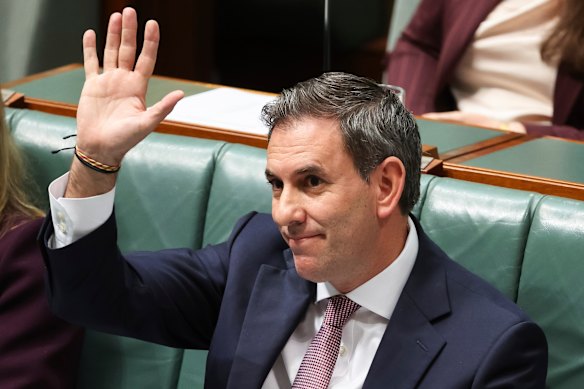
Hands up who’s afraid of the latest inflation figures? Jim Chalmers in question time on Wednesday.Credit: Alex Ellinghausen
At the RBA headquarters in Martin Place, the figures were just as hair-raising.
The Reserve has a dual mandate – keeping inflation between 2 and 3 per cent while aiming for full employment.
The September jobs report, on top of other indicators about employment, suggests keeping as many people as possible in work will be tough while trying to keep inflation under control.
Loading
Bullock, and Chalmers, have appropriately highlighted the way inflation has fallen without real damage to the jobs market over the past three years. The test of that success has arrived.
There should also be an issue nagging at Bullock, as well as the political class, like a spider sitting on a shoulder.
It’s not that long ago that more than half of all central banks were running negative interest rates, while those in positive territory, like Australia’s Reserve Bank, were only charging the equivalent of a peppercorn rent.
Too many thought this could be the “new norm”.
But for the past 15 years or so, there has been a lively debate in central bank circles about if, or when, this collapse in interest rates would come to an end. A range of factors, largely demographic but also some due to the very nature of modern economies, suggest sub-3 per cent interest rates are just untenable.
Telling voters and borrowers that the days of uber-low interest rates are over would be like telling a grisly ghost story around a campfire.
Cut through the noise of federal politics with news, views and expert analysis. Subscribers can sign up to our weekly Inside Politics newsletter.
Most Viewed in Politics
Loading