
 3 months ago
81
3 months ago
81
The heat is radiating in waves off the tarmac as the passengers from Quito leave the plane and head towards the airport terminal in Baltra, one of the only two airports that serve flights from mainland locations in the Galapagos. A huddle forms on the concrete path as the newly arrived visitors point excitedly at something and whip out their phones.
My years of gainful employment as an investigative reporter, aka professional sticky-beak, doesn’t dissipate, even on the other side of the world. I am curious to see what all the fuss is about.
Lying under an exotic cactus tree, the leaves of which are the size of dinner plates, is an iguana with more rolls of neck fat than King Henry VIII and sporting a similar self-satisfied regal smirk. But even His Majesty did not possess such extraordinary green lips.
“Welcome to Galapagos” reads the wooden sign in English and Spanish on the nearby wharf where we were to wait for the Zodiac to take us to our yacht. Lolling underneath the sign, seemingly without a care in the world, is a pair of sea lions.
By that very afternoon, on North Seymour Island, human population zero, I feel a twinge of embarrassment at my initial excited reaction at stepping around semi-conscious sea lions and sighting a single iguana enjoying the sun by the tarmac.
Sign up for the Traveller Deals newsletter
Get exclusive travel deals delivered straight to your inbox. Sign up now.
On North Seymour, the sea lions and the iguanas are plentiful. The latter was described by Charles Darwin as an “ugly animal” with a “singularly stupid appearance.” I beg to differ. These land iguanas are among the largest lizards in the world, and have a life-span of about 60 years. Their diet consists almost entirely of the most-unappetising looking prickly-pear cactus.
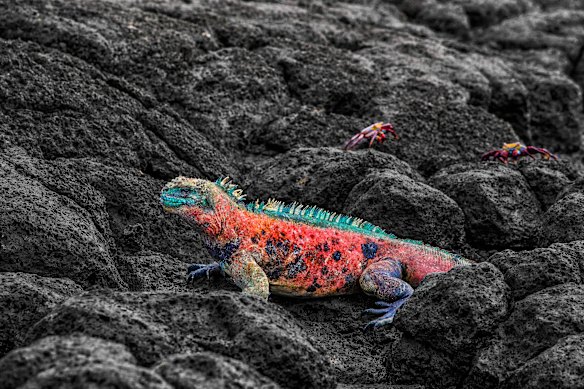
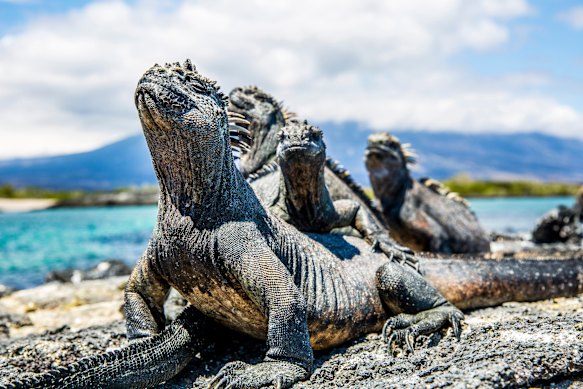
On Espanola Island, the southernmost island in the archipelago, we encounter fabulously coloured marine iguanas. These are nicknamed the Christmas iguana because of their festive colours - mint-green faces, green legs and a long green spine which bristles with dangerous-looking spikes. This contrasts with a rust-red body and tail. The colours are at their most vibrant during the mating season, which runs from December to March.
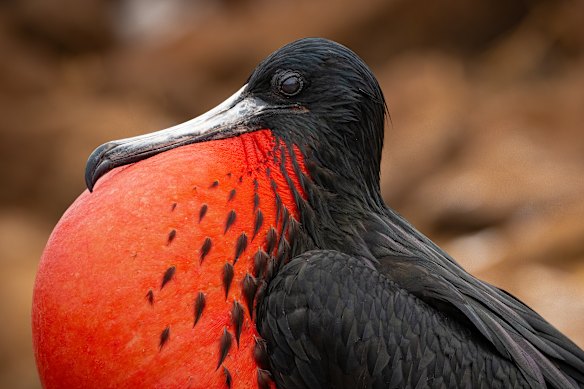
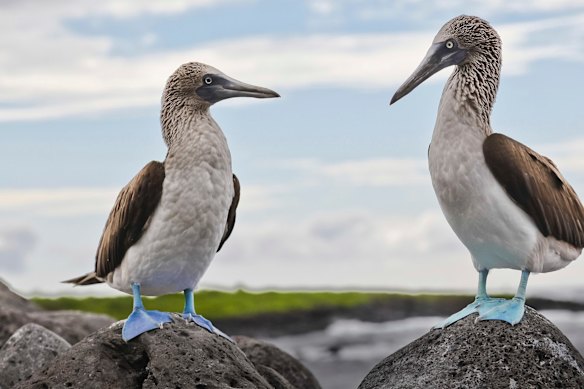
But back to North Seymour. As we walk across the barren island, we encounter the most astonishing sight. A black frigate bird with an enormous red balloon bulge at its throat. The inflated crimson pouch of one bird is so large it almost dwarfs its owner. Our guide says it’s the mating season for frigate birds and the males have a bright red sac on the throat, which they inflate like a balloon to attract females. The famous blue-footed boobies are everywhere, feeding chicks and dive-bombing for fish.
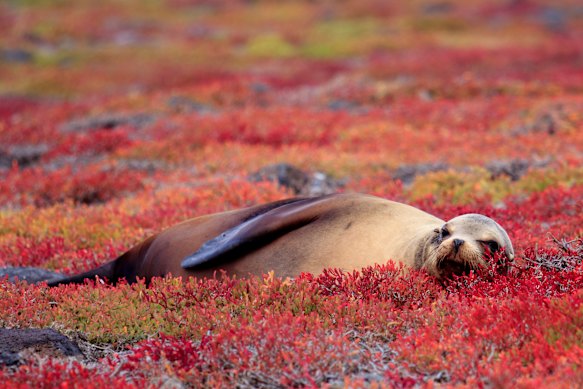
Near the cliffs, dozens of sea lions lie across the rocks, encrusted with gravel-like sand. Some hobble clumsily toward the water using all four flippers. None of the wildlife seems remotely concerned with our small group of curious spectators.
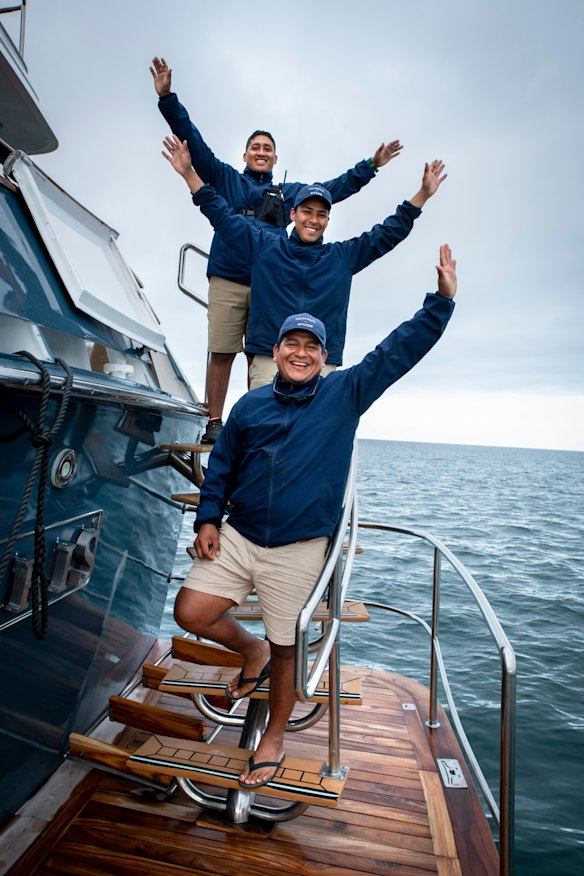
As we sail from island to island, our on-board naturalist and guide, Edwin Alay, explains the geology, the wildlife and the commitment by the people of Ecuador to preserve this unique habitat. Hiking on the islands is strictly controlled for ecological reasons. You can’t wander off by yourself, and you have to be accompanied at all times by a certified guide.
For someone like me, an investigative journalist dealing with deadlines, threats and lawsuits, the most wonderful part of this trip is that your life is organised for you.
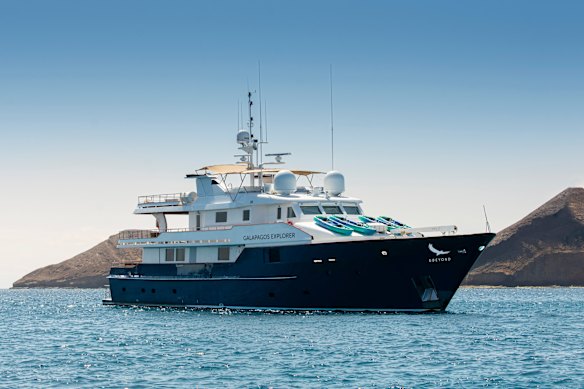
Our luxury yacht, &Beyond’s Galapagos Explorer, has four decks and capacity for 12 guests – there are only seven of us with 12 crew. My cabin is spacious with a large bathroom. I persuade the other guests to let me peek into their cabins and I am shocked at the size of the most glamorous cabin, which is on the third deck. Not only does it have enormous windows on either side of the cabin, the two occupants have a sofa, a desk, a king-size bed and a double bathroom.
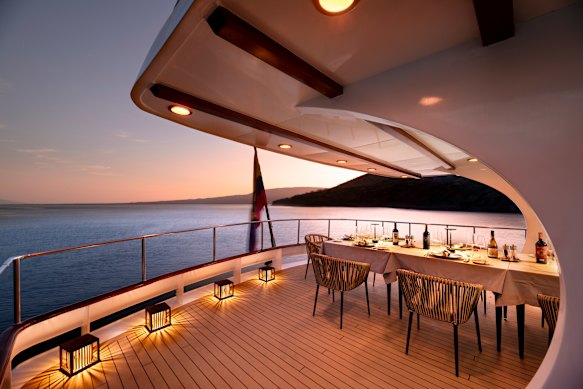
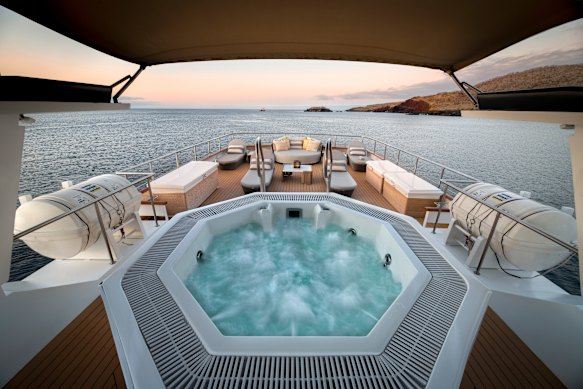
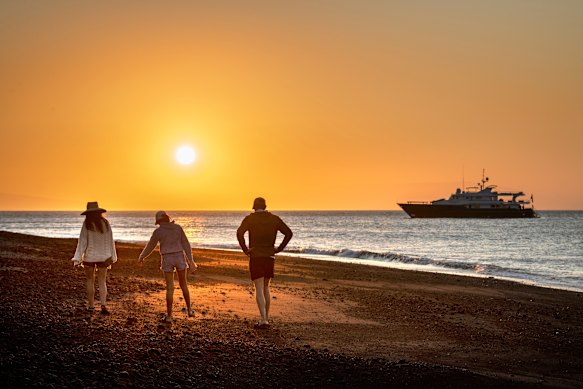
The food is exquisite with three courses at both lunch and dinner. In the evenings before dinner we gather at the cocktail bar on the upper deck to take in the sunset. Crew member Adrian does a passable impression of Tom Cruise in Cocktail flipping the cocktail shaker over his head. What could surpass sipping a margarita, watching two sea lions basking on the landing deck of our yacht as the sun is setting and the dramatic cliffs recede into the night?
Each night before dinner we gather for a briefing for the following day. For example, one day listed: Breakfast at seven, a 1.6 kilometre walk at 7.30, deep water snorkelling at 10, lunch at 12, a walk and a swim at 3.30, kayaking at 4.30, cocktails at 5.30, an excursion briefing at 6.30 followed by dinner at 7. Of course, you don’t have to do any of these things if you don’t want to. But why wouldn’t you?
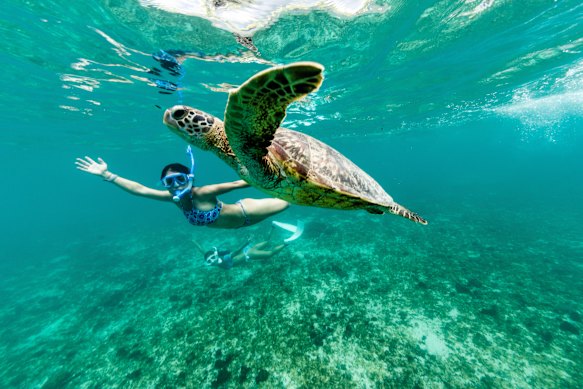
One of the absolute highlights of the trip is the snorkelling. It’s hard to describe the joy of the silence of the ocean as you watch a group of inquisitive sea lions twist and turn right in front of you. With an underwater camera, our guide filmed one sea lion playing with his flippers. Yellow and blue-striped parrotfish glide past, as well as sea turtles, marine iguanas, manta rays and even a hammerhead shark.
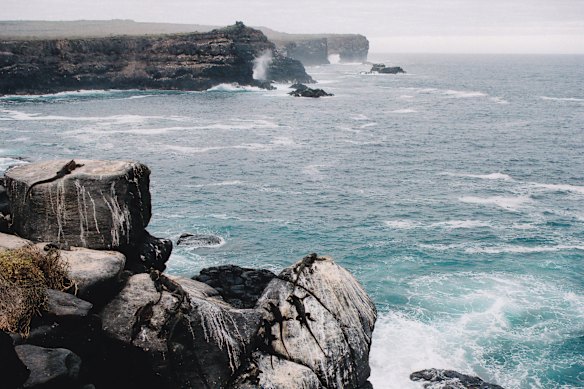
One afternoon we explore Punta Suarez, which is famous for its high cliffs and soaring sea birds. I am most taken by the extraordinary sight of what looked like a large fossilised pig’s head which lay on rocks along way from the beach.
Some of the other passengers on the yacht nickname me “the baroness.” And no, it wasn’t due to my imperious ways, rather a character in a real-life Galapagos murder-mystery from the 1930s. Hearing that I was heading off to the Galapagos Islands, a friend insisted I take a true crime thriller by Abbott Kahler. Published in 2024, Eden Undone: A true story of sex, murder and Utopia at the dawn of World War II is an extraordinary story about a Berlin doctor, who fancied himself as a philosopher, and his patient-cum-lover. The pair ditched their spouses to establish a utopian paradise on the uninhabited, barren Floreana Island in the Galapagos.
Much to their consternation, another German couple, and their son, later joined them on the island. But things really went pear-shaped with the arrival of a self-styled Austrian baroness, who had two male lovers and a servant in tow. The baroness had Trumpian plans to build a luxury hotel on Floreana.
The attempted recreation of paradise followed by murder, poisonings and disappearances were chronicled in papers and magazines across Europe and in the United States in the 1930s. “Modern Adam and Eve in Pacific Eden”, “Mad Empress in the Garden of Eden” and “The Insatiable Baroness Who Created a Private Paradise” were just a few of the headlines topping stories of their exploits.
In 1935, The New York Times ran a front-page story with the headline, “New Galapagos Skeleton Revives Mystery of the Missing Baroness.” The article revealed that an American scientist had discovered a skeleton on the little-visited Marchena Island, one of the most northerly in the Galapagos.
The Times speculated that the discovery of the skeleton “might solve some mysteries”, namely the death of the German doctor and the disappearance of the Baroness and one of her lovers. (I won’t spoil the story.)
I wasn’t the only one onboard intrigued with this drama. On the flight to Ecuador, one of my fellow travellers, a well-known German entertainer, had watched Ron Howard’s 2025 film Eden, starring Jude Law as the misanthropic German doctor (and filmed on the Gold Coast rather than the actual islands).
On our own trip to Floreana we stop in Post Office Bay, where, for 200 years, a wooden post box has provided whalers, explorers and the like a place to leave letters. It was a tradition that passing ships would collect the mail and later post them to the intended recipients. The strange inhabitants of Floreana in the 1930s used the same system. Their missives contained accusations and angry accounts about fellow islanders. The tradition lives on. We gather any postcards addressed to people who live back in our own cities.
After the harshness of the landscapes, volcanic craters, dramatic cliffs and spectacular rocks, which rise more than 150 metres from the sea, the day after our visit to Floreana we dock on the island of Santa Cruz. This is the only “civilisation” we encounter in our week of sailing through the Galapagos. The bustling town of Puerto Ayora is full of tourist shops selling artefacts and tacky T-shirts boasting “I Love Boobies,” a play on the red and blue-footed boobies of the Galapagos.
Standing guard to the entrance of the Charles Darwin Research Station, only a short walk from the centre of town, is a most unfortunate statue of the famous naturalist in which he appears to be about 90. The figure has an egg-head, one eye double the size of another and a beard that looks like it’s been made from cemented spaghetti.
Darwin was only 22 when he set sail on the HMS Beagle from Plymouth in December 1831. For the next five years, he chronicled his astonishing voyage, including his time in the Galapagos. The Voyage of the Beagle, published in 1839, is well worth a read before you set sail yourself. The research centre, named after him, is well-known for its one-time inhabitant, Lonesome George, the Galapagos tortoise who became famous as the sole survivor of his species.
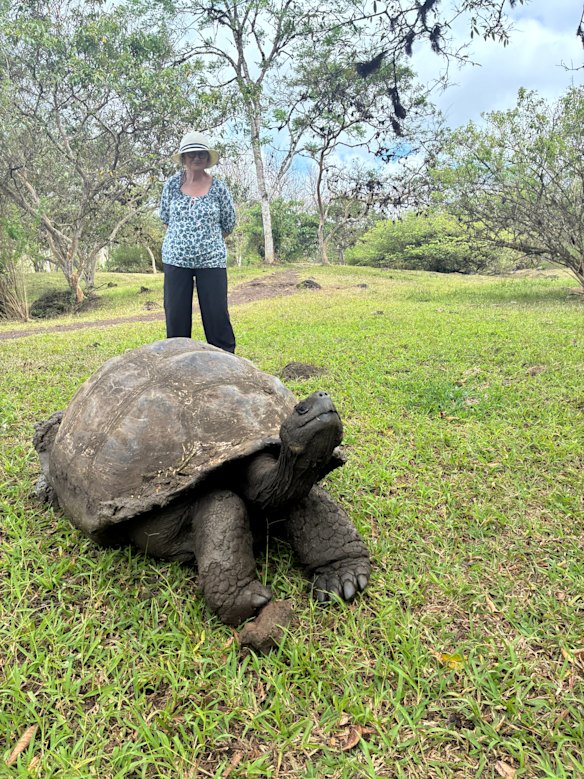
In his book, A Sheltered Life: The Unexpected History of the Giant Tortoise Paul Chambers observed that Lonesome George, who was about 100 when he died in 2012, was “a poignant symbol of the destruction that Homo Sapiens has meted out to the natural world”. Tortoises were not only easy prey, they were tasty. Pirates and whalers devoured tortoises in their thousands driving some species to extinction. In the 1680s, British explorer William Dampier spent time on the Galapagos Islands. He described the tortoises as “extraordinary large and fat, and so sweet, that no pullet [hen] eats more pleasantly”.
This year, for the first time in almost two centuries, 150 giant tortoises are roaming Floreana after being bred in captivity at the research station.
After leaving the research centre, we travel into the almost-tropical highlands to Fausto Llerena Breeding Centre, which also has giant tortoises to be released on the islands of their origins. There are tortoises everywhere: in the shade, in the mud, munching on large leaves. Our lunch is punctuated by the nearby primal mating groans of a giant male tortoise who had lumbered very slowly after an even slower female.
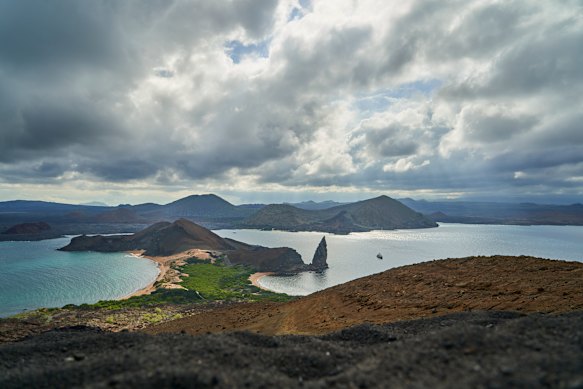
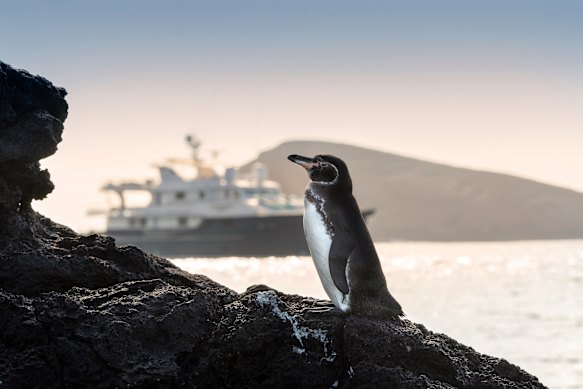
The following afternoon, we sight Galapagos penguins as we head in the Zodiac to one of the most photographed places in the Galapagos: Pinnacle Rock. We also troop up the seemingly never-ending wooden stairs to the lookout on the top of Bartolome Island, the terrain of which was so barren we could have been on the moon. It is worth every step. We watch as the sun sets over Pinnacle Rock and take in the vastness of the islands in the distance.
It is hard to do justice when writing about the Galapagos Islands. Leaving was just as breathtaking as arriving. As we disembark at the same Baltra ferry wharf, I watch a brown noddy tern landing on a pelican. Nearby, the vividly coloured crabs, known as Sally lightfoots, scuttle across the rocks. And, lying on their backs fast asleep, blocking the steps up the wharf, are the sea lions. Not a care in the world.
THE DETAILS
TOUR
&Beyond’s seven-night cruises on the Galapagos Explorer departs from Baltra Island, Ecuador and costs from $15,560 a person twin share, and includes food, drink and all excursions. Flights extra. See andbeyond.com
The writer travelled as a guest of &Beyond.

















































