3 months ago
41
3 months ago
41
When I met Kirk Jones, writer and director of Tourette’s biopic I Swear, a week before the BAFTA ceremony, he hoped Robert Aramayo might defy seemingly insurmountable odds in the best actor race.
“I would love Rob to pick up best actor, but when you see he’s up against Timothee [Chalamet] and Leonardo [DiCaprio], it would be a massive upset,” he told me. “It would travel the world; it would be world news.”
Aramayo, 33, duly caused shockwaves by triumphing against his more fancied rivals for his portrayal of Tourette syndrome campaigner John Davidson, and also picked up the BAFTA Rising Star award for good measure.
I Swear has been the story of the BAFTAS but, unfortunately for Jones and Aramayo, not in the way they would have wanted. Davidson, who was in the Royal Festival Hall, had tics during the ceremony, including saying the N-word when Michael B. Jordan and Delroy Lindo, the black stars of Sinners, were onstage presenting an award. The BBC, which airs the show on a two-hour delay, kept it in the broadcast. Clips of the incident have travelled the world and the BBC has apologised for the “strong and offensive language”, but noted that it “arose from involuntary verbal tics associated with Tourette syndrome, and was not intentional”.
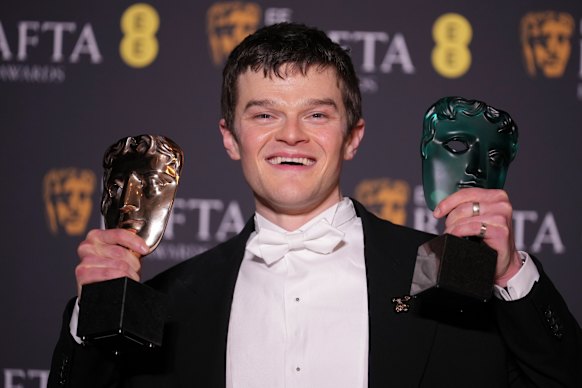
It is a shame the ensuing furore, mostly driven by US journalists and commentators who seem to have a remarkable lack of empathy for Davidson and his condition, has overshadowed a feel-good underdog triumph for British independent filmmaking.
I Swear is the first film that Jones – who previously directed Nanny McPhee, What to Expect When You’re Expecting and My Big Fat Greek Wedding 2 – has made at home for two decades, and has been a huge hit, making more than twice its budget at the box office and being nominated for five BAFTAS.
Jones, who worked for a long time in the US and collaborated with Oscar winners such as Robert De Niro and Tom Hanks, chafed against the strictures of the Hollywood-industrial complex, especially the money men who wield huge power in the big studios and would meddle with his films.
The 61-year-old said he had “lost a bit of faith in the whole industry”, and a few years ago became utterly fed up. “I was so bored with the process, the amount of people that are involved, and the notes that you get and the upset and the stress and, literally, bullying,” he recalls. “I was at an age where I thought, ‘Well, maybe I won’t make a film again. Maybe that’s how it is just going to be.’”
More than anybody else at this year’s BAFTAS, Jones risked it all to get his film made. It’s not quite right to say that he sold his house to fund the film, but it’s not a million miles away.
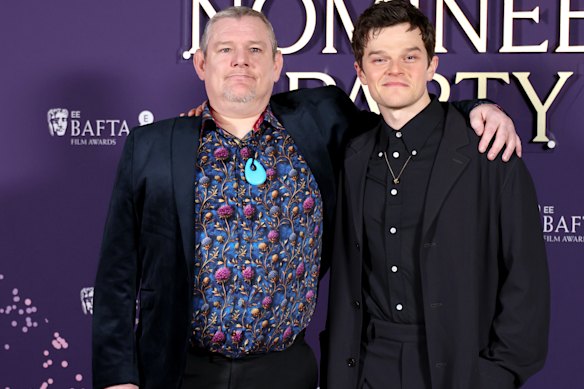
To avoid a repeat of the bad experiences he had had in Hollywood, Jones was determined to have “complete and total creative control” over I Swear. That feeling was reinforced after he had finished the script and met a sales agent who told him that the film’s swearing (on account of Davidson’s condition, the word “f---” is said 98 times, and “c--” features on 28 occasions) would need “to come down because it’s not commercial in this format, and we do not think that we’re going to be able to sell it to other territories around the world and make it work”.
Jones reckoned at that point there were three possible things that might happen with his film: it would never see the light of day; it would take the best part of a decade to “persuade people that they should be investing in it, which I wasn’t prepared to wait for”; or he had to “try and find another way to finance it”.
By chance, before meeting the real-life Davidson and writing the film, Jones and his wife, Cindy, had sold their Buckinghamshire family home and started renting in Bristol, where he grew up and his parents still live. It gave him an unorthodox opportunity to raise the more than £3 million (about $5.67 million) needed to make the film. “I went to the bank and I said, ‘Look, you’ve got everything we’ve ever had, and you’ve got it in that account, and that’s our house money: if we put that on the line and put it down as collateral, am I allowed to borrow money against that?’”
However, while he had squared the bank, Jones said that he had yet not discussed his idea with Cindy. She did not take much convincing to take the punt of a lifetime. “I pitched it and all she said was, ‘If you believe in it, if you feel passionate about it and feel really strongly, then let’s do it.’ That’s it,” he said. “So my wife deserves a huge amount of credit.”
With funding secure, Jones was able to give his project the green light – but the sheer enormity of the project created a whole new level of stress. The second day of shooting was a wash-out, and he started to fret about the cost of everything from portable toilets to idle cameras to tea and biscuits for the crew. And then there was the night he took seven of his colleagues for a curry.
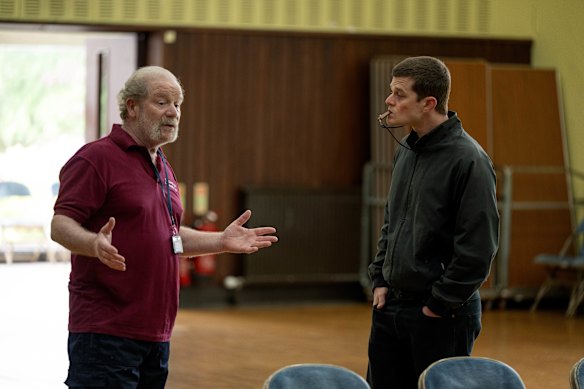
“I think we ordered seven naan bread. And I said, ‘Do we need seven? No, I’m sorry, but do we need seven? We don’t need seven. Can we have five?’ And I was literally counting the naan bread, as if that was going to make any difference in the grand scheme of things,” he said, laughing.
As filming got under way in earnest, these anxieties largely dissipated. “Normally, you want a shoot to end. [It] doesn’t matter what shoot, you just want to survive it,” said Jones. “Within a few days of seeing Rob and seeing the material that we were capturing, I went home, and every night I thought, ‘I am so glad that we made that decision and that this is ours.’ I just knew.”
Jones came across Davidson’s story the way millions of others did: through a series of documentaries that did much to raise awareness about Tourette syndrome. Starting with John’s Not Mad, which aired on the BBC in 1989, Davidson tugged on the nation’s heartstrings as people saw the daily difficulties that came from living with an incurable condition that causes physical and verbal tics in those who have it.
The director found Davidson’s name in an old notebook of ideas and decided it might be the basis for something meatier than the fleeting glimpses people can get from one-off factual programs. “I went back and looked at the documentaries that I remembered, and they still really affected me,” Jones said. “They were so emotionally engaging and upsetting, and then they were really funny. And I started to think that maybe there was a film idea which spanned the whole of his life.”
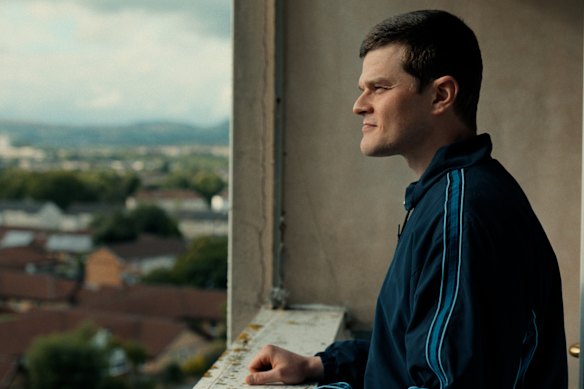
At the heart of the film is Aramayo’s tour de force performance, which has firmly put him on the map after starring in productions such as Game of Thrones and The Lord of the Rings: The Rings of Power. The Hull-born Aramayo immersed himself so much in the role that he spoke in Davidson’s regional Scottish drawl for the duration of the shoot, even off camera, and “collected genuine tics” from other people with Tourette’s that then found their way into the script. “I’ve worked with some incredible actors, some very serious actors, Oscar-winning actors,” said Jones. “I’ve never seen anyone go as deep into a role and a character as Rob did.”
But Jones reckons that, had his film been funded in a more conventional way, Aramayo would have been nowhere near the production. “In the UK, my gut feeling is that people who are still investing in films want to do every single thing they can to protect their investment and stand the best chance of seeing a return,” he said. “And what that means is, when it comes to casting, they say, ‘No, no, no, no, we want someone who is known in America, who’s won awards and who everyone loves.’ I can say now without a single doubt in my mind, I would never, ever have been able to cast Robert Aramayo in this role if we had gone in a traditional direction for financing. Absolutely no way.”
Despite the film’s critical and commercial success, Jones has yet to see a return on his investment. Proceeds from ticket sales are split between cinemas, distributors, marketing campaigns and so on. “In every other respect, you’d think, ‘Wow, we’ve hit the jackpot.’ You know, we took a risk,” he says. “It’s like putting it all on black, and we’ve come good. At no point yet has anyone been able to show me that that is going to be true. I haven’t been paid a single penny for three and a half years.”
He leaves me with a troubling thought. “I’m not even convinced that we’re going to see anything back on this one. But we must do,” Jones adds. “If we don’t, then there’s another article to write in a couple of years’ time [to ask] why didn’t we? How is that possible? To work for free, a low-budget film, for it to be so successful, to sell in every territory? How could we, at the end of that, sit down and have people say, ‘Well done, but sorry, nothing to come back?’”
The Telegraph, London
I Swear is released in cinemas on March 26.