3 months ago
14
3 months ago
14
We have just endured another year of rising road fatalities. NSW recorded its deadliest year since 2017, with 355 lives lost in 2025 – up sharply from 2021’s low of 265. Some claim population growth explains the increase, but even per capita figures tell a grim story: the road death rate has risen from 3.3 per 100,000 people in 2021 to 4.2 today.
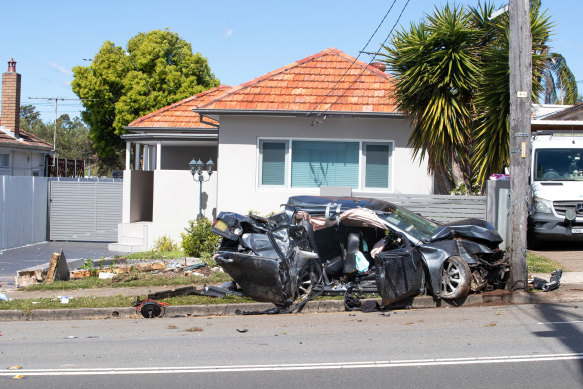
Debris is scattered over the road after a car crash. Credit: Edwina Pickles
Government responses have been predictable and unconvincing. Statements such as, “The Minns government has invested $2.8 billion in road safety initiatives and will consult the community on its next five-year Road Safety Action Plan”, offer little comfort to grieving families. Whatever these initiatives are, they are clearly not working. Nor do we need yet another Yes Minister-style “action plan”.
Road safety experts have advised for decades what works, chiefly much stronger speed enforcement. What’s missing is political leadership.
NSW Roads Minister Jenny Aitchison said the 355 deaths should “stop everyone in their tracks”, urging people not to drive distracted or impaired and to slow down. Transport for NSW Secretary Josh Murray echoed this, pointing to infrastructure, enforcement and education, but ultimately concluding that change depends on “personal responsibility” from drivers.
Sound advice but it misses the point – and slips into implied victim-blaming.
Loading
NSW adopted the Safe System approach in 2008, inspired by Sweden’s Vision Zero, aiming for zero road deaths. The strategy reduces trauma through safer roads, safer vehicles, safer speeds and stronger enforcement coupled with community education. One of its core principles is to shift responsibility away from road users and towards road system designers and managers, building safeguards that prevent deaths even when people make mistakes and behave badly, such as speeding and driving when intoxicated or drug-affected.
Redirecting responsibility back onto individuals allows politicians to avoid making the difficult, and often unpopular, decisions needed to stop dangerous behaviour in its tracks before it causes harm.
Road deaths continue to rise precisely because of this mindset. Politicians appear unwilling to accept an uncomfortable truth: preventing fatalities is their responsibility. It’s time to introduce stronger, evidence-based enforcement laws that reduce speeding and drink and drug-driving. No one has the right to speed or drive impaired, placing other road users at risk.
Speeding is a factor in about 42 per cent of road deaths in NSW each year. Anyone driving from Victoria into NSW can feel the difference in speed-enforcement management. The science is unequivocal: for every 5 per cent decrease in average speed, road deaths fall by 20 per cent.
Loading
Alcohol and drug-related crashes cause about 40 per cent of annual fatalities, yet enforcement – especially drug-testing – is inadequate. The Minns government’s response falls far short. If similar deaths occurred from guns or knives, urgent laws would follow, as seen after the Bondi Beach shooting and Bondi Junction stabbings. Road deaths don’t spark the same urgency, as politicians fear voter backlash from tougher enforcement.
First, remove warning signs ahead of mobile speed cameras. Hidden, unpredictable enforcement encourages consistent compliance, whereas signed cameras only encourage compliance at the camera location itself.
Second, install point-to-point average speed cameras on all major intercity highways and apply them to cars. Their effectiveness is well proven – we don’t need trials. Trials are unnecessary—their effectiveness is already well established. Research by Professor Stuart Newstead’s team at the Monash University Accident Research Centre, including their 2019 study and earlier international evaluations, shows a reduction of about 50 per cent in fatal and serious-injury crashes.
Third, lower 90-100km/h limits on high-risk rural roads – those that lack median barriers, sealed shoulders and roadside protection – to a survivable 80km/h. Victoria’s Mornington Peninsula eliminated fatalities on similar roads by doing exactly this.
Fourth, amend state law to mandate a maximum speed of 40km/h on all residential streets, replacing the current default of 50km/h. Evidence indicates that in poorly lit suburban streets, a driver travelling at 50km/h on low-beam headlights is unlikely to see a pedestrian in time to avoid a collision. At 40km/h, the driver can react and slow to about 30km/h, reducing the fatality risk to about 5 per cent.
Fifth, follow the European Union by requiring repeat speeding offenders to install Intelligent Speed Assistance systems that physically prevent their vehicles from exceeding speed limits.
Finally, ramp up alcohol and particularly drug-testing significantly. Drivers and riders must feel that anywhere, any time, they will be caught if they are breaking the law.
NSW does not lack data, expertise or proven solutions. What it lacks is political will and strong leadership. Until politicians stop redirecting blame towards road users and fully embrace Safe System principles, road deaths will continue to rise. The responsibility – and the choice – rests squarely with them now.
Raphael Grzebieta is professor emeritus at the Transport and Road Safety Research (TARS) Centre, UNSW, and adjunct professor in the Department of Forensic Medicine, School of Public Health and Preventive Medicine, Monash University, Melbourne.
Most Viewed in National
Loading