3 months ago
6
3 months ago
6
An alarming number of Australian women have been killed in recent years. Find out more about their lives. Some of the cases are still before the courts.
See all 53 stories.Retired homicide detective Ron Iddles has recounted to a court the moment he pulled over the accused Easey Street killer and discovered a knife in the boot of his car, unaware the teenager would be charged with the double homicide almost 50 years later.
Iddles said he was working as a constable at Collingwood police station in January 1977, with the double murder of Susan Bartlett and Suzanne Armstrong at the forefront of everyone’s minds, when he performed what he believed was a routine check of a 1968 HK Holden Commodore.
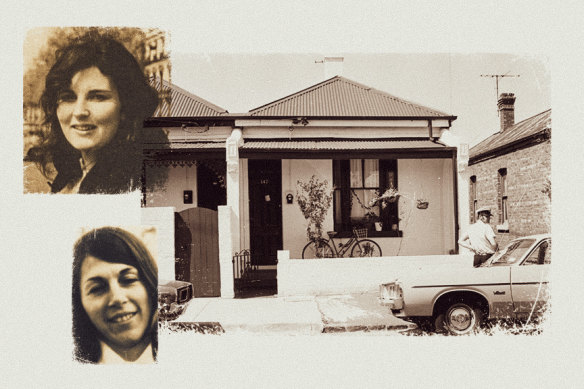
Susan Bartlett (top) and Suzanne Armstrong were killed in their Easey Street, Collingwood, home in 1977.Credit: Stephen Kiprillis
“Pull over the vehicle, talk to the driver, ascertain if he has a licence and check the vehicle. It was a random check, which we routinely did,” Iddles told Melbourne Magistrates’ Court on Tuesday.
“We checked for a roadworthy, registration labels on them, checked whether he has a licence or not. And we searched many cars, yes.”
The random stop took place about four or five days after the killings, Iddles said. He pulled over a male of Greek descent with a name starting with P, who provided his name, age, and date of birth, he said.
Loading
Accused man Perry Kouroumblis, now 66, sat in the dock between two security officers as the retired detective spoke.
Iddles told the court that he recognised the man in the car, saying: “I had spoken to him before.”
A police search of the interior of the car uncovered nothing, but a search of the boot turned up a knife.
“[Kouroumblis] said that he picked it up on the railway line,” Iddles said. “It was laying among the rocks.”
Iddles said he did not notice any obvious injuries on Kouroumblis, and that the interaction lasted about 10 minutes.
“I retained the knife, and to the best of my recollection I took it back to Collingwood ... and gave it to a sergeant or lodged it in property. I cannot recall,” Iddles said on Tuesday.
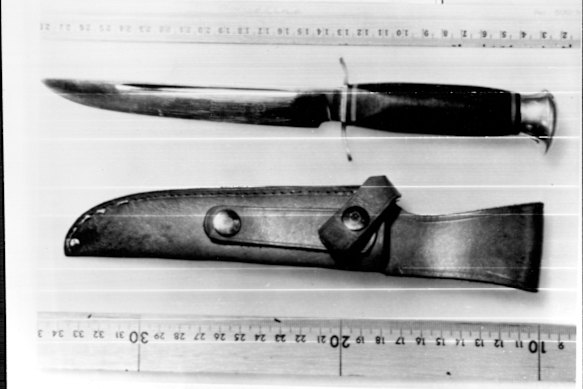
An image of the knife found in a car connected to Kouroumblis.
Police allege that between January 10 and January 13, 1977, Kouroumblis entered the Easey Street, Collingwood, home of Armstrong, 27, and Bartlett, 28, and killed both women. Kouroumblis is also accused of raping Armstrong.
Iddles said he next saw the knife days later being held up by a superintendent on the front page of The Sun newspaper.
“I couldn’t work out why the superintendent would take a knife and hold it and have it photographed to be on the front page of the paper unless they had some investigative reason to put it out there,” Iddles said.
“I never heard another thing about the knife.”
Iddles later became a homicide squad detective and was working as a senior sergeant when the cold case file came to his office in the late 1990s.
Former homicide squad member Stuart Bateson, who worked under Iddles, conducted a review of the case. As part of this, he told the court he had obtained DNA samples from “seven of the strongest suspects”, which included John Grant, Ross Hammond, Ian Lloyd, Barry Woodard, Henry Woodard, and Peter Sampsonidis, which were then compared to a semen sample found at the Collingwood crime scene.
First to be excluded was Grant, a man Bateson recalled was sweating as he spoke to police on the porch of his house in 1998.
Bateson wrote in his notes at the time that, strangely, Grant indicated he wasn’t sure which murder Bateson was referring to when they mentioned the Easey Street murders, despite Grant staying in the house next door to Bartlett and Armstrong’s on the night of the killings, and working as a police reporter at the time.
“I thought it was odd, yes,” he said.
Bateson also recalled speaking to Lloyd, a former policeman, who said he had an intimate relationship with Armstrong at one time while working as a labourer next door.
Loading
All were later eliminated as suspects through DNA.
“That seminal fluid, to me, was critical to the case,” Bateson said, explaining to the court, “To me, that seminal fluid could only have been left by the killer. That’s why I say it was so critical to eliminating the suspects that we did.”
Professor David Ranson, formerly of the Victorian Institute of Forensic Medicine, was asked to assess whether the knife seized from near the Victoria Park railway station at the time of the killings could have been used to inflict the fatal injuries.
In 2018, he was given autopsy reports and 41 black and white photographs, alongside the knife.
Ranson said no measurements were taken of the wounds at the time, making it “problematic”. The court heard he was unable to rule the knife in or out as being the murder weapon.
“I noticed a number of wounds had a squared-off appearance at one end, particular characteristics we see with a single-edged blade,” Ranson said.
The hearing, which will determine whether Kouroumblis stands trial, continues.
Start the day with a summary of the day’s most important and interesting stories, analysis and insights. Sign up for our Morning Edition newsletter.
Most Viewed in National
Loading