3 months ago
34
3 months ago
34
In between developing a chatbot to counter climate change disinformation, pumping out his award-winning TikToks, and hosting his Triple J talkback show, Dr Karl Kruszelnicki has found time to film a second season of his ABC series about the making of popular Australian products.
This time, for Dr Karl’s How Things Work, he visits the factories and farms behind staple consumer goods such as potato chips, AFL footballs, meat pies, guitars, bread, boots, ice cream and books. True to form, he finds fascinating facts lurking on each conveyer belt.
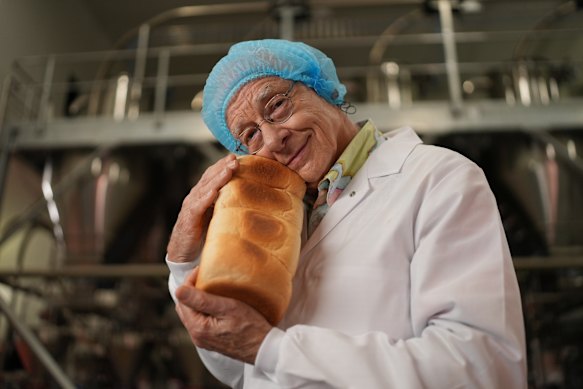
Dr Karl Kruszelnicki visits a bread factory for season two of his ABC series Dr Karl’s How Things Work.
“I discovered things I had no idea about!” says Kruszelnicki, enthusing over a vibrating stainless-steel plate that, using the laws of physics, sends chips uphill for salting. “I formulated an idea that these products show that we are a society of people that need each other because you can make chips one at a time, but you can’t make huge numbers, or as consistently. It’s the same with footballs or books. All of these things require teams of people that exist – not independent of our society – but as a subset of society. That makes me feel good about society.”
His chatbot, Digital Dr Karl, due to launch this month, which uses his voice to answer questions and start conversations about climate change, is funded by Bellagio Center Residency in Italy from the Rockefeller Foundation. The work is the continuation of Kruszelnicki’s decades-long dedication to the issue, which saw him unsuccessfully run for a Senate candidacy in the 2007 federal election. He isn’t ruling out another shot at politics.
Loading
“With regard to the Australian Senate, which is only 70-odd people, I’ve heard some of them say that there’s no such thing as climate change,” says Kruszelnicki, who is 2025 NSW Senior Australian of the Year. “It’s like saying that the seven-multiplication table is a lie. They’re totally wrong. And if I was in there, I would be at least one person trying to tell the truth about climate change and so that’s my motivation to try and make the world a better place for the next generation. I can see [that politics] is a very dirty game. But on the other hand, it’s a game where you’ve got a chance to make the world a better place.”
His 2024 autobiography, A Periodic Tale: My Sciencey Memoir, in which he recalls his childhood as the sole offspring of Holocaust survivors, his “drug-crazed hippie days” and careers in medicine and physics, was shortlisted for the Australian Book Industry Awards Biography of the Year. But it’s not the full story of his life so far.
“I left out bits of my past that were too terrible to write about, because I’ve done bad things,” he says. “I have been a bad boy in the past. And we all make mistakes and hopefully we become better.”
One reader response didn’t exactly take him by surprise, but turned his insatiable curiosity on himself.
“A medical college said, ‘You know that you’re obviously autistic, don’t you?’ And I said, ‘Maybe’. And they said, ‘Oh yeah, definitely’. So I’m having lunch with them to work out exactly which bits of me triggered their autism flag … On one hand, while I do try to fit into society, I have the unfortunate habit of listening to what people say rather than what they mean … It won’t change anything in the past, but it does explain a few things.”
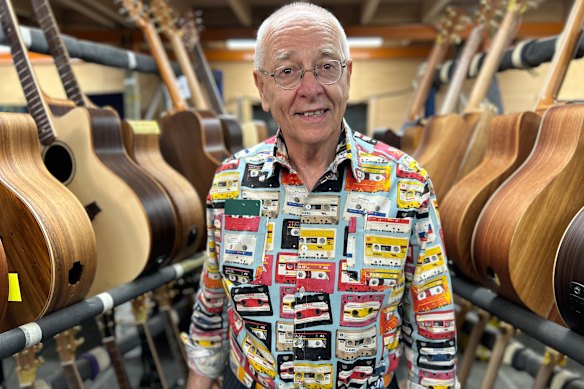
Dr Karl Kruszelnicki at the guitar factor in Dr Karl’s How Things Work.
Of all the products Kruszelnicki investigates in the series, he found the process of guitar-making most affecting.
“It’s quite different from the chips … It’s the human involvement at each stage on this production line,” he says. “There are many stages where there are humans doing human things. They’ve got a template that is different for each type of guitar, and then they have to apply their own special little bit just here ... Each guitar is tested by a human, who every now and then says, ‘It’s a dud – it just is’ and then they throw it out.”
Dr Karl’s How Things Work returns at 6pm on Tuesday, January 6, on the ABC.
Most Viewed in Culture
Loading