3 months ago
17
3 months ago
17
The image was chilling and dystopian. More than 60 men dressed in black, many with hats and sunglasses to obscure their identity, stood in formation outside NSW Parliament House before a banner that read: “Abolish the Jewish lobby.” At the end, they chanted “blood and honour”, a slogan of Hitler Youth.
They had permission to be there. The police watched on.
How was it allowed to happen? Who knew in advance? And as the political fallout lingers, what laws might change because of this lapse?
The news
At 10am on Saturday, about 60 neo-Nazis rallied outside the gates of NSW Parliament House. They stood beside a banner that read “Abolish the Jewish Lobby”, but the protest had been deemed authorised as the group had notified police of its intention to hold the rally.
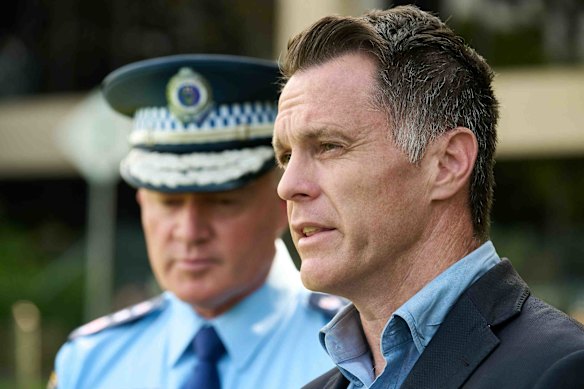
NSW Premier Chris Minns and Police Commissioner Mal Lanyon speak about the rally on Saturday.Credit: Flavio Brancaleone
Police decided not to challenge the rally, and it later emerged neither Premier Chris Minns nor Police Commissioner Mal Lanyon had been informed in advance. Both were swift to condemn the rally as antisemitic and said hate speech had no place in NSW.
In the days since, the police and the government have struggled to deal with the fallout and have faced questions about how it happened.
How we got here
While white supremacists and nationalists have long been on the fringes of Australian society, the National Socialist Network (NSN) emerged in Melbourne in 2020 under the cover of the COVID-19 pandemic. They have been prominent in Victoria, where rallies involving neo-Nazis have turned violent: police have been injured, speeches have been made on the steps of parliament, and an Aboriginal camp in central Melbourne was stormed in a breakaway attack from the March for Australia rally.
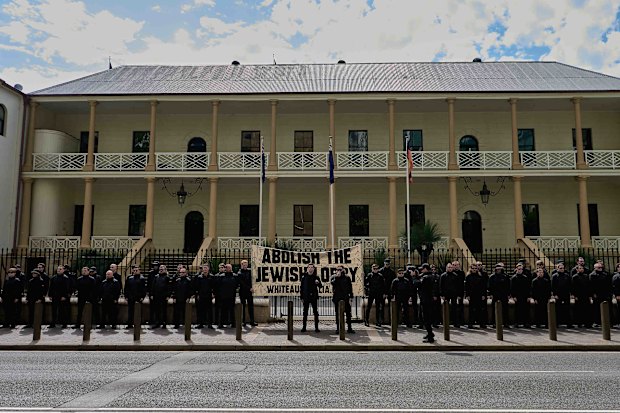
The National Socialist Network holding a rally outside NSW Parliament in Sydney.Credit: Flavio Brancaleone
In NSW, the group’s activities have been more muted. However, police have broken up three previous rallies, including on Australia Day last year, using existing laws.
NSN successfully held a rally in June and its members were present at the Sydney March for Australia demonstration, but Saturday’s event marked the group’s boldest statement so far.
The threat had been known to police: Deputy Commissioner Peter Thurtell told budget estimates in September such groups were being monitored by “our engagement and hate crime unit and our counterterrorism command and our state intelligence group”.
How it unfolded
October 27: The NSW leader of the National Socialist Network, Jack Eltis, submitted a Form 1 application as a “notice of intention to hold a public assembly”. Eltis, a north-west Sydney tradie, who describes himself as a “white man of honour”, described himself in the form as the “NSW state leader” of White Australia. The Herald revealed the application was addressed to Lanyon.
November 3: Thurtell said he was made aware of the planned rally five days before the event. He said later he did not have any information there would be any illegal activity, but acknowledged: “In hindsight, it was an oversight of mine not to tell the commissioner.”
November 4: In a wide-ranging speech about the threats facing the country, Australian Security Intelligence Organisation (ASIO) director-general Mike Burgess sounded the alarm about the NSN, although he noted it had not engaged in terrorism. “I remain deeply concerned by its hateful, divisive rhetoric and increasingly violent propaganda, and the growing likelihood these things will prompt spontaneous violence, particularly in response to perceived provocation,” he told the Lowy Institute.
Friday: The Speaker of the Legislative Assembly, Greg Piper, became aware of the planned protest. The President of the Legislative Council, Ben Franklin, was also informed. Piper said he was aghast when informed late on Friday and immediately asked his staff to contact the parliament’s security team for an urgent intervention, but was told it was too late.
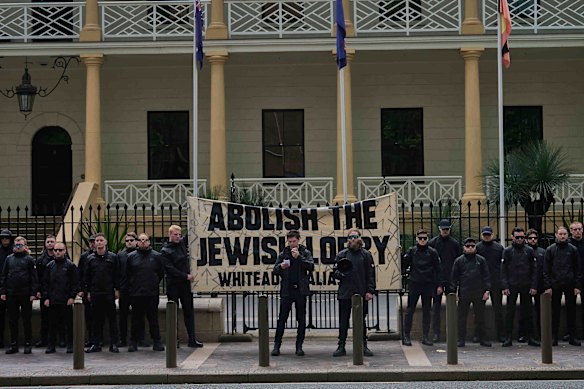
The National Socialist Network holding a rally outside parliament in Sydney on Saturday.Credit: Flavio Brancaleone
Saturday: The rally took place at 10am. A Herald photographer captured the event. Minns and Lanyon held a media conference about 3pm, where the premier and the police commissioner both said they had not been informed in advance. Minns raised the prospect of introducing new laws.
Sunday: The Herald revealed it was not the first time neo-Nazis had rallied outside parliament, as the extreme right group has become increasingly brazen and has tested police powers.
Monday: Minns and Lanyon hit the morning TV shows and radio in an attempt to control the fallout. The state MP for Vaucluse, Kellie Sloane, and the federal MP for Wentworth, Allegra Spender, both received violent and misogynistic threats for denouncing the rally; they referred the threats to NSW Police for investigation.
Tuesday: Parliament resumed for the final two sitting weeks of the year. Question time was dominated by the fallout: Minns denounced the demonstration as “divisive, bigoted, racist and antisemitic” and, along with Attorney-General Michael Daley, said the government is exploring ways to outlaw “Nazi behaviour and speech”.
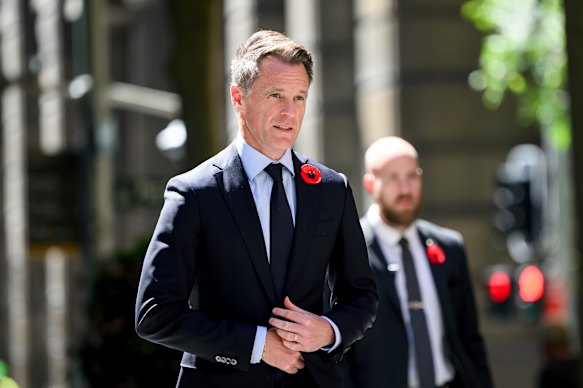
Premier Chris Minns at the Sydney Remembrance Day Service on Tuesday.Credit: AAPIMAGE
What they said
“There’s no place for it in our modern community. It’s designed to wrench at our community and tear one Australian from another. It’s also highly, a group that’s ... almost targeting young people to join this horrific, fascist, racist Nazi movement. And it needs to be confronted.” Chris Minns, NSW premier
“The premier, the police minister and the police commissioner must explain how, on their watch, something as vile and coded as calling for ‘abolishing’ a ‘Jewish lobby’ has been allowed to occur outside the cradle of democracy in NSW.” Mark Speakman, NSW opposition leader
“There was a communication error within the police force for which I did not personally know that today’s protest was taking place.” Mal Lanyon, NSW police commissioner
“It seemed quite evident to me that this should not go on outside the parliament, but we were told there was nothing that could be done,” Greg Piper, Speaker of the Legislative Assembly
“Our law enforcement and security agencies need the right legislative tools to monitor and disrupt violent extremists and to prevent them from menacing or physically harming peaceful Australians. But the single most important thing we must do is to restore decency, civility and basic rationalism to our country.” Alex Ryvchin, co-chief executive of the Executive Council of Australian Jewry
“I remain deeply concerned by its hateful, divisive rhetoric and increasingly violent propaganda, and the growing likelihood these things will prompt spontaneous violence, particularly in response to perceived provocation.” Mike Burgess, ASIO director-general
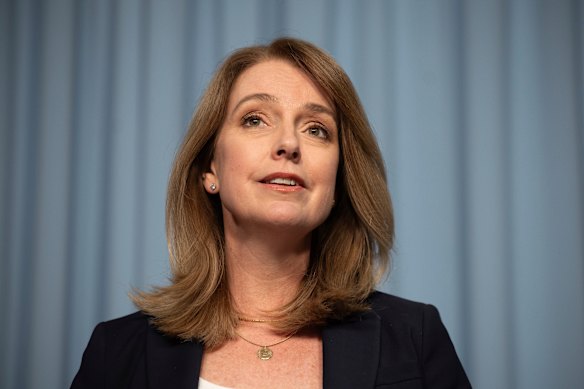
Member for Vaucluse Kellie Sloane speaks on Monday about the threats she received after condemning the neo-Nazi rally.Credit: Sitthixay Ditthavong
“I will not be bullied out of saying what I think, and I will stand up for people in my community and for the broader community of Sydney who don’t like hate, who don’t want division any more, and who don’t accept this kind of behaviour.” Kellie Sloane, MP for Vaucluse
“Targeting any community, because of their faith, culture or language is abhorrent. We acknowledge the direct impact that yesterday’s events will have had on our Jewish community and we stand in solidarity with them.” NSW Faith Affairs Council and Multicultural NSW Advisory Board