3 months ago
27
3 months ago
27
More often than not in the NRL, it’s the point of no return.
That pivotal moment when full-time is fast approaching, the game is in the balance and a team is under siege on its own line. Then the defence cracks.
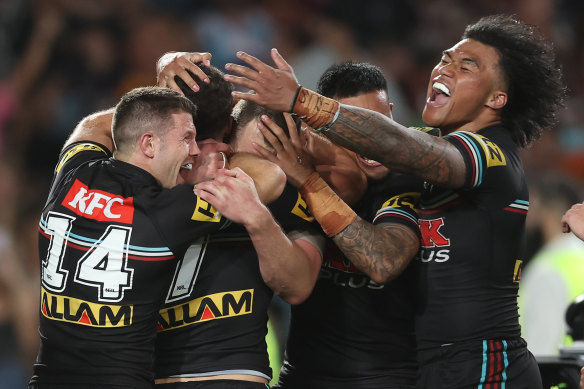
Penrith won one of the great deciders in 2023 with the biggest comeback in grand final history. Could they have done that if they’d had to kick off after scoring?Credit: Getty Images
Hearts sink and heads drop, because before they have even refilled their lungs with oxygen they’ll be kicking off again. Unless they can produce a play to regather possession, the result is all but in the bag.
So it has been for every rugby league season since 1908, except for one – the breakaway Super League campaign in 1997, which many fans would rather forget, or remember only because it split the game they loved in two.
In a bid to differentiate themselves from the established ARL competition, Super League implemented a number of on-field rule changes. One was the introduction of the video referee, which has clearly stood the test of time. The other decreed that whichever team scored points would restart play with a kick-off.
“Scorer’s kick”, in other words.
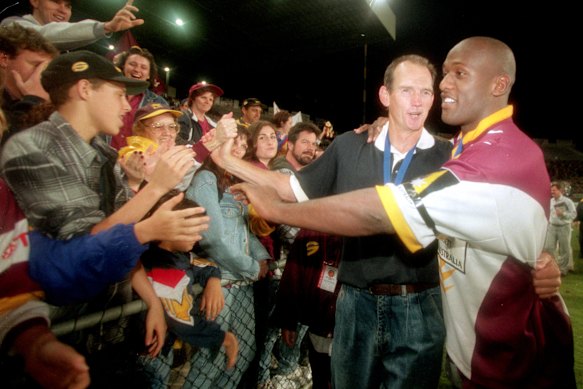
Wendell Sailor, Wayne Bennett and the Broncos won the Super League title in 1997 under the modified kick-off rule.Credit: Getty Images
Initially, the change attracted criticism, largely because in the early rounds of the season Super League games were high-scoring try fests.
At the time, David Waite, coach of ARL team St George, described the rebel competition as being “a bit like basketball”.
“My view is that the ‘you score, we score’ doesn’t fool anyone,” he said.
By the end of the season, however, statistics suggested the new rule didn’t make that much difference.
In 96 Super League fixtures, 692 tries were scored, or 7.2 a game. In 141 ARL games, 959 tries were scored (6.8 a game). The average score in Super League was 28-15. The average ARL scoreline was 25-13.
So hindsight would suggest it evened itself out, yet when the two leagues reunited at the end of 1997 to form the NRL, tradition held sway, and scorer’s kick was consigned to the dustbin.
Until now.
Barely a month before the first pre-season trials, scorer’s kick is among four changes the NRL has asked clubs to consider. The others are an increase in game-day squad sizes from 17 to 19, set restarts instead of penalties outside the 20-metre line and six tackles instead of seven for the defending team if their opponents knock-on over the tryline.
Of those changes, scorer’s kick – recommended by a highly qualified committee of coaches comprising Wayne Bennett, Craig Bellamy, Ricky Stuart, Ivan Cleary and Craig Fitzgibbon – appears the most significant and most likely to cause controversy.
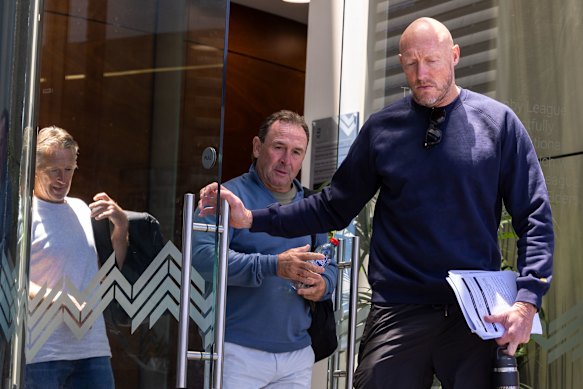
Coaches Craig Bellamy, Ricky Stuart and Craig Fitzgibbon at NRL headquarters after last month’s meeting to discuss possible rule changes. Credit: Sam Mooy
In an email to clubs, NRL chief executive Andrew Abdo explained that scorer’s kick would be optional, because the team that has conceded the try would also be given the choice of kicking off, instead of receiving the ball.
Abdo said this would introduce “a new tactical element to the game where the captain can decide whether possession or field position is more important based on game circumstances”.
Bennett, who coached Brisbane to the Super League title in 1997, is clearly a fan of the concept, arguing that in the modern game, especially since the advent of the interchange and, more recently, set restarts, momentum swings have become increasingly hard to counter.
Scorer’s kick, theoretically, would give teams some respite when they are on the back foot, keeping them in the contest and reducing the likelihood of blowout scorelines.
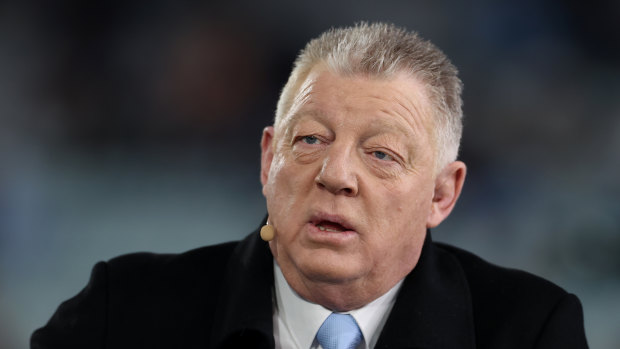
“It was a disaster”: Phil Gould said changing the kick-off rule did not work for Super League and it won’t work now.Credit: Getty
“It makes it fair,” the game’s most experienced coach said last month. “You have equal opportunity with the ball. Ball control has always been important in the game, but it’s distorted because you can score, then you go back and get the ball back.”
Others are sceptical.
Canterbury boss Phil Gould has been the most outspoken critic, stating on social media: “Whoever it was that regurgitated the concept of the scoring team kicking off in the NRL should be publicly whipped. Please ... they tried this rubbish years ago, and it was a disaster.”
Cleary appears dubious, pointing out that Penrith (2023) and Brisbane (2025) won grand finals after launching mid-game comebacks. Such revivals hinge on getting the ball back from the kick-off.
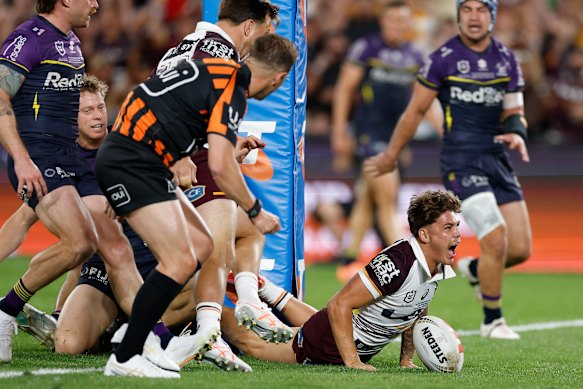
Could Reece Walsh and the Broncos have produced their grand final comeback with a changed kick-off rule?Credit: Getty Images
Manly coach Anthony Seibold also has concerns. He played during the Super League era and has not forgotten that “there were still big scorelines and big momentum swings”.
He was wary of “change for change’s sake”, and recommended a trial period to assess the impact of scorer’s kick.
“Some coaches and players see potential for an added tactical element, but others believe this change alters game momentum,” Seibold says.
“I feel, tactically, short kick-off rules already provide a tactical option for the non-scoring team.
“Our club’s concern is built around how the tactic is communicated and what it does to the game, as this may increase stoppages if teams need to reset their positions once a decision is made.
“Clubs also need further detail on the process and communication of the rule.
“Our thoughts are that the rule be trialled before being implemented. Therefore, we can see how the rule changes momentum of the game and/or does it make the game better viewing and a better game for the players?”
Knights coach Justin Holbrook said he felt some of the proposed rule changes were “terrific” and would improve the game, but he was not convinced about scorer’s kick.
“I’m not sure if that’s going to be put in,” he says. “At the moment, it’s just a recommendation.
“Until it gets confirmed, I’m not really going to look into it too much … if it does, we’ll adapt to it.
“If all of a sudden you’ve got the choice [to kick off or receive the ball], it all depends on the position.
“If you’re behind, you want the ball back. If you’re not, you’ll kick long and things like that. It’ll all be the game situation if that comes in.”
Almost three decades after his “you score, we score” comment, Waite is still involved in rugby league, as chairman of Runaway Bay junior club on the Gold Coast, and as an advisor in Melbourne Storm’s pathways system.
He enjoys the modern game but insists it needs to maintain a “balance” between attack and defence.
He said scorer’s kick could potentially “sway the seesaw a bit”, but the NRL’s best coaches will soon adapt.
“I’m not against change and having a look at new ideas,” Waite says. “Obviously the game is still about possession and field position. That’s the war of attrition.
“It will add some fascination to see how coaches go about it.”
He predicted that most teams will opt to receive the ball after conceding a try, rather than kicking off.
“Although if they drop the kick-off, or turn the ball over on tackle two or three, they might be wishing they’d made a different decision,” he says.
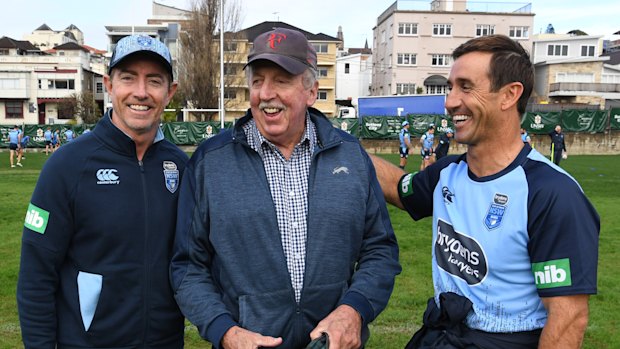
Warren Ryan, pictured with Greg Alexander and Andrew Johns, changed the game in the 1980s with his innovative coaching.Credit: NRL Photos
He felt it was “really healthy for the game” that the NRL was willing to seek the advice of senior coaches to hopefully create an improved product.
Waite served his coaching apprenticeship at Canterbury in the mid-1980s under Warren Ryan, whose famous “umbrella” defensive system proved so effective it prompted officials to introduce the 10-metre rule, doubling the distance between the attacking team and the opposition defensive line.
Ryan, one of the all-time great coaches, believes scorer’s kick makes perfect sense.
“It’s consistent with the concept of a shared-possession game,” Ryan says. “We’ve scored, now you receive the ball from the kick-off, and we’ll see if you can score.
“I think it’s reasonable that the side that has been scored against should have the option of possession, if they want it. I don’t think it’s a bad thing.”
Ryan noted that rugby league’s rules have been tweaked multiple times over the years, normally for the code’s betterment.
Loading
“There’s not much wrong with the game as it is,” Ryan says. “The game has generally evolved as it has for good reasons. I don’t think they should tamper with it too much.
“But it’s supposed to be a game of shared possession. That’s why they got rid of unlimited tackles and went originally to four tackles and then six tackles.
“People wanted to see their team get a fair share of the ball, and this is consistent with that philosophy.”
Most Viewed in Sport
Loading