3 months ago
34
3 months ago
34
Like any literary festival, Adelaide Writers’ Week is all about the words.
And Australia’s premier books event was looking forward to hundreds of thousands of them wafting across appreciative audiences in the gently sloping Pioneer Women’s Memorial Garden, on the banks of the River Torrens, at the annual ideas jamboree next month.
That was until a letter from South Australian Premier Peter Malinauskas was sent to the festival’s board on January 2. The words it contained detonated like a thunderclap, with some in the arts community convinced it contained an “or else” demand to remove a controversial writer. Wrong, according to the premier, who says he was responding to a board request for his opinion, issued no directions, but was very forthright in writing exactly what he thought.
On January 8, the Adelaide Festival board made an announcement that set off the extraordinary chain of events of the past week: it said it had removed Australian-Palestinian academic Dr Randa Abdel-Fattah from the Writers’ Week line-up.
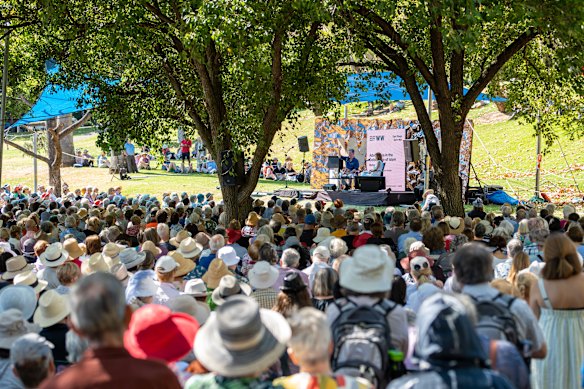
The Adelaide Writers’ Week crowd fills the Pioneer Women’s Gardens.Credit: Andrew Beveridge
The move prompted 180 authors to withdraw from the event. Writers’ Week director Louise Adler quit on Tuesday, as did most of the board. The board said in a statement that while it was not suggesting “in any way” that Abdel-Fattah or her writing had any connection with the Bondi terror attack – in which 15 people, most of them Jewish, were shot and killed – but that given her past statements, “it would not be culturally sensitive to continue to program her at this unprecedented time so soon after Bondi”.
Disastrously, Writers’ Week was cancelled, and Malinauskas – who is facing a state election in March – was accused of pressuring the board (which he vehemently denies).
A former board member then emerged to accuse Adler of hypocrisy over a previous cancellation of a Jewish writer, Malinauskas protested his innocence, and Abdel-Fattah sent him a concerns notice, a precursor to defamation action.
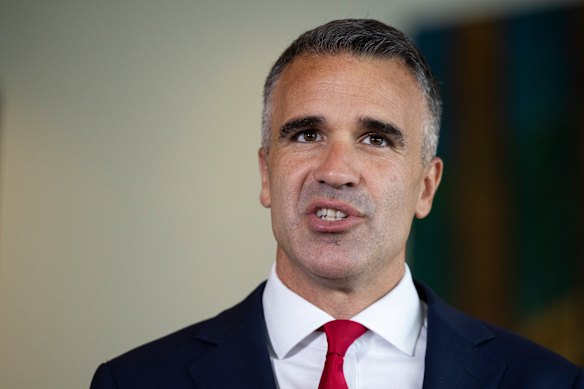
South Australian Premier Peter Malinauskas. Credit: Alex Ellinghausen
A newly formed board then apologised to Abdel-Fattah and invited her to speak at next year’s event. She has accepted the apology but has not accepted – at this stage – the invitation to return.
Writers’ Week remained cancelled as the bigger Adelaide Festival attempted to prevent boycotts infecting its event, which starts in late February and ends a week before the state election. Late on Thursday, opening-night festival headliners Pulp dropped another bombshell, revealing they were set to withdraw, but the festival asked them to hold off while working through the dramas – which they did, with the board’s backflip on Thursday.
Loading
Meanwhile in Canberra, anti-hate speech laws prompted by the Bondi terror attack faced a painful and contested passage through parliament.
Many of those who attend the annual ideas jamboree that is Adelaide Writers’ Week praise its civilised atmosphere generated in part by its beautiful location, nestled amid the holly oaks, poplars and myrtle trees of the city’s Pioneer Women’s Memorial Garden.
Its hallmark is “peak gentility”, says Adler. The prospect of sitting in the summer shade listening to great minds, opposing voices, robust discussion and civilised debate draws thousands of pilgrims from across Australia for the event, which this year was to feature such luminaries as CNN chief international anchor Christiane Amanpour and former New Zealand prime minister Jacinda Ardern.
Held over six days, conversations are conducted in parallel over a handful of stages. Most sessions are free. If you don’t want to hear what’s being said on one, you can head to another, and if you don’t like any of that, you can go and get a cup of coffee, Adler says.
“The 160,000 people that flock to AWW can choose to attend a session or not. If you find an idea or theme upsetting, ‘self-care’ is recommended.”
But, this week, practising self-care will be needed by many people involved with the event, which became highly contested ground.
Clearly, many in the Adelaide arts and culture community, at what is normally its biggest and best time of year, are devastated. You can hear it in their voices, when normally ebullient and cheerful souls are reduced to a whispered monotone on the end of the phone.
Everybody was shattered and tense, said one arts executive, requesting anonymity to speak frankly without retribution.
“It has made everyone feel so down. We have the festival season coming up – normally everyone is so buoyant.
Adler, 71, who resigned via a column in Guardian Australia (“of course she did” an ex-board member said archly) attended her first Adelaide Writers’ Week as a teenager, when her mother took her out of her Jewish high school in Melbourne for the event. She has loved it ever since.
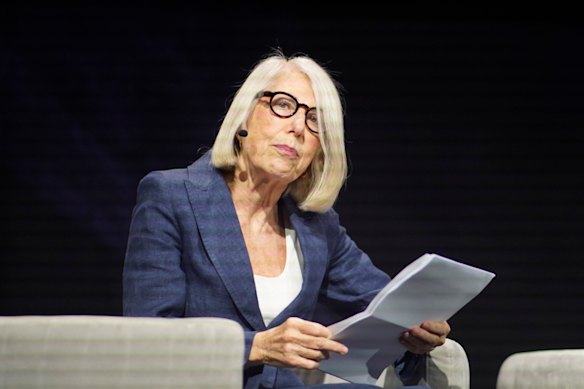
Louise Adler resigned on Tuesday as director of Adelaide Writers’ Week.Credit: Dion Georgopoulos
Through intellectual rigour, enthusiasm and charm, Adler, a former Age arts editor and book publisher (who is married to storied comic actor Max Gillies) has had a significant impact on publishing.
She is a member of the progressive group the Jewish Council of Australia, which rejects antisemitism and supports Palestinian freedom, while arguing criticism of the political ideology of Zionism and the State of Israel is not antisemitism. Adler’s programming at AWW has reflected this, generating public controversy and chagrin among some board members.
Malinauskas, 45, a former official in the conservative retail worker’s union SDA, enjoys nothing more than boosting his state’s coffers via major events, whether that be the AFL’s Gather Round, Saudi-backed LIV Golf or the Supercars Adelaide grand final. In 2024, at the AFL grand final, he did a deal on the spot to secure the event’s headliner, Katy Perry, to tour Adelaide the following year.
It is the letter that the premier sent on January 2 to then-Adelaide Festival board chair Tracey Whiting that is shaping as key to the entire Writers’ Week saga.
It lies at the heart of several competing narratives: that the premier subjected the festival board to relentless pressure until it cancelled Abdel-Fattah; and that the board, having previously grappled with Adler and expressing dissatisfaction over her Palestinian programming, asked the government for advice over an artistic, reputational and governance hot-potato it felt unable to deal with without input from a key stakeholder.
The premier’s letter has not been released. Some in the arts community have dubbed it the “Or Else” letter, believing Malinauskas implied that there would be consequences for the festival unless Sydney-based Abdel-Fattah was cancelled.
Loading
The premier denies this and says that uninviting her was a board decision. (The festival’s executive director, Julian Hobba, also said this week that it was a board decision to remove her from the line-up.) Her inclusion was not listed in the Writers’ Week program when it was released in October and many found out she had been invited to the festival only when the board announced it was uninviting her.
On Friday, Malinauskas told this masthead that the board had approached him in September.
“The board chair alerted my office to the considerable challenges and the risks that they were encountering as a result of very strong differences of opinion between the board and their executive. We made clear this is their responsibility to sort it out. Not mine.
“Post Bondi, this issue came up again, obviously.”
He said he offered an opinion around Christmas in discussions with the chair, as members of the board wanted to know definitively what his position was.
“They wanted to have a sense of confidence that the premier would have their back if they made the decision to cancel or remove Abdel-Fattah from the program,” he said.
“I said of course, and I wrote a letter accordingly so that nobody could be under a misapprehension about what my position was.”
The letter was “considered”, he said, and “made clear, without qualification, that this was the board’s decision to make” as a principle but also as a matter of law. (State legislation forbids the government from instructing the festival.)
He says he also wrote: “I reserve my right to be able to speak about my position publicly, absolutely.” That position was that Abdel-Fattah should be removed: “I wrote that crystal clear. I think it might have been the first line or something.”
Asked about the contents of the January 2 letter, an Adelaide Festival spokeswoman said: “In line with standard government practice, we’re not able to provide any correspondence between the government and board.”
According to former Adelaide Writers’ Week director Jo Dyer, the person responsible for the entire mess is indeed the South Australian premier.
“Both the premier and the board were separately warned what the consequences would be if they pursued this path, if he kept pressuring the board to uninvite Dr Abdel-Fattah, and if the board, as they eventually did to their great discredit, buckled under that pressure,” she says.
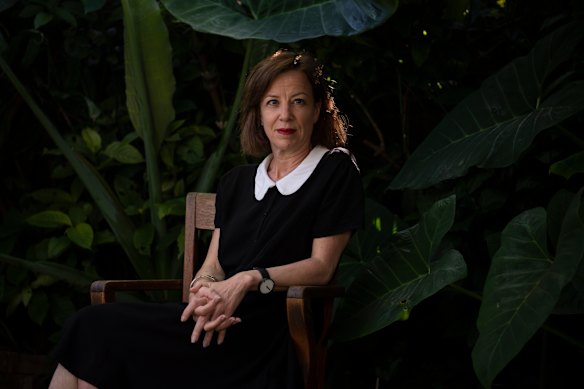
Former Adelaide Writers’ Week director Jo Dyer.Credit: Wolter Peeters
“They either didn’t believe the warnings or they decided to proceed anyway – and if it’s the former, it’s extraordinary, given that less than 12 months ago the example of Bendigo Writers Festival was right there to see. And if it’s the latter, then they’re stupid.”
Dyer argues Malinauskas “doesn’t understand the role of culture and the arts in the reputation of South Australia”.
Beyond the state borders, federal Minister for the Arts Tony Burke remained tight-lipped while federal Opposition Leader Sussan Ley agreed with the decision to uninvite Abdel-Fattah.
Norman Schueler, of the Jewish Community Council of South Australia, had asked the festival board to remove Abdel-Fattah, and rejoiced when it did.
But after the board’s backflip on Thursday, he said he was in “total disbelief”. “The board has acted with unconscionable conduct,” he said. “It has pandered to a vociferous minority … it’s run scared into the arms of self-righteous persons [and] trashed the reputation of the festival.
“I do not believe the board has the right to apologise on our behalf; our communities have been profoundly hurt,” he continued, adding he would fight to have Abdel-Fattah kept off the program next year.
Abdel-Fattah has come under fire for past social media posts that said Zionists had “no claim to cultural safety” and that institutions that considered “fragile feelings of Zionists” were “abhorrent”.
She was also criticised for posting an illustration of a paraglider with a Palestinian flag parachute as her Facebook profile photo the day after the October 7, 2023, Hamas attack on Israel. She has since apologised.
It is clear that festival executives did not want to rescind the invitation, in contrast to the board. Although what transpired behind closed doors is not clear. Most of the former board have declined to comment, citing confidentiality surrounding board matters.
Since Adler took over the directorship, there has been controversy, which some of her detractors say is deliberately courted. Others would argue it’s inevitable at an event that addresses the big, complex issues of our day.
In 2023, three Ukrainian writers withdrew from the event – as did a sponsor, over comments made by Palestinian-American writer Susan Abulhawa, after she labelled Ukrainian president Volodymyr Zelensky, who is Jewish, “a depraved Zionist”.
After that controversy, Malinauskas, who has both Hungarian and Lithuanian forebears who fled communist Europe, made public his disagreement with programming decisions, but also that he didn’t want to program the festival.
“Of course, he is perfectly entitled to that view; indeed, in this democratic country he can even choose not to attend her event,” Adler told this masthead on Wednesday.
“His problem is that in front of 1200 people in the Adelaide Town Hall, he declared that if politicians were to take on the role of arts curators we might as well be living in Putin’s Russia. He could have adopted exactly the same response to Randa Abdel-Fattah’s appearance.”
She went on to say that “to suggest that a premier’s views regarding the inclusion or exclusion of a given writer, when the state is the principal funder of an arts organisation … didn’t constitute ‘pressure’ and didn’t actually send a message is disingenuous”. The state government contributes around $10 million annually to the Adelaide Festival.
Loading
“The term ‘cultural safety’ is code for saying, I don’t want to hear your opinion.”
Of Adler, Malinauskas says: “She’s charming, she’s persuasive, she’s intelligent.
“Recent events obviously have us on a point of disagreement rather than agreement. ”
But then he refers to the cancellation in 2024 of Jewish American columnist Thomas Friedman and Adler’s resignation statement about silencing writers.
“To resign on a matter of principle and then … for it to be revealed that you yourself had not adhered to that principle only two years earlier is quite remarkable,” he said.
“I can be comfortable in my conscience that everything I’ve said and done has been motivated by genuine good intent, consistent with basic principles that I would have thought most people share: good people can arrive at different conclusions.”
Loading
In 2024, Adler programmed both Jewish and Palestinian writers.
According to ex-board member Tony Berg, a Jewish businessman and a governor on the Australia-Israel Chamber of Commerce, this programming was still biased, and Adler led a push to rescind an invitation to Friedman after he likened the situation in the Middle East to the animal kingdom. Friedman told this masthead on Thursday that he did not withdraw from the 2024 event of his own volition, but was uninvited by organisers, who told him the timing would not work.
Abdel-Fattah was one of 10 academics who wrote a letter to the Adelaide Festival board asking for Friedman to be removed from the Writers’ Week program.
At the time, the board said publicly that Friedman would longer appear due to a scheduling conflict, but in his resignation letter to the board in October, Berg accused Adler of removing him.
Last year, Adler programmed British historian Simon Schama to speak on antisemitism, for a headline paid event at Adelaide Town Hall introduced by the premier.
Former Liberal prime minister Tony Abbott was on this year’s program talking about his big-selling Australia: A History, now in its second print run.
Last year Adler invited Abdel-Fattah to join the 2026 Writers’ Week to speak about her new novel, Discipline, which examines ideas of truth and censorship.
The board met and decided to do nothing, leading to Berg – a director of advisory group Gresham – resigning last October, saying he couldn’t sit on a board that employed a director of Writers’ Week who continued to deal with the board “inappropriately” and “who programs writers who have a vendetta against Israel and Zionism”.
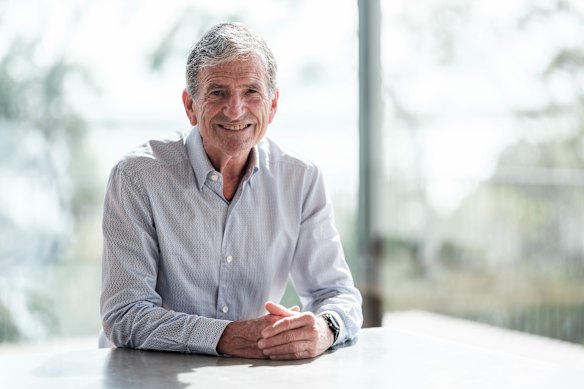
Tony Berg resigned from the Adelaide Festival board in October.Credit: Oscar Colman
The board, in the knowledge that festival staff did not want to withdraw the invitation, put out its statement that was widely criticised for conflating Abdel-Fattah’s attendance with the atrocity at Bondi.
In Australia, it is an obvious fact that a huge swath of artistic life is underwritten by governments. Freedom of expression has come up hard against corporate governance and stakeholder management on many occasions in recent years.
The bigger picture issues it underlines are ongoing, and the arts have been the epicentre of divisions over Israel and Palestine in the past few years. There has since been a litany of arts-related stoushes inspired by what is happening in Gaza, including the implosion of the Bendigo Writers Festival, State Library Victoria cancelling pro-Palestinian writers’ workshops, Creative Australia uninviting then reinviting Khaled Sabsabi to represent Australia at Venice Biennale, and a concert by pianist Jayson Gillham being cancelled by Melbourne Symphony Orchestra after dedicating a piece to journalists killed in Gaza, saying some had been deliberately targeted by Israel. The Sydney Theatre Company also faced a backlash when it apologised after actors wore keffiyeh scarves on stage during a performance of The Seagull, as a gesture of solidarity with the Palestinian people.
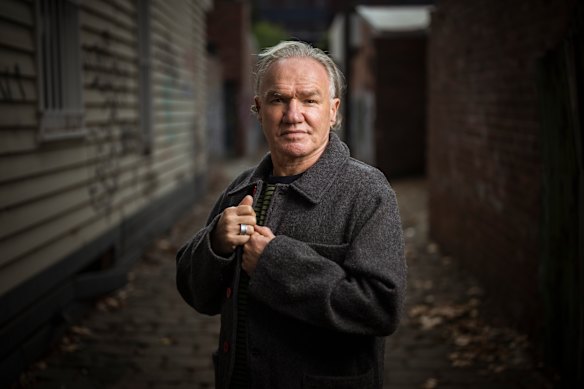
Professor Tony Birch.Credit: Chris Hopkins
Asked what – if any – lessons can be learnt from the Adelaide Festival debacle, Professor Tony Birch, chair of Australian Literature at University of Melbourne, says it seems to have taught us little. “For more than two years now, the faceless members of creative boards have interfered with the freedom of expression and human rights of authors and artists.” he says. “We’ve experienced car crash after car crash and yet, the incompetence continues.”
Birch says Abdel-Fattah’s invitation should never have been withdrawn. “She is an important Australian author … and a proud Palestinian woman with the right to speak up about the violence suffered by the people of Gaza,” he says. “To silence her voice would diminish us as a community if we claim to uphold the democratic rights of all people in this country.”
Birch argues it is imperative that writers and artists produce work with freedom. “What we have witnessed over the past week undermines this ethic. As a writer, I support the freedom of expression of all artists, regardless of whether they agree with me or not. I welcome rigorous debate as much as I do solidarity. If I cannot defend my own position against an adversary, my work has no value. The best means of assessing a moral or political position is to test it.”
Adler says that for two years now, the Murdoch press and Israel supporters have waged a relentless campaign to silence artists, writers, and academics who are critical of Israel.
She believes it is vital for everyone involved – artists, boards, and management – to be clear about what’s at stake. “At the heart of this endeavour is to support artists and their right to speak. We have seen boards are subjected to political interference, to pressure from donors with chequebooks, and interest groups who are very capable lobbyists,” she says.
“But the question is, what relationship should the board and managers of arts organisations have with these external forces?”
Adler says you could hardly blame any of these organisations for saying, “it’s all too hard, the static will impact our financial position, it will compromise our artistic integrity”.
Describing this idea as the “pre-emptive buckle”, she says it’s a deliberate strategy. “The intention for years – long before Bondi, long before October 7 – is to censor Israel’s conduct.”
But ex-festival board member and former federal Liberal minister Amanda Vanstone disagrees.
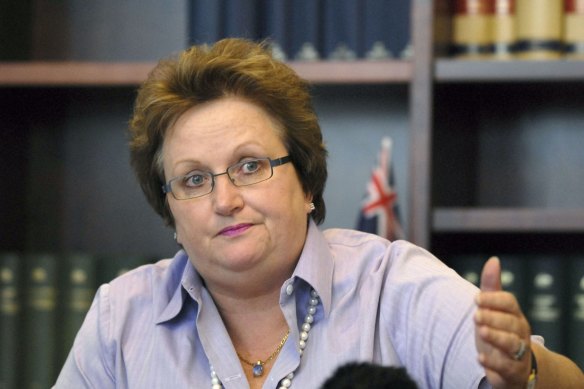
Former Liberal senator Amanda Vanstone was previously on the Adelaide Festival board.Credit: David Mariuz
“For god’s sake, this is the third time these issues have been raised,” she says of such controversies involving the event in recent years.
“The board obviously has an interest that the festival doesn’t appear to be pushing one particular political view.”
Philanthropist, business executive and University of Melbourne chancellor Jane Hansen acknowledged the festival’s importance in the arts calendar.
The Hansen Little Foundation, funded by Hansen in conjunction with her husband, real estate executive and former Essendon Football Club president Paul Little, is listed as a key literary festival donor but has not given in the past few years.
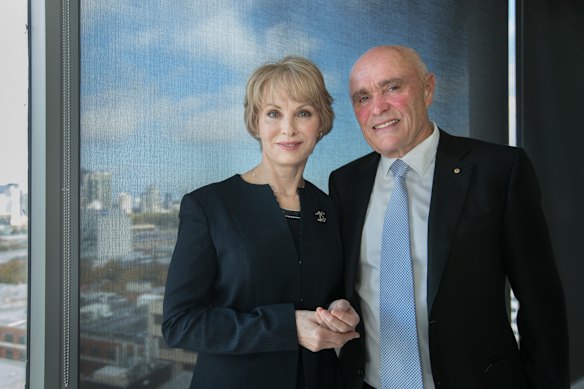
Philanthropists Jane Hansen and Paul Little. The couple’s foundation has previously donated to the Adelaide Festival’s literary fund.Credit: Simon Schluter
“[I] would dearly hope it continues,” she says. [It’s] a very challenging time for public institutions to adequately respond to very justified community outrage and distress.
“We must all be alert to that.”
For now, the bigger show – the Adelaide Festival – will go on, and while this year’s Writers’ Week remains cancelled, many South Australians including the premier are hopeful it will return in 2027.
Malinauskas has spoken at every Writer’s Week since becoming premier and would consider an invitation to speak next year, “if and when the time comes”.
“I might not be premier mate. I have an election coming up.”
Start the day with a summary of the day’s most important and interesting stories, analysis and insights. Sign up for our Morning Edition newsletter.