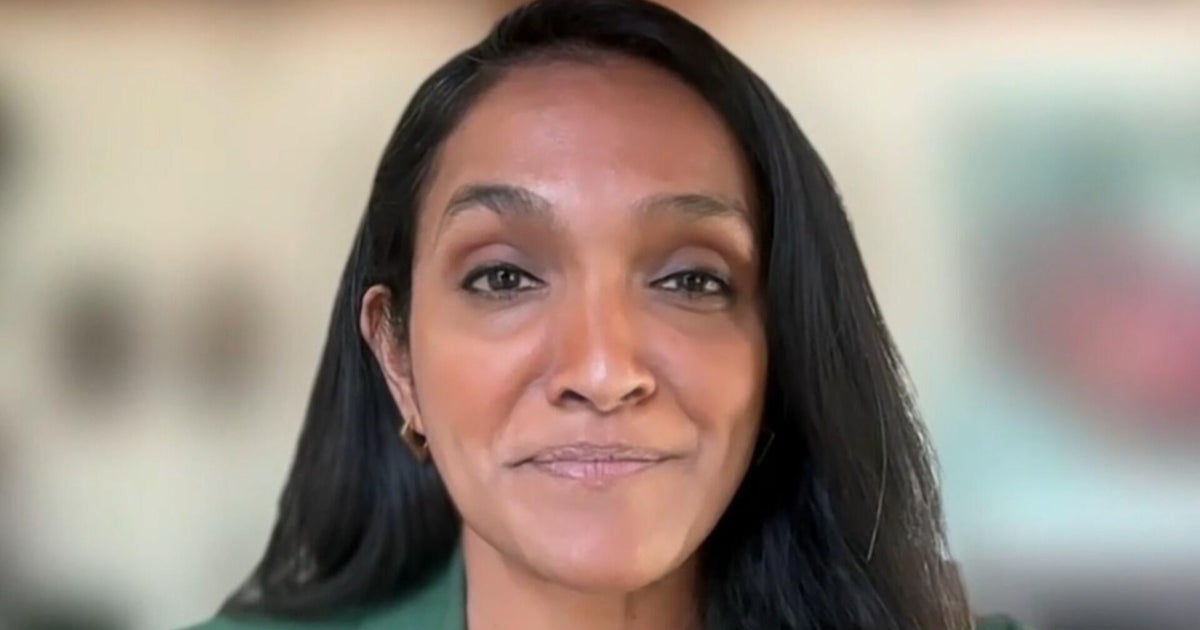
Becca Valle didn't understand why she kept having aching headaches. She was happy at a new job. She was living with her boyfriend and happy to be near her family. She had recently checked a major item off her bucket list by running a marathon. All in all, her stress levels were low.
In September 2021, Valle began waking up with painful headaches that would become debilitating throughout the day. Valle was convinced it was migraines. Her doctor thought something might be wrong with her sinuses.
One day three weeks later, the pain Valle was experiencing became so bad she couldn't sit up or stop vomiting. When her boyfriend came home from work, they went to the hospital. A scan showed blood in her brain. Doctors performed an exploratory craniotomy, where a part of the skull is removed to examine the brain.
"I don't know that I was with it enough to really know what was going on, which is probably a good thing, because if I had taken the time to process that they were cutting a piece of my skull to go into my brain, I don't know that I would have felt great about that," Valle, then 37, said.
The surgery found a brain tumor that was removed in a second craniotomy, and testing showed it was glioblastoma.
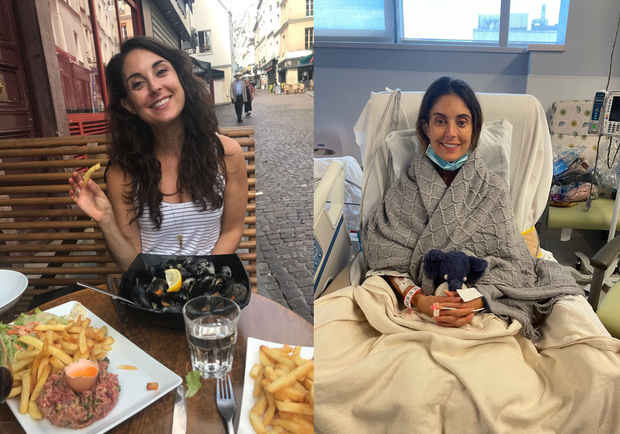 Left: Becca Valle in Paris before her diagnosis. Right: Becca Valle in the hospital.
Becca Valle
Left: Becca Valle in Paris before her diagnosis. Right: Becca Valle in the hospital.
Becca Valle
Most glioblastomas cannot be fully removed with surgery. Even in cases like Valle's where the tumor is completely removed, patients receive chemotherapy and radiation to attack any remaining cancer cells. Only about 10% percent of glioblastoma patients live more than five years after diagnosis, according to the University of Texas' MD Anderson Cancer Center.
Treating glioblastoma is complicated by the blood-brain barrier, a protective layer of cells that prevents most medications from entering the brain, preventing many side effects but making it harder to treat the brain itself.
Participating in trial was "no-brainer," Valle says
Valle was given the option of enrolling in a clinical trial that was studying the effects of briefly opening that barrier. Saying yes was easy, she said.
"It was a no-brainer. This could save my life," Valle said.
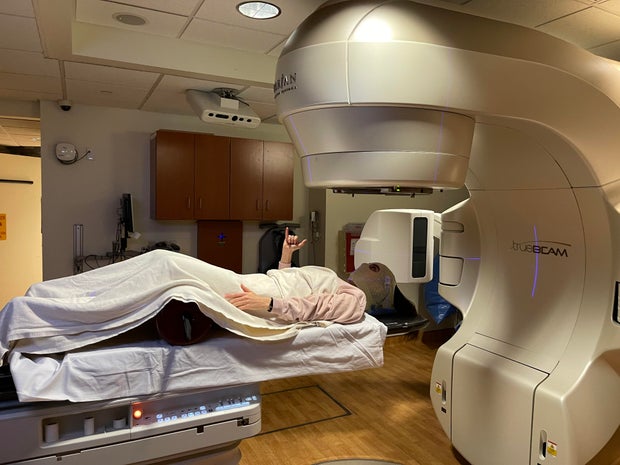 Becca Valle undergoes radiation treatment.
Becca Valle
Becca Valle undergoes radiation treatment.
Becca Valle
Dr. Graeme Woodworth, the study's lead researcher and the chief of neurosurgery at the University of Maryland Medical Center, posited that a focused ultrasound could safely open the blood-brain barrier and allow systemically administered chemotherapy to be more effective.
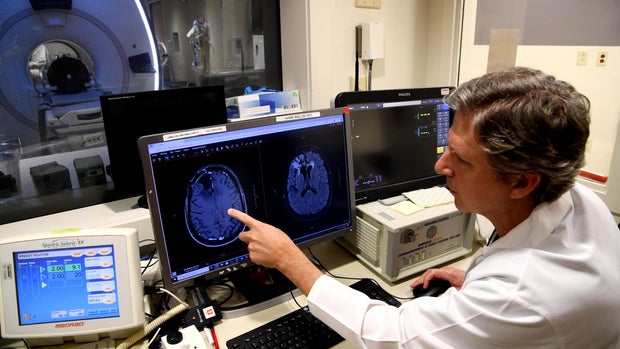
Sound waves from the ultrasound had been shown to interact with circulating microbubbles, standard imaging contrast agents used in tests like echocardiograms. The sound waves activate the bubbles, causing them to expand and oscillate, leading to "teasing apart" the brain blood vessels, Woodworth said. For up to a few hours, molecules like chemotherapy drugs are able to pass through the blood-brain barrier, he said.
Valle was one of 34 participants in the trial. Each underwent between three and six focused ultrasound treatments over six months. They also underwent frequent MRIs to ensure their cancers had not recurred and that the focused ultrasound was not causing any problems. The treatment involved wearing a large device around the head.
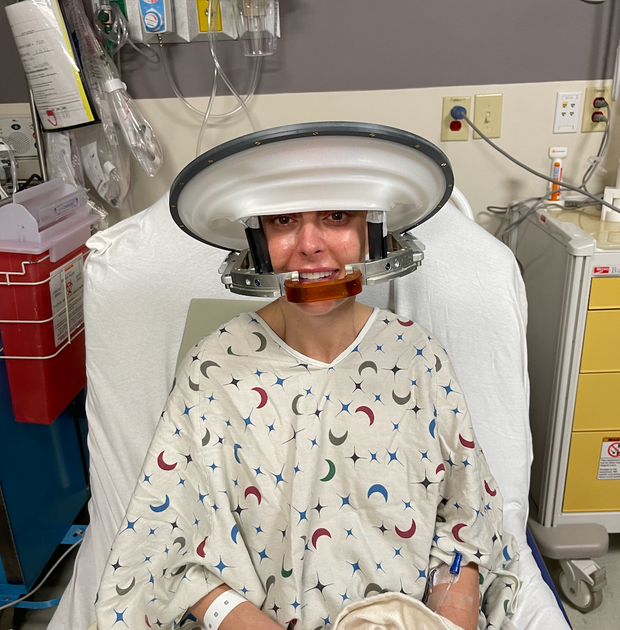 Becca Valle on her first day in the clinical trial.
Becca Valle
Becca Valle on her first day in the clinical trial.
Becca Valle
Trial data shows "survival advantage"
Woodworth said the study data showed "early evidence" the method worked.
"During the study, we did not have a way to directly track the drug in the body," Woodworth said. "So we could not assess if we were getting more drug into the tumor region. It wasn't until we had the follow-up data, months and months later, that we saw up to 40% of the patients in the study were still alive at a time we expected most would have succumbed to progressive brain cancer."
Woodworth and his multi-institutional team established a contemporary matched control group to see how glioblastoma patients that did not undergo focused ultrasound compared to those in his study. The control group was much larger than the study group, he said. The data showed a "survival advantage" for patients who took the oral chemotherapy and had the focused ultrasound, as opposed to those who just had adjuvant chemotherapy. The comparison showed the monthly treatment is safe and may "improve survival and tumor control," he said.
"Important step in the right direction"
Dr. Patrick Wen, a neuro-oncologist at the Dana Farber Cancer Institute who was not involved in the trial, called Woodworth's research "an important step in the right direction" and an "encouraging signal." He said he hopes further studies look at different chemotherapy medications and use randomized control groups, instead of matched groups, to create more rigorous data.
Woodworth said ongoing studies are seeking to confirm and expand his research.
The University of Maryland is not currently offering the focused ultrasound treatment for patients with glioblastoma, as the treatment method and device are under review with the FDA.
A spokesperson said the hospital is running a clinical trial looking at using the technique to treat brain metastases in patients with a certain type of lung cancer.
 Dr. Graeme Woodworth.
University of Maryland Medical Center
Dr. Graeme Woodworth.
University of Maryland Medical Center
The study also sparked a new direction of research. Blood tests conducted before and after the patients underwent the focused ultrasound showed different results, Woodworth said, raising the possibility that non-invasive tests called liquid biopsies could be used to monitor the progression of brain cancers.
Woodworth and a multi-institutional team conducted a second clinical trial that is awaiting review from the FDA. He said he hopes the research will eventually lead to the development of an accessible device to open the blood-brain barrier for patients with brain disorders.
"If we are able to get this device into clinics, it really opens the door for doctors, pharmaceutical companies and biotech companies to work together," Woodworth said. "With an FDA-approved device that can safely and repeatedly open the blood-brain barrier, we can now start thinking about effective combination therapies for GBM patients in new, exciting ways."
An outlier living "life to the fullest"
Valle said she had no side effects from participating in the trial. Four years after her diagnosis with glioblastoma, she has no evidence of disease. It's a rare positive outcome for a disease that kills most patients within 18 months.
"I am truly an outlier," Valle, now 41, said.
 Becca Valle hiking in Italy after the trial.
Becca Valle
Becca Valle hiking in Italy after the trial.
Becca Valle
Valle said she feels like she is back to her old self. She is planning a ski trip to Europe and focusing on living in the moment. She only needs MRIs twice a year. Otherwise, she tries to stay positive and think about the future, not statistics.
"I don't think about the cancer. It doesn't serve me to live life worrying about if it returns," Valle said. "I've always been a 'Live life to the fullest' person. Why change that now?"
Edited by Sarah Lynch Baldwin
In:
Woman speaks out after surviving glioblastoma
Woman shares survival journey after migraines led to glioblastoma diagnosis
(03:01)