3 months ago
14
3 months ago
14
Jake Weatherald paused for a moment as England celebrated his lbw, then made the “T” sign for a review.
Six weeks back on debut, Weatherald had chosen not to review an lbw decision when the ball turned out to be pitching outside leg stump. This time he did query the decision, only to finish with the same glum walk back to the dressing room.
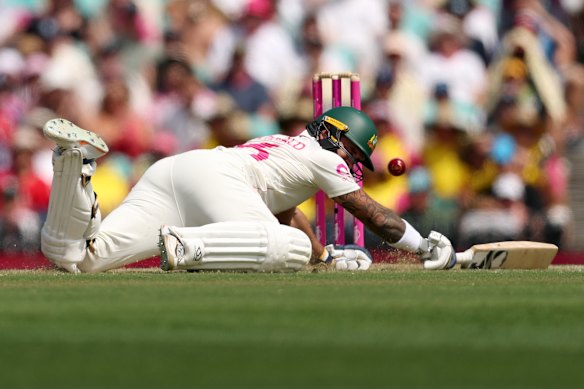
Jake Weatherald hits the deck on Monday in Sydney.Credit: Getty Images
In between those two lbw calls, Weatherald has at times looked the part and at others out of place. His best contributions came in the second innings in Perth and the first in Brisbane, combining nicely with Travis Head for a pair of stands that played a big part in getting Australia to a 2-0 lead they would not relinquish.
But at the same time, Weatherald has shown himself to be consistently vulnerable to full deliveries moving back into him, either swinging down the line from over the wicket, like Jofra Archer’s ball to him in Perth, or angled back from around the stumps, as per Ben Stokes here.
Loading
Those kinds of dismissals are not ideal for an opener, given the likelihood of the full ball to move around when it is new. And England, for all their inconsistencies on this tour, have managed to hammer away at Weatherald along those lines. Inducing mistakes and preventing him from making the sorts of score that would make his place safe for Australia’s next Test matches in August against Bangladesh.
There are a couple of clear alternatives for the selectors to consider. First of those is Queensland’s Matt Renshaw, long considered a possible successor for Usman Khawaja and a player with prior international pedigree.
Part of what makes Renshaw an attractive option for consideration is the fact he is a fine slips fielder – the same spot to be vacated by Khawaja – and also has shown the capability to adapt his game for conditions as contrasting as Australia and India. He also led all comers with three hundreds in the bracket of Sheffield Shield games before the Big Bash League.
Further south in Victoria, Campbell Kellaway has also made a strong run at consideration. At 23, he is comfortably younger than Weatherald or Renshaw, although a little more advanced in years than Sam Konstas.
JAKE’S TEST OUTPUT
- First Test, Perth: 0 and 23
- Second Test, Brisbane: 72 and 17*
- Third Test, Adelaide: 18 and 1
- Fourth Test, Melbourne: 10 and 5
- Fifth Test, Sydney: 21
Kellaway and Konstas batted together for Australia A in India at the start of the season, and while it was Konstas who made a century, the means of Kellaway’s production were considered more polished by those who saw their partnership live. While Kellaway did not produce as many runs a Renshaw in the Shield, he will have the opportunity for more at the season’s back end.
For all of that, plenty of arguments can be made for giving Weatherald a longer run at it. He has dovetailed nicely with Head at the top of the order, with stands of 75, 77, 37, 33, 8, 27 and 57 averaging out at 44.86 runs per partnership, an eminently respectable figure in historical terms.
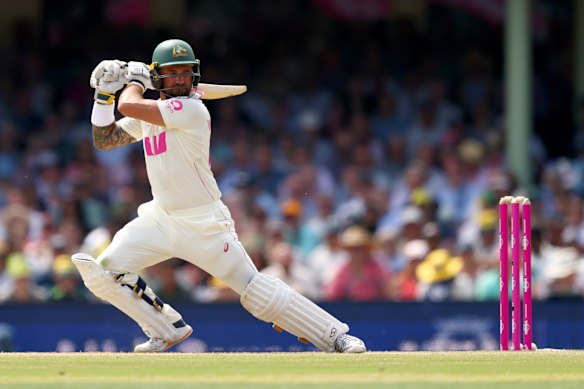
Jake Weatherald cuts.Credit: Getty Images
Weatherald has also shown himself to be a popular and well-balanced member of the squad, not backing down from the occasional verbal battle and also demonstrating an equable temperament, fashioned over a decade in the professional system. He has some technical work to do when it comes to his head position when the ball move back into him, but so did Head once upon a time.
Head’s thoughts, too, should not go unnoticed, for it has been his move up to the top of the order that has been hugely influential in the outcome of the Ashes series.
Loading
“International cricket is extremely tough,” he said before this game. “The wickets have been challenging across the board the last few years, that’s well-documented. It’s not an excuse and I think he’s a good enough cricketer for international cricket and I think he showed a lot of glimpses over his first four Tests.
“It’s not always gonna go your way and there’s a lot of guys who look like they have been under the pump with the bat who are the best of our generation. It can be a tough way to start your international career, but I think he’s a good enough player to play international cricket.”
One thing that is not in doubt is how on more than one occasion, the fast starts made by Head and Weatherald have brought a momentum to the Australian innings that has kept England’s bowlers on the back foot.
That was again the case in Sydney, where despite evidence of nip in the pitch for the new ball and the steady encroachment of overcast skies that forced the use of floodlights, the home side scored at appreciably faster than five an over. By stumps, Head was unbeaten on 91 from 87 balls, at one time threatening to make a century in a session.
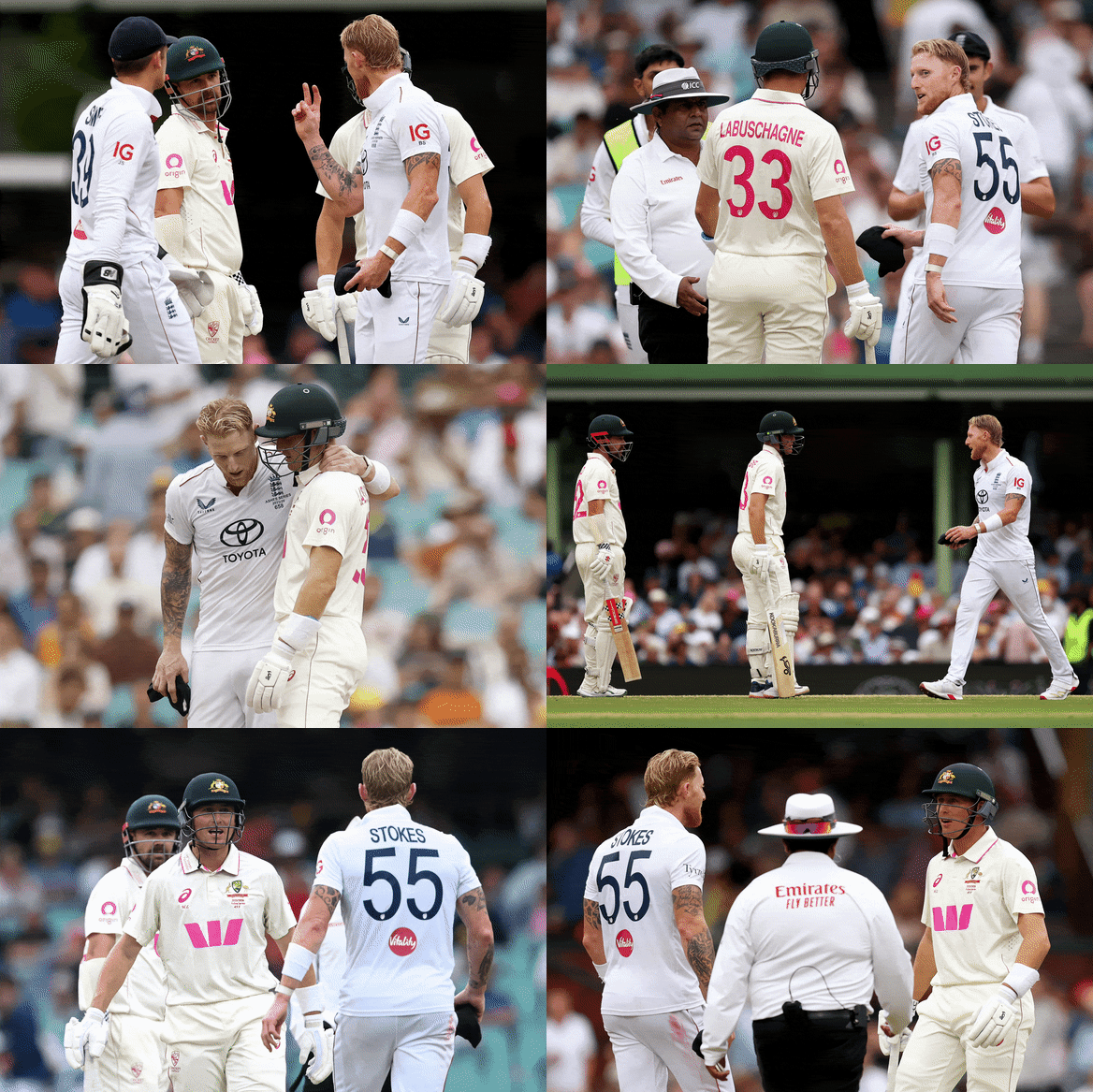
Tempers flared late on day two of the SCG Test as Ben Stokes appeared to tell Australia’s Marnus Labuschagne to “shut the f---” up in fading light.Credit: Getty Images
The flood of runs annoyed Stokes enough to have him telling Marnus Labuschagne to “shut the f*** up” during a mid-pitch confrontation connected to fading light. Undoubtedly, Labuschagne has enjoyed coming in to bat with the runs and adrenaline already flowing, returning his fastest scoring rate in an Ashes series by a wide margin.
Labuschagne though, has not gone on to a truly sizeable score, and neither has Weatherald. How much of Australia’s success in this series can be attributed to the debutant opener is for the selectors to consider.
News, results and expert analysis from the weekend of sport sent every Monday. Sign up for our Sport newsletter.
Most Viewed in Sport
Loading