
 3 months ago
80
3 months ago
80
When my mate Chris Robson and I left England in 1988, we planned to visit every United Nations-recognised country in the world. Last year, Chris enjoyed a multi-destination holiday in Libya, Chad, South Sudan and Yemen, all of which sit uncomfortably on the Australian Government’s Smartraveller Do Not Travel list. I went to Italy for a fortnight instead.
Chris and I both ended up living in Sydney, but I dropped out of the game when I had children. Chris, however, has only 10 countries to go: Haiti, St Vincent, St Lucia, St Kitts, Grenada, Mali, Niger, Mauritania, Sudan and Costa Rica.
Now that he has retired from corporate life, he hopes to reach the natural conclusion of what he calls his “extreme hobby” by the end of 2026.
I’m thinking of going back to Italy.
The website NomadMania acts as a kind of clearing house for obsessive and exhaustive travellers. It was founded by British-born former university lecturer Harry Mitsidis, the son of a Greek father and a South African mother. Mitsidis travelled extensively as a child, then Interrailed around Europe as a teenager. “I had travelled to about 70 countries without even thinking about it,” he tells me by phone during a “quick visit” to Belgrade, Serbia.
It took him about five years to get through the remaining 120-odd nations. “I finished in 2008, in Equatorial Guinea,” he says.
He was only 36 years old, with most of his life ahead of him, so the logical next step was … to do it again.
“I am one of four people who’ve done every country twice,” says Mitsidis, “and the second time around, Equatorial Guinea was the last one again.”
Statistics collected by NomadMania suggest that 13 Australians have visited every country in the world and become what’s known as “United Nations Masters”.
“That’s the terminology we use for this, scientifically,” explains Mitsidis. “I came up with the term 15 years ago.”
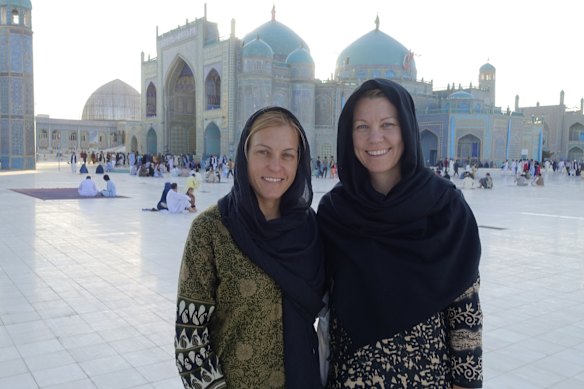
Ten of the 13 scientifically recognised Australian UN Masters are NomadMania members, including Rachel Davey, who appears to be the first Australian-born woman to have visited every country in the world – a project she completed with her Slovakian partner, Martina Sebova, whom she met on an overland tour of Europe in 2008.
Both women worked in the travel industry, and by 2016, they realised they had each seen about 100 countries. So they spent the following two years saving money and selling almost everything they owned to pay for a single, continuous, mostly overland journey to their 88 unvisited states. They left Melbourne in 2018, expecting their journey to take about two years.
“There were nine countries to go when the pandemic stopped us in our tracks,” says Davey, “and we got stranded in Micronesia.”
They were forced to negotiate a tortuous journey back to Australia from Pohnpei in the Federated States of Micronesia. “We had to backtrack through a bunch of islands, and Brisbane,” says Davey. “I think the flight home was about 60 hours’ journey time.”
As the world closed down for COVID-19, the pair “waited it out until eventually the other countries opened up”, says Davey. “And as soon as they did, we went out and finished them all.”
When visiting Islamic nations, such as Afghanistan, Davey and Sebova were generally assumed to be either best friends or sisters. But no matter what they wore, they could never pass themselves off as natives.
“You can’t hide your blue eyes and the way you walk,” says Davey. “I walk with a straight back and with confidence, and even if I’m wearing local dress, you can tell I’m not local.”
In the absence of a male escort, they were sometimes treated as honorary men – but they were also able to enjoy the company of local women in ways that would be forbidden to male travellers.
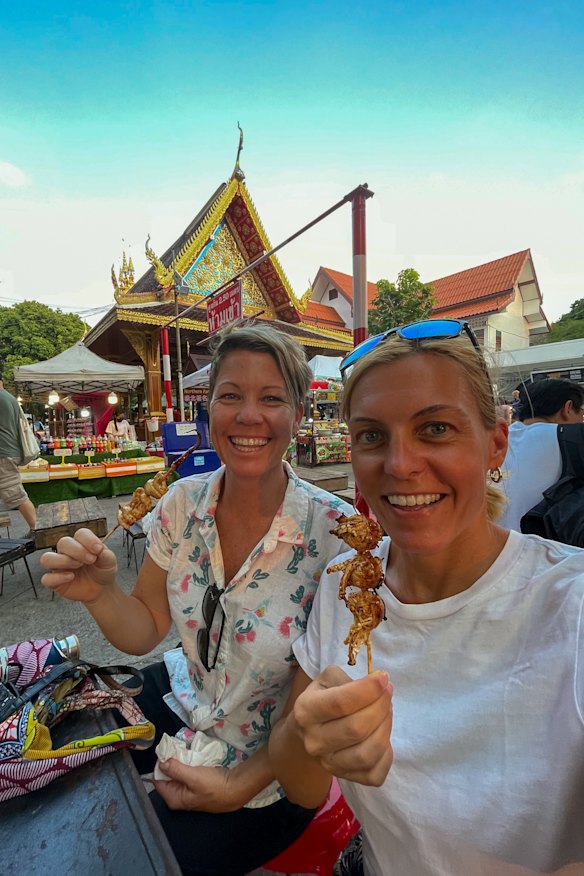
Davey and Sebova now base themselves in Chiang Mai in Thailand, where through their company – Very Hungry Nomads – they run tours that are often for women only, to places that women don’t usually visit. On the schedule for later this year is northern Pakistan.
Davey says that she loves Thailand for its people, beauty, culture and food. I ask Harry Mitsidis which country is his favourite.
“Where I am now,” he says.
Serbia?
“I know it’s an odd one,” he says. “But back when I was exploring it in the early 2000s, it had just come out of war and isolation, so being a foreigner here was exotic and people were very receptive. I ended up learning the language and I feel at home here. I’ve visited every nook and cranny of Serbia.”
Although he says Serbia is “not really on the usual tourist radar”, it is hardly ignored by casual travellers – something you can’t say about some Pacific islands.
“If you see someone going to Nauru, and it’s not for anything work-related, it has to be someone who’s trying to go to every country,” says Mitsidis.
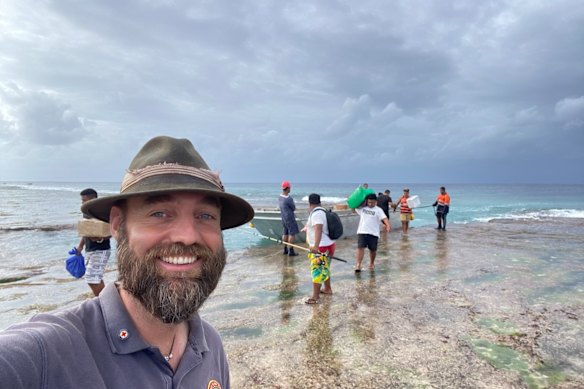
In 2023, my mate Chris was heading to the South Pacific island republic of Tuvalu (population: 10,600) on a Fiji Airlines flight loaded largely with diplomats, aid workers and Tuvaluans returning home, when he realised that “there were three other guys on the plane who all seemed to be doing the same thing that I was – which was flying in from Fiji to say they had visited Tuvalu.”
And it turned out that the island was already playing host to the most famous of global completists, Thorbjørn “Thor” Pedersen of Denmark, who was aiming to go everywhere in the world without once taking a flight.
Pedersen was stranded in the Tuvaluan capital of Funafuti for 59 days, waiting for a cargo ship to Fiji. All five men – a Norwegian, an American, a Peruvian, Chris and Pedersen – had dinner and drinks together. “Thor was a very nice, modest guy and very interested in what the rest of us were doing and how many countries we were on,” says Chris.
When I reach Pedersen by phone in Denmark, he remembers the meeting with affection, too, although he says, “I was two countries away from being able to go back home, having been out there for nine years, right? Getting stuck in Tuvalu didn’t sit right with me.”
But Pedersen was used to being stuck. He achieved international fame during the pandemic, when he was forced to interrupt his odyssey for two years in Hong Kong.
Why did he set out to cross the planet only by land and sea in the first place? “I find it very difficult to identify who the heck I was back in 2013 and why I thought it was such an important task,” he says Pedersen. He grew up in Denmark “reading about explorers who had an opportunity to do the first great thing: the first to reach the top of Mount Everest and come back down alive; the first to make it around the globe; the first to the North Pole, and the South Pole”. He dreamed of adventure, but “slowly realised I was born too late”, he says.
Then he came upon the fact that nobody had ever travelled through every country in the world without taking a flight. So he left home in 2013 determined to accomplish the task, and spend at least 24 hours in every country in the world.
He travelled partly as an ambassador for the Danish Red Cross, sticking to a strict $US20-a-day budget using his own savings along with some crowdfunding and corporate sponsorship. It was all going well – albeit slowly – until he arrived in Hong Kong on a cargo ship from the Marshall Islands in January 2020. He planned to wait four days for the next freighter to Palau, and ended up staying for two years.
Like Davey, Pedersen had only nine countries left to visit. He assumed that what appeared to be an outbreak of animal flu in Wuhan would pass in a few months, and he resolved to use the time eating well, catching up on his sleep and exercising.
For 11 months, Hong Kong immigration was “pretty OK”, he says, but then officials began to suggest that there must be planes going back to Denmark. Pedersen says he told them, “I’m sure there are, but I’ve got a big, beautiful project.” They replied, “We don’t care about a big, beautiful project. We care about immigration. You need to get on one of these planes.”
His only chance to stay involved finding a job, and he ended up working as “a junior assistant to a reverend who wasn’t there, in a church that had been abandoned for the pandemic”. Pedersen became the only member of staff of the Danish Seamen’s Church Hong Kong at a time when there were no Danish seamen able to visit Hong Kong. However, Pedersen emailed stranded ships, asked them what they might need, and strove to supply their requirements from local stores. He became a celebrity, working in collaboration with the Hong Kong Tourism Board, and was dubbed “The only tourist in Hong Kong”.
By the time he reached his final country, the Maldives, Pedersen had been away from home for almost 10 years.
Global nomads typically speak effusively about finding the good in people everywhere. As Davey puts it, “the people that have the least are willing to give the most”. Pedersen agrees with that particular point, but says his travels have taught him many lessons, including that “people are not inherently good”.
“In most situations, you will come across people who have no incentive to treat you badly,” he says, “so you will get the best side of them. But give them a uniform, give them power, give them money, and then you can truly see how good people are.”
Post them to a border, he adds, and “it’s like a small kingdom at that checkpoint.”
“I was wondering why the people that have almost nothing give me everything,” he says, “and it’s because to them, everything is an opportunity. The worst-case scenario is they’ll have good conversation or a good story, and the best outcome is they’ll gain a friend or maybe a job opportunity or a contact.
“The people that have everything, they do not need anything. Once you start to have more than others, you start, in many cases, to believe that you earned it, and you become suspicious that everyone wants to take it from you. Maybe you feel better than other people, so you distance yourself, and that’s when you start to see people get corrupted, and maybe that’s the evil side of people.”
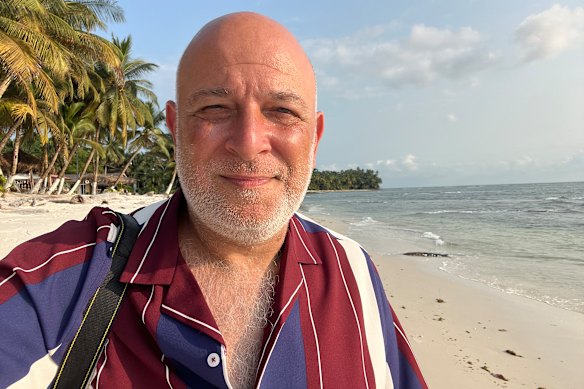
World travellers (other than Pedersen) can face criticism for catching planes largely for the sake of landing and then taking off again. Mitsidis says that many NomadMania members prefer to travel overland wherever possible. “However,” he says, “even for those who do fly often, we believe that the benefits should also be considered, especially in places where the locals have limited interactions with foreigners. Building bridges, establishing connections and increasing the sense of belonging to a global community to a certain extent offset the ‘negatives’ in terms of carbon footprints and environmental impact.”
I ask Mitsidis what he thinks of Australia, but he barely knows the place. “Australia has always been a springboard to places like Nauru and Tuvalu,” he says, “and so I’d fly to Australia, spend a few days there and then head off to the Pacific. I’ve never really had a trip [just to see] Australia, and I really need to make amends. So it’s on my list.”
Which list is that? Well, having visited everywhere in the world twice, Mitsidis says he plans to retire from the NomadMania website and the travel business that has grown around it, and is “looking forward to a life of leisure … just travelling”.
Get the best of Good Weekend delivered to your inbox every Saturday morning. Sign up for our newsletter.
Read more from Good Weekend:
- Elijah was 10 when his friend typed ‘porn’ into a search engine. He was afraid – but unable to look away
- He keeps ex-PMs on retainer, parties with Trump and dines with King Charles: this is Anthony Pratt
- How Luke Bateman became Australia’s most unlikely book influencer
- Artist Khaled Sabsabi on becoming the centre of a political firestorm

















































