3 months ago
36
3 months ago
36
James CookScotland editor

 PA Media
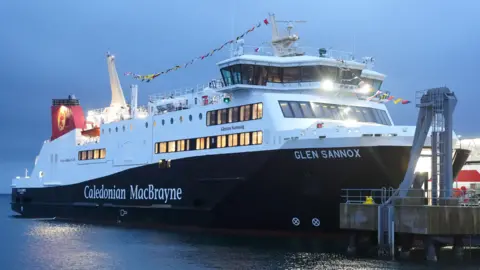
Glen Sannox began serving the Isle of Arran in January last year
A troubled Scottish ferry needs new propellors as part of multi-million pound repairs after just over a year in service, MSPs have heard.
Shipyard bosses told a Holyrood committee that repair costs for the Glen Sannox could hit £3.2m after a small crack was discovered in the hull.
Ferguson Marine chief executive, Graeme Thomson, said that extra steel had been added to strengthen the CalMac vessel, but only new propellors would tackle "the root cause" of the crack.
"There is an opportunity to improve the design of the propellers," he told Holyrood's net zero, energy and transport committee on Tuesday.
Glen Sannox began serving the Isle of Arran in the Firth of Clyde in January 2025, seven years late and four times over budget.
The 336ft (102m) vessel, with space for 127 cars and 852 passengers, was the first major new ferry to join the fleet off the west of Scotland in a decade.
Glen Sannox was briefly taken out of service last year for the crack on a weld seam to be repaired, and was again off duty in November for annual maintenance at Cammell Laird's yard on Merseyside.
The committee heard that the problem related to "cavitation" - when bubbles detach from a propellor and pop, causing damaging vibrations.
Thomson said that the source of the crack was "vibration through the hull caused when the ship went astern."
Similar work would be needed on its sister ship, the Glen Rosa, he added.
The issue is understood to run right back to the ferries' controversial design, which was intended to allow them to ply both the Arran route and the higher-speed 'Uig triangle', which links Skye to North Uist and Harris in the Outer Hebrides.
Glen Sannox was the first UK ferry capable of running on the dual fuels of liquified natural gas (LNG) and marine gas oil (MGO), a low-sulphur type of diesel.
 CalMac
Glen Sannox was removed from service last year due to a crack on a weld seam
The Glen Sannox and Glen Rosa procurement has been an industrial and political scandal which has damaged the reputation of the SNP government in Edinburgh, its ferry procurement agency, Cmal, and the state-owned ferry operator, Caledonian MacBrayne.
In 2017, then First Minister Nicola Sturgeon presided over a sham launch of Glen Sannox, which was not ready for sea and had a fake funnel and painted-on windows.
The Scottish government later nationalised the ailing Ferguson's shipyard in Port Glasgow where Glen Sannox and Glen Rosa were being built.
The second ferry is due to be handed over in the fourth quarter of this year, joining Glen Sannox on the route from Troon, South Ayrshire to Brodick, Arran sometime in 2027.
Watch: The Glen Sannox saga in two minutes
Ferguson Marine bosses told the parliamentary committee that although they had "high confidence" that Glen Rosa would not face further delays or budget increases, that could not be assured.
Thomson said: "I have a high confidence in the number and schedule for Q4 2026, but I don't think any CEO dealing with a complex vessel like this would be able to give a guarantee just now."
He was challenged by committee convener Edward Mountain, of the Scottish Conservatives, who said he had found a decade of examining the ferries extremely frustrating.
"Everything changes," he said, adding "It seems like quicksand."
Deputy First Minister and Economy Secretary, Kate Forbes, told Holyrood the contracts would help unlock up to £14.2m of funding to modernise the yard.
"We are strengthening ferry resilience and connectivity for communities that rely on dependable services," she said.
Ferguson's employs about 300 workers, including 50 apprentices, in a deprived part of the country where the legacy of shipbuilding runs deep.
About half of CalMac's existing ferry fleet was built at the facility, which opened in 1903, and is the last remaining yard on the lower Clyde.