3 months ago
22
3 months ago
22
In June, another one of those explosive palavers-about-practically-nothing kicked off across social media; this one about the cheap cut of a particular Prada coat, the lumpy slump of a Birkin handbag, the tackiness of a too-blonde hairdo and a catalogue of other wrongwrongwrong fashion faux pas spotted among US producer Ryan Murphy’s costume test shots for his latest biopic TV series, American Love Story, due out next month.
The series stars Sarah Pidgeon and Paul Kelly as Carolyn Bessette Kennedy and John F. Kennedy Jr., the ill-fated “American royalty” couple who embodied high-born uber-coolness before – spoiler alert – they died in a plane crash in 1999. Murphy released the test shots and test videos of his actors in test costumes but, it seems, the social mediaverse was too invested, or too braced for a barney, to care.
The “test” rider was gleefully ignored, outrage rocketed, Murphy’s list of crimes, particularly against Bessette Kennedy’s icily elegant style stretched like a bad rap sheet into July and beyond: “wrong blonde”, “too skimpy”, “wrong brown”, “too short”, “too cheap”, “wrong bag”, “a crime against fashion”.
Mainstream media including The Cut, The Guardian, NBC news, Variety and even British Vogue joined the squabble. Everything about the test shots was shredded: cuts, colours, textures, silhouettes, accessories, jewellery. The real Bessette Kennedy, they chorused, dressed in multi-mind-blowingly-curated layers of visual semiotics that she scrambled daily to identify herself as inimitable. She habitually tore luxury brand tags from her clothes to throw off critics and soared sartorially to a level of cool not witnessed since. THIS costume folderol was not THAT. “Fashion murder” was mentioned.
“I’m not really shocked people got so involved,” says Melbourne-based costume designer Maria Pattison. “We all live in a visual culture, we’re obsessed with it and we can’t escape it. We have to dress in all our layers of meaning; personality, culture, mood, where we place ourselves in life ... We can use clothing as a shield or as expression, or as something in-between, but however we use it, it will always reveal.”
Pattison is one of four top costume designers I asked to throw light on their art, which in turn throws light on our own amateur efforts, standing in front of our wardrobe each morning.
“People often have a limited concept of what we do as costume designers,” Pattison says. “They think we’re just fashion people when really, it’s more that we have processes of climbing inside a character. We’re character people, we’re story people. Everything you see on screen is the result of a series of complicated decisions; you play with audience perception, their memories of archetypes, their cultural baggage.”
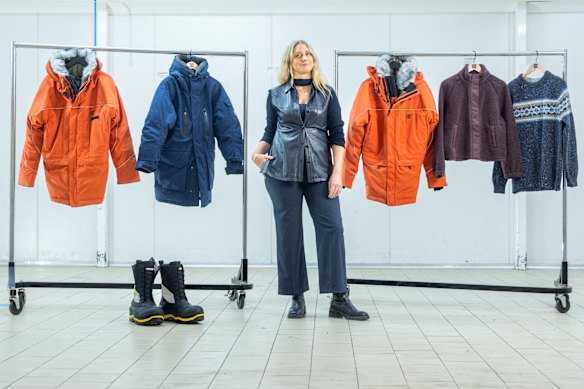
Maria Pattison among items she’s chosen for a new film being shot in Antarctica.Credit: Wayne Taylor
At the University of Melbourne, Pattison lectures on screen production design. She has a masters in visual anthropology from the University of Berlin, among other qualifications, frequently draws links between that science and fashion, and has costumed some deliciously complicated characters in her 18-year career, including the tricky protagonists of Cate Shortland’s 2017 film Berlin Syndrome, and that of cult leader Grigori, played by Vincent Cassell in Ariel Kleiman’s 2015 film Partisan.
“Grigori is a great example of how subtle costume can be, how you could change one element and completely flip the character,” Pattison says. “He is a controlling, sinister man underneath but, charming to the world. You could put him in dark menacing colours or maybe black jeans or a gangster costume to reference that archetypically evil or threatening thing but, what’s that? Too obvious, like a caricature, so completely wrong.”

Vincent Cassell (left) in incongruous mohair, with Jeremy Chabriel in Partisan.
For Partisan, Pattison and her crew focused on unsettling Cassell’s audience. “We became obsessed with textures and colours. We gave him linen trousers, relaxed luxury things; classic but not too stiff, not too formal, floral patterned shirts but not those abrasive, comic florals. More subtle, beautiful silhouettes ...
“At one point, we put him in a soft, black mohair woman’s cardigan. So you see; there’s this play happening, right? Evil man in a soft fuzzy cardigan? It’s a balancing act; very delicate, very intuitive, this unsettling dichotomy, this little swell of incredulity in the audience, that softness and play emphasising that sinister aspect of his character ...”
International costume designer Katherine Milne describes using similar trickery in Peter Farrelly’s 2024 film, Ricky Stanicky. “It came down to this hat for [actor] John Cena’s character. I know – a hat! But it had to have so many obvious essences, it was so complicated. We could have picked a safari hat, and it maybe would have fit with the crumpled safari suit we put him in, but it would also be too obvious; we went with a slouch hat (one side flipped like a digger’s) so it was sort of wacky and confusing, like his character.”
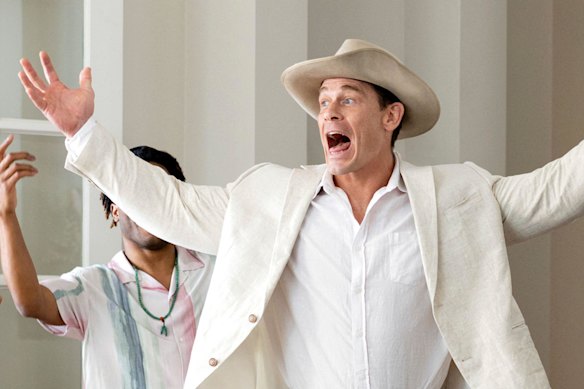
John Cena in Ricky Stanicky: “We went with a slouch hat so it was sort of wacky and confusing, like his character,” says Katherine Milne.Credit: Alamy Stock Photo
Milne’s career highlights span Xena: Warrior Princess to Jonathan Hensleigh’s Ice Road films starring Liam Neeson. “Every script is a mosaic,” Milne says. “A collaborative process but, for my part, you read, you get the feel, you absorb the story, the era, where we are in the world ... Who is this person? What is their history? You feel the sparks and start pulling elements out: what do you want to explain or to hide about them, how does that all fit?”
Loading
Costume design projects are akin, she says, to solving “giant puzzles”, comparable in skill if not scale to everyday dressing. “Getting it wrong” is a hazard of both.
“We get it wrong sometimes because we can have a kind of dysmorphia about ourselves,” says legendary Australian costume designer Marion Boyce. “Think about it; you can buy something very fashionable and expensive and hope all you like that that will reflect you, but it doesn’t come off if it’s not truthful. It looks off. And, when something like that happens on screen, you can see it immediately. People – audiences – quickly recognise a falsehood. They might not know exactly why it’s wrong, but it’s just wrong, they know it, and it’s jarring.”

From left: Judy Davis, Sarah Snook and Kate Winslet in The Dressmaker.Credit:
Boyce has costumed countless characters – serial killers to Disney aristocrats – in a career spanning more than 30 years. She’s best known for her infusion of dreamy, offbeat glamour in Jocelyn Moorhouse’s 2015 film, The Dressmaker, and for the splendidly crisp, resonant ensembles in the original ABC television series Miss Fisher’s Murder Mysteries.
“I could have got Phryne really wrong,” she says of the 1920s Miss Fisher character played by actor Essie Davis. “There was quite a bit of pressure to do her sexier; that whole ‘gangsters and flapper frocks’ thing; more skin, shorter skirts, plunging tops ... the whole ‘male gaze’ thing. But that wasn’t her essence. That would have been wrong. She was more complex, a much more fascinating character; driven, interesting, individual, very much her own woman.”

Marion Boyce with costumes from Miss Fisher’s Murder Mysteries during a 2016 exhibition of her work in Brisbane.Credit: Glenn Hunt
Boyce’s Phryne “materialised” in her first readings of the scripts. “That’s where that huge puzzle starts,” she says. “Where you get what makes the character tick.”
Boyce says that on every set and in every scene, Phryne’s wardrobe was recalibrated – as costumes are in every film project – with a conga line of collaborators: directors, producers, lighting and camera technicians, action consultants, writers and actors.

Marion Boyce on Phryne Fisher (played by Essie Davis): “She had this ... energy so I wanted her to sort of burst onto scenes like this huge hurricane.”
Eventually, Boyce fleshed out Phryne’s micro-character-quirks into a distinct rack of fashions in an evocative palette of bulls-bloods, plums, rose-bronzes and petrol-blues with strikes of true red, white fur and other semiotic-loaded accents of colour, texture and gleam.
“One thing I also did was use fabric as a metaphor for Phryne,” Boyce says. “She had this ... energy so I wanted her to sort of burst onto scenes like this huge hurricane.”
Boyce designed coats, kimonos and dusters in worsted wools, heavy satins and velvets weighted to fly open and flap about as Phryne walked and ran or simply arrived. Skirts in airy georgettes and animating silks including crepe were also cut to undulate or slap around her calves. In one early episode, a bronze-ish collar of marabou feathers became its own metaphoric “mini hurricane”, which accented Phryne’s sleek bob and a half-cloche hat that was not ostentatious, not tacky, not overtly sexy but just perfectly Phryne.
Loading
In another scene, Phryne strides across a road in mid-heel T-bars picked out for fast, confident walking, her petrol coat swinging open like a magician’s cloak and Boyce’s “huge puzzle” of sartorial micro-decisions sparking her truth: extrovert, confident, intelligent, nonchalant, glamorous, aware but unfussed by her power and sexuality. Short skirts, plunging tops and the whole “male-gaze thing” be damned.
Oscar-winning costume designer Jenny Beavan believes ordinary mortals can express their own character as exquisitely – if not as accurately – with their own clothes. “Of course you can, it’s your story to tell,” she says. “In fact that’s what we do when we dress, tell our story, and that’s what my job is, storytelling.”

Kristin Scott Thomas in Gosford Park (left) and Anya Taylor-Joy in Furiosa wear costumes designed by Jenny Beavan.
Three Oscars, four BAFTAs, two Emmys, an Olivier and a swag of other gongs mark Beavan top in her profession. Her four-decade career spans a vast range of costume projects from the terribly English Merchant Ivory films (Gosford Park, A Room with a View, The Remains of the Day), to George Miller’s post-apocalyptic Mad Max: Fury Road and its prequel, Furiosa.
Via Zoom from London, Beavan is straight-talking, down-to-earth and, early on, admits to loathing trendy fashion. “Not interested in it all,” she says. “But. I do use it as my language to ‘disappear’.”
Beavan is her own “costume designer”, prescribing plain French workwear (frustratingly “on trend” at the moment) and on most days, all black, because, theoretically, it is the least “readable” category of fashion. Today her black is broken by glints of silver jewellery and her halo of pale hair.
Her personal costume formula may seem simple. “But it’s never simple is it?” she says. “One thing I am is an obsessive observer, a people-watcher; I love public transport for that reason, always fascinated by the choices we make, the things we choose to wear, why we wear them.”

Jenny Beavan: “That’s what we do when we dress, tell our story, and that’s what my job is, storytelling.” Credit: Getty Images for CDGA
The intuitive mechanics of putting together a personal wardrobe, in other words, and costume design’s mille-feuille of semiotics, are in the same sartorial ballpark.
Beavan talks about the gentle charms of Anthony Fabian’s 2022 film Mrs. Harris Goes to Paris. She costumed it mid-pandemic with a scattered skeleton crew. Against all odds, they conjured a gobsmackingly accurate line of 1950s Dior gowns for a Parisian salon scene and a lower-key, spot-on wardrobe for the film’s namesake, a London cleaning lady played by Lesley Manville.
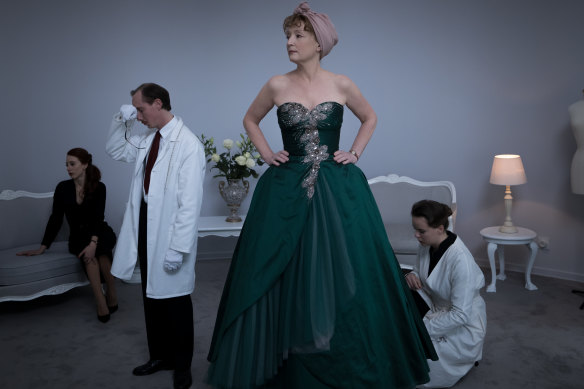
Lesley Manville (third from left) in Mrs. Harris Goes to Paris.
“This was a character who loves clothes but can’t afford them,” Beavan says. “She has a softness, but she’s not weak; she’s poor, but not impoverished, she’s motivated, she’s hopeful.”
Adding to Mrs. Harris’ complex character, she is also alternately feisty and humble, occasionally fancies a bit of a knees-up, keeps herself nice at all times and is so gaspingly besotted by an employer’s haute couture gown that she plots to buy one of her own from Monsieur Dior’s atelier. In Paris.
Beavan managed to infuse Manville’s costume rack with that shemozzle of character traits. She got it right, partly by avoiding the archetypically obvious: a BBC-esque char’s dull apron, kerchief and slippers, for example, or a fashion tragic’s trendy (at the time) sharp-cut suit with schlooped waist and foofed skirts.
“Too tailored, too stiff,” Beavan says. “Not right.” Once she had scoured Fabian’s script, made copious notes, felt the glow of instinct rise, she began puzzling together Mrs. Harris in costumes on a model stand “to get to that feeling where I know [the character] and I just know it’s going to be right ... that point when, ‘Yeah, that’s something she would love’.”

Jenny Beavan on Mrs. Harris: “This was a character who loves clothes but can’t afford them.”
Beavan dubbed one of her favourite costumes, practically vibrating with Mrs. Harris-ness, her “treble floral”: “floral blouse, floral skirt, floral apron”. A lot, but perfectly right, resonantly meaningful, semiotically loaded.
Meanwhile, the clobbering of Ryan Murphy’s test costumes by outraged fashionistocrats spurred the producer to appoint 10 fashion apostles – aficionados of the sartorial semiotics personally curated by Carolyn Bessette Kennedy and John Kennedy Jr. in their style-sainted lifetimes. This time they better be right.
Must-see movies, interviews and all the latest from the world of film delivered to your inbox. Sign up for our Screening Room newsletter.