3 months ago
26
3 months ago
26
Astrange thing happened early last month. The death of a 14-year-old golden retriever named Dozer was reported by Australian news outlets with a sadness and solemnity usually reserved for the demise of beloved public figures. Human ones. The obituaries enumerated Dozer’s sterling qualities – his faithfulness, his friendliness, his love of the outdoors, his enthusiasm for food. On social media, there was an outpouring of grief. People posted that they were “heartbroken”, “absolutely sobbing”. One person noted that the desolation crossed generations: “My 12-year-old son is crying with me, too.”
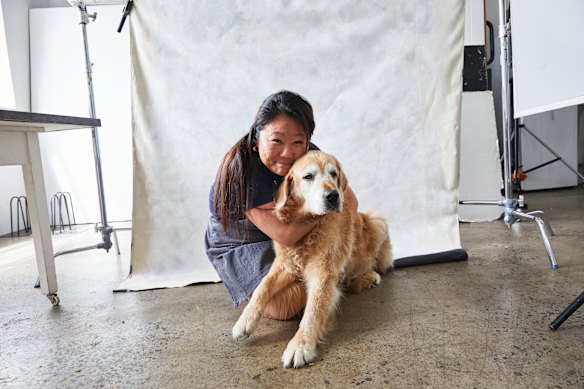
Dozer was the canine companion of Nagi Maehashi, Australia’s reigning cookery queen. He was genuinely appealing – I encountered him in the course of researching this story – but, as I think he’d have been the first to acknowledge, it was his association with Maehashi that made him a star. She published charming pictures of him, wrote fondly of his winsome ways, portrayed him as her trusty sidekick. “I loved him fiercely and completely,” she declared in a memorial video, sending everyone into further floods of tears.
Before Dozer died, I had spent many hours with Maehashi and interviewed everyone from her mother to her publisher. I had thought I fully understood the Maehashi phenomenon. But suddenly, watching the online mass mourning, I wasn’t so sure. On Facebook, someone asked: “Why am I sitting here bawling my eyes out for a beautiful dog and beautiful woman I’ve never met?” Good question.
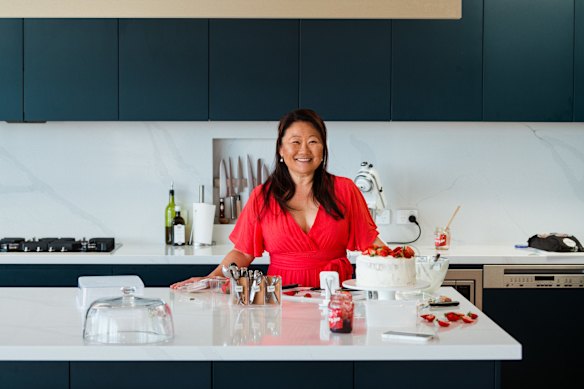
Weeks earlier. On a warm morning in the affluent Sydney suburb of Hunters Hill, Maehashi is standing at a marbled kitchen counter in a large, modern house, assembling a triple-layer chocolate cake. It is not going well. “My mousse is too sloppy,” she says, referring to the goop she is slathering between the layers. She can see what will happen: the layers will slip out of alignment and the cake won’t stand straight. “Look at that. It’s sliding. Oh yes, this is not cool.”
To her fans – who call her Nagi, no surname needed – Maehashi is an inspirational figure: a self-taught home cook who has turned her hobby into a multimillion-dollar business. Along the way, she has assumed the role of national culinary coach. Should garlic be chopped or crushed? Is it OK to use imitation vanilla essence? What, exactly, is a rolling boil? Australia looks to Maehashi for the answers. As we stand at our stovetops weighing up whether to add more salt to a sauce, or stare into our fridges wondering what on earth to make for dinner, the question we ask ourselves is: what would Nagi do?
The kitchen in which I’m watching the chocolate cake go sideways is the nerve centre of Maehashi’s operations. It is here that she devises and tests the recipes she publishes on her popular food blog, RecipeTin Eats. The website gives highly specific instructions for everything from boiling an egg to rustling up coq au vin for eight. According to Maehashi’s brother, Goh, who is RecipeTin Eats’ IT manager, it has 16 million visitors a month. “Entire Nation Seemingly Unable to Cook Without Consulting RecipeTin Eats”, ran a headline on the satirical news site The Betoota Advocate. A fictional sociologist quoted by the Advocate warned: “If RecipeTin Eats ever crashes, we’re in real trouble.”
Mind you, we have Maehashi’s two cookbooks as back-up. Her first, RecipeTin Eats: Dinner, published just over three years ago, was the highest-selling book in Australia in 2023. The next year, it was the second-highest seller, beaten only by Maehashi’s follow-up volume, Tonight. Between them, Dinner and Tonight have sold about 1.2 million copies. Such is Maehashi’s influence over the way we cook and eat that The Australian Financial Review placed her at the top of its 2025 cultural power list.
Maehashi is known for her sunny disposition. Even her long-standing concern about Dozer – who in 2024 was diagnosed with laryngeal paralysis, making it difficult for him to breathe – hasn’t stopped her radiating good cheer in the photographs and videos that accompany the recipes she posts online. There’s no camera rolling at the moment, though, and this chocolate cake is starting to seriously annoy her. Having nudged the layers back into place and finished spreading the mousse, she is icing the top and sides of the structure with ganache, a mixture of melted chocolate and cream. She draws back to examine her handiwork. “God, this is a disaster,” she says. “I’m definitely not posting this.”
Like a lot of people, I imagine, I stumbled into the Nagiverse by accident. A few Christmases ago, I decided to roast a duck. This was uncharacteristically ambitious. I’m a competent cook but not an especially confident one. Duck-roasting sounded tricky to me. I Googled recipes and found one that promised there was nothing to it: “Easy to make, easy on the wallet, and a gorgeous centrepiece to add to your festive gathering!” Above the encouraging words was a picture of Maehashi’s beaming face. I had no idea who she was. I’d never heard of RecipeTin Eats. But I took a deep breath and followed her directions. She was right. The duck was easy. And gorgeous.
Since then, her fame has increased exponentially. It isn’t only Australians whose taste buds Maehashi has tickled. Roughly a quarter of the visitors to her website are in the US, while another quarter are in the UK, Canada, New Zealand and other countries. But it’s in Australia that she has comprehensively won hearts and minds. When, in April last year, she accused baker and social media influencer Brooke Bellamy of plagiarising her recipes in the book Bake with Brooki (an allegation Bellamy strongly denied), it was national news. Elsewhere in the world, wars raged. Here, we avidly followed a dispute over ownership of a set of instructions for making caramel slice. Then Maehashi’s name popped up in the sensational trial of Victorian woman Erin Patterson, found guilty of killing three relatives and attempting to kill a fourth by serving them beef Wellington laced with death cap mushrooms. The jury heard evidence that the recipe – minus the poisonous fungi – came from Maehashi’s Dinner.
That Patterson had a copy of the book wasn’t surprising. Who doesn’t? But Maehashi tells me she was rocked by the case. “I was like, ‘No way!’ It’s pretty horrible, you know, to be associated with murder.”
For someone who looms large in our collective consciousness, Maehashi has a low personal profile. We know her position on par-boiling potatoes before roasting (she’s in favour) and on buying pre-shredded cheese (against), but most of us know little about Maehashi herself. I’m keen to find out why she abandoned a stellar career in corporate finance. I want the lowdown on how she reinvented herself as a food blogger, and what impels her to spend more than $1 million a year of her own money to provide meals for people in need. I’d like the story behind her abrupt decision last year to take a break, which she announced online under the heading: “I NEED TO STOP”. I have plenty of cooking-related queries, too. Where does she stand on the use of thickened cream, for instance?
On her website, Maehashi is a reassuring presence, telling us not to worry if we’ve run out of caster sugar because plain sugar will do the job perfectly well and, listen, the dessert will still be delicious. Working from her recipes and the detailed notes appended to them is like having a good-humoured friend beside us in the kitchen, guiding us step-by-step towards completion of whichever dish we’ve decided to tackle. For me, meeting her face-to-face is slightly discombobulating because she already seems so familiar. “That’s the trick, isn’t it?” she says. “You make people feel like they know you, but they don’t, actually.”
Physically, Maehashi is small and sturdy, with thick black hair she ties back when she’s cooking. She is 48 but seems younger, perhaps because of her exuberance. “She’s loud, right? A pretty rambunctious person,” says Ardyn Bernoth, former national editor of the Good Food section of The Age and The Sydney Morning Herald. Bernoth recalls registering the impact on a cafe full of diners when Maehashi burst through the door with her high-volume voice and big laugh: “She sat down and I watched the whole restaurant turn around and look at her with a bit of a sneer. They were like, ‘Who is this loud person?’ Then I saw them turn back to their tables and go, ‘Oh my god, it’s that woman from RecipeTin Eats!’ ”
Maehashi’s brother, Goh, often witnesses that jolt of recognition: “When we go out anywhere, whether it’s to the shops or to a restaurant or just walking around, the number of people who stop her and say, ‘Oh my god, you’re Nagi’ – it’s just bizarre.”
Maehashi has made a lot of money from book sales, but her main source of revenue is advertising on her blog. The amount advertisers pay depends on the size of the audience they reach. “I earn micro-cents per visitor to my website, so I need a lot of visitors to earn a decent income,” she says. The day she launched the blog in 2014, it had only two visitors: Maehashi and her mother. She built from there. “I played the long game, basically. I didn’t worry about being trendy or clickbaity or going viral. All I worried about was creating recipes that worked and were well explained.”
Her determination to win the trust of visitors and keep them coming back led to a habit of obsessively testing and retesting recipes. She says her vanilla cake is the record-holder: she tested it 89 times before publishing it. She tested beef Wellington more than 30 times, and that’s a dish that takes forever to prepare.
“She’s always been very driven,” Goh says. “And she’s very goal-oriented. When she gets into her mind what she wants to achieve, she goes relentlessly at it.”
Before Australia succumbed to Nagimania, we fell for a succession of big-name British chefs. On NielsenIQ BookScan’s list of the 10 bestselling cookbooks in the country since 2002, Jamie Oliver occupies no fewer than four spots. His 15-Minute Meals, published in 2012, has sold almost 590,000 copies, making it the second-most popular after Maehashi’s Dinner, which has sold 723,000. Maehashi is a long-time admirer of Oliver, whose BBC show The Naked Chef premiered in 1999. “He’s one of the first TV chefs I started watching,” she says. “He really got me into cooking.”
Another English cook she idolises is Nigella Lawson, whose best-known book is How to Be a Domestic Goddess. Maehashi once had dinner with Lawson. “And one of the first things I noticed about her was how profoundly intelligent she is,” she says. “The second thing I noticed is that she swears like a trooper. Oh my god. I was like, ‘Could I love you any more?’ ” Actually, there was more to love about Lawson: “She is a solid eater and a solid drinker. That really appealed to me.”
Maehashi was too star-struck to consume a lot that evening – Lawson emptied the bread basket on her own, she says – but in normal circumstances she, too, has a hearty appetite. “You know how some people are interested in knitting? Or exercising or surfing or gardening – that kind of stuff? My thing has always been cooking and eating.”
Her interest in eating came first. She tells a story about being hit by a car as she crossed a road in Sydney at the age of 7. She was unconscious for two days, she says, but by far the most upsetting part of the experience was learning when she woke up that Goh and their sister, Tamaki, had been treated to burgers from McDonald’s in her absence. “That’s all I can remember: waking up in hospital, hearing they’d had Maccas and bursting into tears.”
As a celebrity cook, what sets Maehashi apart is her relatability. More than cheeky Jamie Oliver or glamorous Nigella Lawson or the suave British-Israeli chef Yotam Ottolenghi – whose Simple is seventh on the cookbook bestseller list – she gives the impression that she’s just like us (except a better cook, obviously). Ottolenghi’s recipes call for ingredients like za’atar and pomegranate molasses. Maehashi, too, publishes some exotic and difficult-to-execute recipes, but her emphasis is on meals that can be made with a minimum of fuss from everyday items. “I shop at Coles and Woolies, not gourmet stores,” she says.
She keeps an eye out for bargains. “That coriander is so cheap,” she says, as we dash through a supermarket in her neighbourhood one afternoon. On her blog, she dispenses commonsense budgetary advice. Don’t use fancy wine for cooking: a complete waste of money. Don’t buy Himalayan salt: it’s just salt, except pinker and pricier. “There are some things in life that you can’t go no-frills on,” she tells me. “Cling wrap is one of them. Toilet paper is another.” Home-brand rice is best avoided too, in her opinion. But plenty of inexpensive products are excellent. Take Coles’ triple-cream brie, which costs $5 for 200 grams. “Bizarrely good!”
The conversation turns to tinned tomatoes, and whether it’s better to use Australian or Italian brands. No contest, Maehashi says. “Australian tomatoes are so shit. Even fresh tomatoes in Australia are hopeless.” She always buys Italian tins but is aware that they usually cost more than the local product, and that most people throwing together spaghetti bolognese for the family on Monday night will have gone for the cheapest option available. When she started her website, she says, one of the first tips she published was to add a little sugar to sauces made from Australian tomatoes to counteract their sourness. Years later, a woman recognised her in the street and grabbed her. “She said, ‘The sugar. Just a teaspoon of sugar in the bolognese!’ She was like, ‘It’s a game-changer.’ ”
Maehashi gets a kick out of encounters like that. “Most people are just friendly and enthusiastic and fellow food-lovers,” she says. What slightly takes her aback is how emotional some become. “Sometimes people cry,” she says, lowering her voice. “It’s really weird. I’m not trying to be mean. I genuinely don’t understand. I didn’t cry when I met Nigella.”
The closer Maehashi comes to being a culinary cult figure, the stranger it gets for those in her immediate orbit. Her mother, Yumiko Maehashi, who drops into RecipeTin Eats HQ while I’m there, says she sometimes browses through comments left on the website. “A lot of people say, ‘You changed my life.’ And I go, ‘What?’ ” Yumiko smiles, part pleased, part puzzled. “Unbelievable that recipes can do that.”
The Maehashis migrated to Australia from Japan in 1981, when Nagi was three years old. Yumiko and her husband eventually divorced and he returned to Tokyo, leaving her to finish raising their three kids on her own. She had a decent job in IT, but soaring mortgage rates meant money was extremely tight. The family’s home in Asquith, in Sydney’s north, was modest. “A fibro house that was falling apart,” says Nagi, the oldest of the children, who attributes her ingrained thriftiness to growing up with a sense that the wolf was never far from the door. She looks back with gratitude on the way her mother navigated through those lean years, all the while serving up delectable Japanese meals. (Yumiko now has her own blog, an offshoot of Maehashi’s, called RecipeTin Japan.)
The two women get along well these days but don’t mind admitting that their relationship has had rocky patches, especially when Maehashi was a rebellious teenager who snuck out of the house at night and stashed vodka in the garden. “Vodka doesn’t go off, even if it’s in the sun,” she says. Not that drinking it warm is ideal. “Now I keep it in the freezer.”
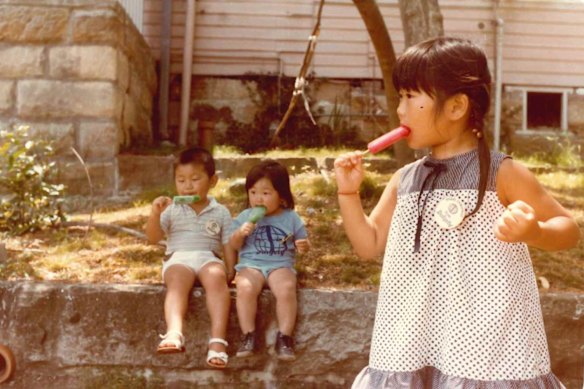
At North Sydney Girls High, an academically selective school, she wasn’t prefect material – “I ran with the slightly naughty crowd” – but she breezed through exams, excelling at maths. After graduation, she accepted a cadetship with the multinational accounting firm PwC. “I went straight into a full-time corporate job and I did university at night,” she says. “To be honest, I just wanted to move out of home and be independent.”
Crunching numbers, writing reports, wearing sharp suits – Maehashi adored the corporate world. After seven years at PwC, she moved onwards and upwards, ultimately landing the role of deputy chief financial officer at Brookfield Multiplex, a global construction and property group. “She’s probably the smartest person I’ve ever worked with,” says investment banker Jeff Locke, who was bemused when he learnt that, at the age of 34, Maehashi was embarking on a radically different career. “She never told me she could cook,” Locke says.
One weekend in 2011, Maehashi went for a walk on a headland in Sydney’s northern beaches region. “I found this really old, really rundown beach shack with an amazing deck and amazing views,” she says. “I could see no one was living in it.” The owner agreed to rent it to her. She got herself an adorable puppy, Dozer, but the killer hours she worked, combined with the long commute to the city, meant that she saw less of him than she wanted. Though a natural-born financial hotshot – “I was a deal junkie” – she turned her mind to starting a small enterprise she could run from home. “I always knew that at some point in my life, I wanted to try something of my own,” she says.
Consternation was the general reaction when she announced her departure from Brookfield Multiplex. “I will never forget my corporate friends sitting me down, saying, ‘What are you doing?’ It wasn’t an intervention, but they definitely thought I was nuts.”
‘Even if I got home at 10pm, I would cook something to relax. On TV, I only watched cooking shows.’
Nagi MaehashiFrom Maehashi’s perspective, the move made perfect sense. Food preparation had been her private passion since she started cooking for herself at 18. “Even if I got home at 10pm, I would cook something to relax,” she says. “On TV, I only watched cooking shows. The only books I read were cookbooks.” Her original idea was to create an app that allowed people to store their recipes online. She called it RecipeTin. With her mother as her IT consultant, she spent 18 months and most of her savings developing and promoting the app. It didn’t take off, so she decided to try a food blog – RecipeTin Eats.
This time, she had more luck. “The turning point was about four months in, when we made $18 revenue from ads on the website,” Maehashi says. She split the money with Yumiko – “because she insisted” – and from then on, felt confident of success. All she had to do was keep increasing visitor numbers. If you Google a recipe in Australia in 2026, RecipeTin Eats is often in the prized top position on the first page of the search results. Back then, though, the challenge was to push the website up the rankings – partly through the use of keywords and other techniques collectively known as search-engine optimisation, but mainly by making it such an attractive destination that its following would grow organically.
Because Maehashi was creating all the website’s content herself, she had to learn to photograph food to a professional standard. It was a struggle, she says. “I would take 200 photos of a brownie and they all looked exactly the same. All terrible.” She still supplies most of the images for the website, shooting them in a makeshift studio in a double garage near the kitchen. But in order to lessen her workload, she has started passing on her hard-won skills to Jean-Baptiste Alexandre, the classically trained French chef she hired as her second-in-command five years ago. “I feel like you’re just going to get this massive plate of meat,” she says, as the mild-mannered Alexandre stands on a stepladder and aims a camera at a dish of chicken chasseur. “I don’t think you can see the drumstick form. You want the leg sticking up a bit.”
For the next quarter-hour, the Frenchman scoots up and down the ladder, adjusting the angle of the drumstick and firing off shots as Maehashi issues instructions. Speed is imperative because the longer food is removed from heat, the less juicy and appetising it looks through a macro lens. “The food is dying!” Maehashi shouts at one point. “Go-go-go-go-go!” Unhappy with something Alexandre is doing, she snaps: “No-no-no-no-no!”
After the shoot, I’m wrung out just from watching but Maehashi is jaunty and Alexandre seems relieved. “It doesn’t always go as well as that,” he says.
Pan Macmillan Australia publisher Ingrid Ohlsson can tell you precisely when she realised that Maehashi’s first book was going to be a hit. Several months before the release of Dinner, Ohlsson was eating with Maehashi at a small French restaurant in Sydney. She says their meal was interrupted by a diner from another table, who said to Maehashi, “I’m terribly sorry, but I’ve just got to tell you something: your lamb shanks have changed my life.”
Ohlsson laughs at the memory. There had been a lot of debate at Pan Macmillan about whether Maehashi’s online popularity would convert to book sales, she says. After all, her recipes were available free on her website, along with digital bonuses like a sliding bar that altered the quantities in the lists of ingredients according to the number of people for whom meals were being made. But after the lamb shanks remark, Ohlsson was sure they were onto a winner.
Many of us have cookbooks we rarely open, points out Jonathan Green, presenter of the ABC Radio National food program, Every Bite. But Maehashi’s books, practical and unpretentious, seem to Green the kind that get well-thumbed and splattered with oil. “They have a ‘Yeah, let’s work my way through this’ kind of vibe.”
Maehashi is aware that Ohlsson and others in the book industry are cock-a-hoop about her sales numbers. She knows that her website numbers – 47 million page views a month in the past year, Goh reports – are even more impressive. But she says she herself can’t get excited about the statistics. She loves cooking, and likes interacting with people who use her recipes, but at this stage merely increasing her reach seems to her a ho-hum achievement. “It just doesn’t really make me happy,” she says. “It doesn’t fulfil me.”
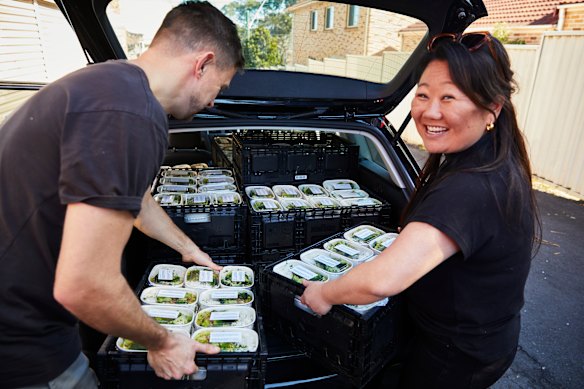
What does make her happy is her charity, RecipeTin Meals, where she employs four cooks to produce 600 meals a day for vulnerable members of the community. Maehashi pays for the food, the salaries, the commercial kitchen, the entire exercise. There is no government funding and no corporate sponsorship. When we visit, the cooks have just prepared that day’s dessert – a vast quantity of pineapple upside-down cake. It looks fantastic but when Maehashi offers me a piece, I hesitate: “I feel like I’m taking it out of the mouths of – ”
“You are,” she says, handing me a plate.
One morning, I meet Maehashi at her 140-year-old Gothic revival sandstone house in Hunters Hill, where she is distributing warm croissants to an army of tradies. She bought the place for $7 million in late 2023 and soon discovered the final cost would be much higher. “Termites. Flooding. Mould. Asbestos,” she wrote in a bitter Instagram post. She tells me she blames herself for the fiasco. Yes, she had the place inspected before she signed the contract. “But I didn’t do enough due diligence.” In mid-2024, she put the house back on the market. “No one wanted it, because everyone was smarter than me.”
Seeing no other choice, she pushed ahead with the required work, trying to convince herself it would all be worth it in the end. Floors were replaced, internal walls demolished, the wiring redone and a stormwater system installed in the garden. She finally moved in late last year. Maehashi says her anxiety about the project contributed to her decision to temporarily step away from RecipeTin Eats in early 2025. The main reason she took leave, though, was exhaustion. “I burnt out really badly,” she says. “I just wasn’t coping. So I stopped work for a couple of months. I wasn’t having a mental breakdown or anything. I just needed to rest.”
Soon after returning to duties, she made the plagiarism allegation. “I thought that was very bold of her,” says Stephanie Alexander, author of Australia’s culinary bible, The Cook’s Companion. “A lot of people would shy away from that topic but I know how infuriating it is when you recognise your turn of phrase, or something you’ve crafted, in someone else’s work.”
Alexander likes Maehashi’s oomph and ingenuity – full marks for adding food photography to her skill set – but she’s dismayed when I mention that, along with everything else, Maehashi does her own washing-up. “Oh god, tell her to get somebody to do the dishes,” she says. “That’s a terrible end to a testing session, to have to roll up your sleeves and get into the mess.”
Maehashi argues that, on the contrary, having her hands in the suds is kind of comforting: what’s important to her is keeping it real. “BAD DAY,” she will post, when things have gone wrong in the kitchen. To Ardyn Bernoth, who has helped her with RecipeTin Meals, it is plain that Maehashi’s authenticity is central to her appeal. “She is exactly what you see,” Bernoth says. “A totally open book.”
Yet Maehashi gets a little steely when I check that it’s correct she is currently single. “There’s a whole conversation thread on Reddit about how no one actually knows anything about my personal life,” she says. “I generally don’t talk about that aspect.” She makes clear to me that, despite what others might think, she and her public persona aren’t quite the same. “That’s the magic of social media and the website,” she says. “It doesn’t mean that I’m not genuine. It just means that I only choose to show one part of me.” To keep the other part in reserve seems to her to be reasonable. “I feel like I give people enough.”
Maehashi has a tight circle of old friends, but in a tribute to Dozer on her website, she paints him as having been her closest ally – “my one constant through the good and bad times”. She thanks him for being non-judgmental – “for never caring what I weigh, what I wear, what I look like”.
Dozer and Maehashi were a wildly successful double act. As her brother Goh put it to me before Dozer died, the dog was “a key part of the RecipeTin brand”. To Maehashi, though, Dozer was much more. He was “everything”, Goh said.
Incidentally, thickened cream gets the thumbs-up. “Yeah, yeah,” says Maehashi, as we stand together at the dairy cabinet at Coles. “Flavour-wise, this is completely fine.” I confess to her that the cream question has bothered me for years. Pure cream can be difficult to find, but I’ve persisted in hunting it down because I read somewhere that the other stuff was inferior. To learn that thickened cream is OK – well, it’s a relief. “It’s just been thickened so it whips faster,” she says, probably hoping that I’m not going to burst into tears and tell her she’s changed my life.
Thinking about it later, I realise that Maehashi is right, and not just about the cream. She gives people enough.
Read more profiles from Good Weekend:
- ‘Feared, respected and disliked’: The private powerbroker who has Lachlan Murdoch’s ear
- Exploitative and callous, or excellence and innovation? The man who wants athletes to push their bodies to the limit
- Never in her wildest dreams did Ita imagine her career would go the way it did
Get the best of Good Weekend delivered to your inbox every Saturday morning. Sign up for our newsletter.