3 months ago
20
3 months ago
20
The Brazilian fans call it “Fonsequismo”, which translates to “Fonseca Mania”.
It is a catch-all term to describe the carnival-like support for 19-year-old tennis prodigy Joao Fonseca, whose exciting playing style and rapid success have sparked a movement unlike almost any other in the sport.
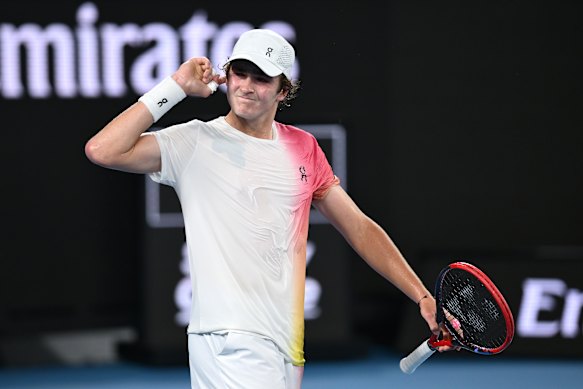
Fonseca hopes to one day challenge Carlos Alcaraz and Jannik Sinner at the top of the tennis world.Credit: Getty Images
He qualified for last year’s Australian Open while still having a triple-digit ranking – after winning the Canberra Challenger, on the secondary tour – then claimed his maiden top-10 scalp, upsetting Andrey Rublev.
Fonseca’s Instagram followers rocketed from about 250,000 pre-match to beyond half a million after the Rublev victory. That tally is now 1.2 million, and he is the only teenager inside the top 30 of the ATP rankings.
After watching Brazilians take over court seven at Roland-Garros last year before Fonseca even walked on court for his first-round match, American former world No.11 Sam Querrey likened the craze to The Beatles arriving in the United States in 1964.
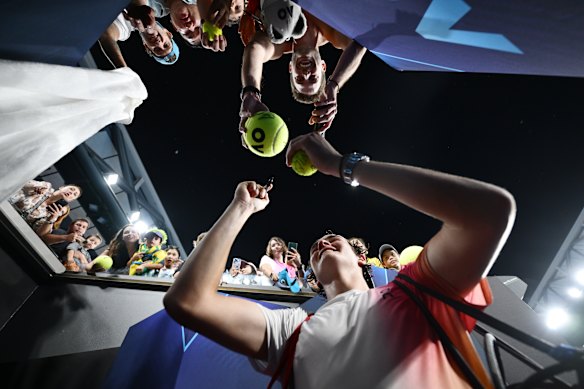
Brazilian teenager Joao Fonseca is already one of the most popular tennis players on the planet.Credit: Getty Images
Fonseca is the player Brazil has waited almost two decades for, since triple Roland-Garros champion and former world No.1 Gustavo “Guga” Kuerten’s retirement.
“I don’t know when ‘Fonsequismo’ started, but people like to do crazy stuff,” Fonseca told this masthead, laughing.
“It’s actually nice. Tennis is getting more popular in Brazil, like the ‘Guga’ era, so it’s super cool to see that – and people say it’s because of me.”
Passionate Brazilian fans, decked out in green and yellow and often carrying the national flag, routinely line up for hours in great numbers before Fonseca’s matches to make sure they fill the stands.
Loading
Incredibly, they drowned out the partisan French crowd’s cries of “Allez!” as Fonseca swept aside local player Pierre Hugues-Herbert in straight sets in the second round at Roland-Garros last year. The travelling circus of support that accompanies the former world junior No.1 is already well known on tour.
But there is also plenty of substance to Fonseca, the player.
Retired Brazilian player Andre Sa, who made it into the top 20 in doubles and top 60 in singles, calls Fonseca “the real deal”.
Sa is Tennis Australia’s head of player liaison these days, but spent three years in Team Fonseca, helping the young star’s coach, Guilherme Teixeira.
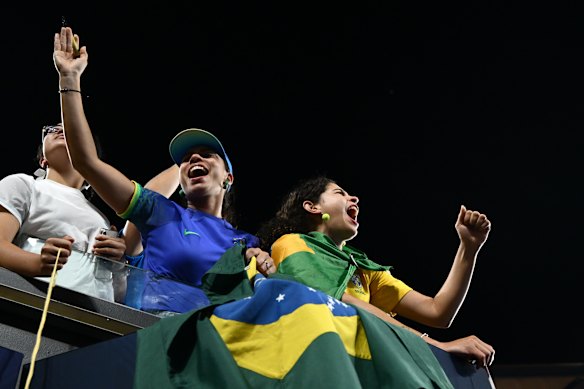
Brazilian fans follow Fonseca across the globe in large numbers.Credit: Getty Images
“He’s the complete package: great player on court, great person outside the court, great family, well-mannered, speaks multiple languages, and his charisma is off the charts,” Sa said. “If he starts winning more matches, he’s going to be a proper rock star.”
Fonseca has the attention of all the right people, from Carlos Alcaraz, Jannik Sinner and Novak Djokovic down.
All three superstars have spoken glowingly of him, with Alcaraz saying at this time last year that “we’re going to put Joao Fonseca’s name on the list of the best players in the world really soon”. Sinner accurately predicted that Fonseca would finish last year ranked in the top 30.
“It meant a lot when they said it, and it still means a lot,” Fonseca said.
Loading
“I got to know Carlos soon in my career as a pro player because I was his hitting partner in some tournaments, and I practised two times with Sinner as well, at the ATP finals in 2023. They are amazing players, and at another level from the other players on tour.
“I hope in the future that I can compete with them. It’s a distant goal, of course, but it feels possible. What I can say is that I’m working very hard to be there.”
Alcaraz and Sinner combined to win the past eight grand slam titles, and contested the past three major finals against each other.
With Djokovic in the final stages of his peerless career, the tour is crying out for new talent to challenge the Alcaraz-Sinner duopoly.
Fonseca, the 2023 US Open boys’ champion, is leading that charge. But there are other candidates emerging.
Czechia’s Jakub Mensik (ranked No.18), Americans Learner Tien (26), Alex Michelsen (37) and Ethan Quinn (76), Frenchman Arthur Fils (41), and Peruvian Ignacio Buse (100) are all 21 or younger.
However, the youth movement does not end there.
Four other junior world No.1s aged 20 or younger – Belgian Alexander Blockx (115), Norway’s Nicolai Budkov Kjaer (135), Spaniard Martin Landaluce (146) and Japan’s Rei Sakamoto (200) – also show great signs. German Alex Engel (180) and Rafael Jodar (165) are only 18 and 19, respectively.
Loading
“[Buse’s] a great guy, a very hard worker. He’s going to jump quickly to the big tournaments,” Fonseca said.
“Kjaer won Wimbledon [juniors] last year, and played some good matches at the Next Gen finals. Landaluce and Jodar have great potential as well, and I played juniors with Blockx – he is very good. All those guys are going to be in the top 100 quickly. The next generation of tennis is in great hands.”
News, results and expert analysis from the weekend of sport sent every Monday. Sign up for our Sport newsletter.
Most Viewed in Sport
Loading