
 2 months ago
69
2 months ago
69
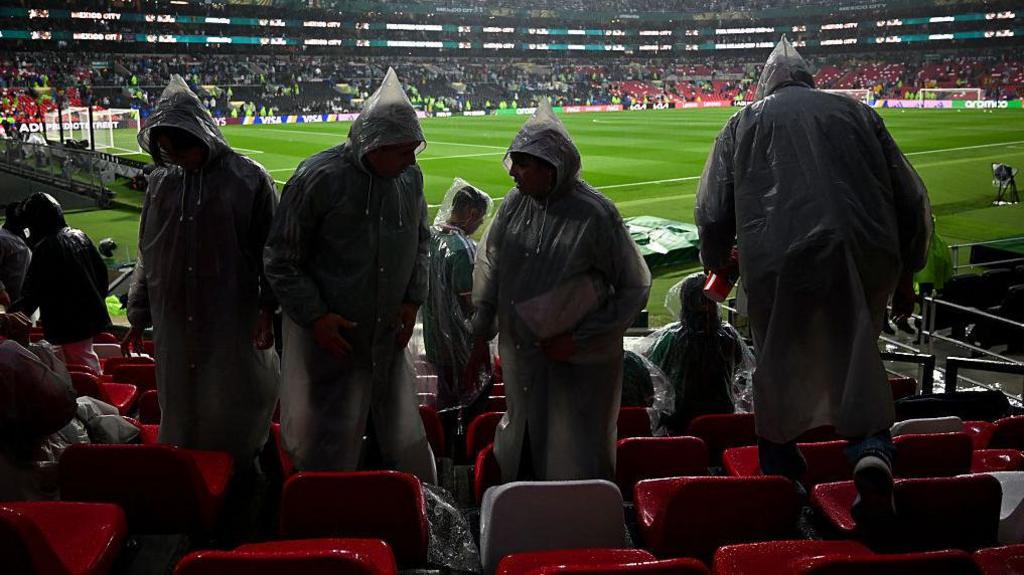 Image source, Getty Images
Mexico's last-32 game against Ecuador was disrupted by thunderstorms
ByDale JohnsonFootball issues correspondent and Andy CryerBBC Sport Senior Journalist
Uncertainty, chaos, anger and U-turns.
England's World Cup last-16 tie against Mexico was plunged into limbo on Friday after a chaotic five-and-a-half-hour period that left everyone guessing.
First Fifa was set to bring the match forward by six hours. Then there was anger from the English and Mexican football associations. And then the kick-off time stayed as it was.
England's seismic meeting against the co-hosts in Mexico City was suddenly shrouded in uncertainty.
The match at the Azteca will now start, as originally planned, at 18:00 local time on Sunday - 01:00 BST on Monday.
It means those in England will still need to either stay up late or set their alarm clocks to watch live on BBC One and iPlayer.
BBC Sport attempts to unpick exactly what happened during one of the World Cup's more baffling episodes.
18:30 BST - the drama begins
England fans were gearing up for a long overnight shift on Sunday to watch their last-16 tie against Mexico.
Then reports started to emerge from Mexican journalists that Fifa was considering moving the kick-off forward six hours.
The reason? Sources said it was because of storms forecast around the Azteca at the original kick-off time.
Fifa was said to be concerned about the potential impact of lightning and flooding.
Were the celebrations in Mexico City which left four people dead, after the co-hosts last-32 victory over Ecuador, also part of the concern? It was hard to tell.
Andres Vaca of radio station TUDN broke the story of the potential switch in kick-off time, leading to much bewilderment - and not just among the fans.
England's squad was wrapping up an open training session in Kansas when the first ripples were drifting across social media.
The Football Association knew nothing about a potential schedule change when BBC Sport journalists began to raise questions.
Information was chased. Sources briefed about the change. An official announcement from Fifa was said to be imminent.
It would have been an unprecedented move.
Then the fallout began.
20:00 BST - FA and Fifa locked in talks
It was not until around 20:00 BST that the Football Association was informed that Fifa was indeed intending to alter the kick-off time.
The FA asked for more time to look in to the plan and understand the reasoning.
But that was just the start.
Behind the scenes, both national associations were locked in talks with Fifa. Both the English and Mexican governing bodies were angry that the change was being proposed less than 48 hours before kick-off.
Among the issues raised were the impact on fan travel, the logistics of changing the staging of such a huge event at short notice, and the impact on the teams' preparations.
Meanwhile, England's players faced the media at their Kansas City training base. Morgan Rogers and Marcus Rashford had clearly been briefed on the news. They gave answers that showed calm, and an insistence that any change would not affect them.
At about 21:30 BST, England boarded their chartered flight to Mexico City not knowing when the match would be.
In Mexico City, the co-hosts' manager Javier Aguirre was carrying out his media duties, calling the proposed changes were a "kick in the gut".
Reports in Mexico claimed the BBC was part of lobbying around the proposed kick-off change. A BBC spokesperson said the corporation was "not involved in these discussions".
22:00 BST - start of the U-turn
Extreme weather has had to be a consideration going into this tournament. At last year's Club World Cup in the United States, there were six major weather delays in 63 matches.
Sources continued to brief that, given the forecast, world football's governing body wanted to minimise disruption to teams, fans and media.
But, just as it seemed as if it was going to be a case of waiting for the kick-off change to be confirmed, reports emerged from Mexico media that Fifa was now considering a U-turn.
It seemed as if the anger from the Mexico and England corners, aligned with all the logistical hurdles, proved too much.
How this could not have been anticipated is one of the key questions in the aftermath.
Mexico journalist Gibran Araige posted on social media: "Well, it looks like Fifa is backing down on the schedule change.
"Everything points to the match staying at 6pm [Mexico time]. Both federations are annoyed."
Sources close to the England camp told BBC Sport that lengthy discussions between all parties were continuing behind the scenes in an attempt to persuade Fifa not to amend the fixture.
Just before 00:00 BST, sources told BBC Sport the kick-off time would remain as originally planned.
After the chaos, what now for fans?
So we were back to where we started. But why?
Sources confirm the final decision was made for a variety of reasons.
One of these issues was fans potentially missing the game.
The England Supporters' Travel Club was given an allocation of 3,000 tickets for the game, which sold out at the ballot stage in December.
The impact on the supporters would largely have depended upon where they are, and when they intended to get to Mexico City.
With a kick-off scheduled for 18:00 local time, fans could fly in earlier on Sunday.
There are two flights that land in Mexico City from Atlanta on the morning of the game, which would have enabled supporters to make the original kick-off.
The flights land at 09:55 and 11:55 - and had the match been shifted to 12:00 local time, any fans taking those flights would have seen their plans thrown into chaos.
Other factors counting against the move to 19:00 BST included the pushback from both national associations and the logistics of having to push back the Brazil-Norway tie - scheduled for 21:00 BST on Sunday - to avoid an overlap of fixtures.
For those in the UK, the decision to stick with the original 01:00 BST kick-off on Monday means a very late night.
Will the weather be easier to play in now?
From Ben Rich, the BBC's lead weather presenter
There was still a chance of a shower at the earlier 12:00 kick-off time, but it was smaller than it would be later in the day - and any showers that do develop would be less likely to grow into severe thunderstorms.
Temperatures are likely to peak at 23C, several degrees higher than they would have been at 18:00 - although humidity in the middle of the day may actually be a little lower than it would be later on.
Daily thunderstorms are normal in Mexico City at this time of year - but forecasts suggest the risk on Sunday is particularly high, and if those storms develop they could be severe.
Mexican government forecasters say troughs - small-scale low pressure features - are expected in the middle and upper layers of the atmosphere over central parts of Mexico on Sunday, making the atmosphere very unstable.
As the sun heats the air close to the ground, that instability will allow the air to rise rapidly, forming the big cumulonimbus clouds that produce thunderstorms.
On Sunday, these storms look likely to bring frequent lightning, and there is also the risk of hail.
Thunderstorm activity tends to peak around, or just after, the highest temperatures of the day - during the late afternoon and into the evening.
So moving the kick-off earlier could have allowed the match to take place before the worst of the thunderstorm activity gets going - although this was certainly not guaranteed.
Is the later kick-off better or worse for the altitude?
Dr. Barney Wainwright, senior research fellow at Leeds Beckett University, told BBC Sport earlier this week how altitude can affect athletes.
"Maximum aerobic capacity at this kind of altitude usually drops around 10%," Wainwright said. "And that has a knock-on to performance."
But would kicking off at 12:00 local time rather than 18:00 have made any difference?
"If it is warmer, the heat can have a double whammy effect with altitude," Wainwright explained.
"When there's less oxygen in the air, that means there's less in the blood. That affects your ability to produce energy for the muscles and your exercise capacity.
"It also takes away from the brain. And the brain is important for us because we need oxygen in the brain for decision making, visual processing, those kind of things, which is important in football."
Wainwright added that while the forecast might be for 21C, you can add a few degrees on to account for the supporters and the temperature at pitch level.
But this might not be significant enough to make any real difference to the players.
"That would make it a bit more difficult," Wainwright said. "But overall, from an altitude perspective, it won't make any real difference to them."
The earlier kick-off could have affected the players' rest patterns, though.
Altitude can affect sleep patterns, and an early kick-off would have meant no chance to catch up.
But, Wainwright added, the prospect of stoppages for thunderstorms in the evening could be advantageous for England, giving them chance to take a break from the effects of the altitude.

















































