3 months ago
21
3 months ago
21
By Lucy Denyer
December 22, 2025 — 10.55am
I can’t quite remember when a David Walliams book first entered our house, but I do remember my reaction. On the surface, it looked fine. Entertaining title; jolly-sounding plot; lively illustrations by Tony Ross. But reading a few pages was disappointing. Walliams didn’t have the verve and wicked humour of Roald Dahl – clearly his inspiration. Above all, where Dahl was cunning, Walliams was simply crass.
Walliams was dropped by his publisher, HarperCollins, on Friday for alleged inappropriate behaviour towards young women. As exclusively uncovered by the London Telegraph, the author faces multiple accusations of harassing junior female staff. To dump him is a huge commercial decision: he has brought HarperCollins $200 million in sales via more than 40 books that have sold more than 60 million copies, are widely used in schools and have been translated into 55 languages.

Children’s author and Little Britain star David Walliams has been accused of harassment and inappropriate behaviour.Credit: Getty Images
But as many parents could tell you, those books’ own attitude to women has always been suspect, even unpleasant. Despite writing for an impressionable audience of pre-teens – especially boys who are learning to interact with their real-world female peers – Walliams has seemed viciously dismissive of many of his female characters, simply because they’re overweight, unattractive or have some degree of power. Here are a few examples.
The underwear obsession
Walliams focuses an awful lot on underwear, specifically women’s underwear, which tends to make an unscheduled appearance in a sudden and humiliating manner. Take Demon Dentist, in which the “prim and proper” Miss Hare, a science teacher, falls one day in class. Poor Miss Hare, we’re told, tumbled through the air. The science teacher’s legs were now where her arms had been. Worse than that, her knickers were where her head had been. Miss Hare had flashed her knickers to the entire class … And these were no ordinary knickers. Oh no. These knickers were large and rather frilly, almost Victorian.
Of course, this is hilariously funny, and not weirdly prurient.
Later in the book, Winnie, a social worker with “an abundant bum”, gets stuck in a wire fence. Shoved through it, “it took a few moments for Winnie to realise she was now only in her underwear … standing there in her bra and knickers. The bra was quite the biggest Alfie had ever seen. It looked like it could comfortably hold two footballs, and was bright orange. The knickers, that might have doubled as a child’s play tent, were a shocking shade of pink.” It’s a mixture of salacious and degrading, which is a nice message to send. So much for trying to teach my own boys that women’s breasts and bodies come in all sorts of glorious shapes and sizes.
The fatty females
Walliams glories in overly buxom women, whose fatness is a purely negative characteristic, and who are spitefully and gratuitously thus described. Pushing Winnie (of the abundant bum) through the fence is “a bit like pushing a car”.
Auntie Dhriti of Grandpa’s Great Escape, mentioned as an aside by Raj, the Indian corner-shopkeeper, can’t leave the flat above the shop – but not because she’s too old. “She was always a large lady,” Raj tells Jack, “but since living above a sweet shop she has ballooned. I would have to hire a crane and knock down a wall if she ever wanted to pop out.”
Sheila, Zoe’s unpleasant stepmother in Ratburger, is mean and, what else, fat: “Zoe’s stepmother was quite short, but she made up for it by being as wide as she was tall.” Naturally, her obesity means she’s also demanding – “so lazy she would order Zoe to pick her nose for her, though of course Zoe always said ‘no’. Sheila could even let out a groan while changing channels with the TV remote.”
The terrible teachers
For Walliams, there are no Miss Honeys. Teachers, at least the female ones, aren’t inspirational or beloved; they’re objects of fun, boredom or terror, no matter how vainly they may be struggling to teach their subject.
Miss Verity, for example (Grandpa’s Great Escape), “was a tall, thin woman who wore long skirts down to her ankles and frilly blouses up to her chin … she was one of those teachers who somehow managed to make an exciting subject deathly dull.” Her “method of teaching was mind-numbing … Facts were all she cared about.” (Imagine!)
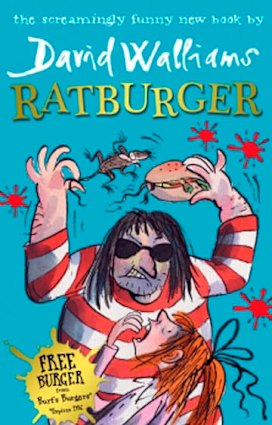
Walliams’ portrayal of women in his best-selling children’s books is being re-examined amid allegations.Credit:
When Grandpa comes into the classroom one day and salutes her then kisses her hand, she’s “obviously flattered by Grandpa’s gallantry. It might have been some time since a gentleman had made a fuss of her in this way.”
The list goes on. Miss Hare, as we’ve seen, is primarily funny for flashing her knickers. Miss Midge, the strict history teacher in Ratburger, plays the tuba in a “truly awful” manner, “like a hippopotamus farting”.
Miss Spite (Billionaire Boy) “smelt of rotten cabbage. That was the nicest thing about her. She was one of the school’s most feared teachers … Miss Spite loved nothing more than giving punishments, once suspending a girl for dropping a pea on the floor of the school canteen.” So what if they – or the teachers whom Walliams’ readers saw in real life every day – were actually doing good work?
The gold-digging girlfriend
Joe Spud, hero of Billionaire Boy, is the richest 12-year-old in the world. Alas, his parents split up when he was eight because his mum had “been having a torrid affair with Joe’s Cub Scout leader”. (Walliams is weirdly obsessed with mothers who disappear, walk out or abandon their children; they feature in several of his books.)
Since then, Joe’s dad has been “going on dates with an endless parade of Page 3 girls”, and one of them is Sapphire Stone, a 19-year-old model from Bradford: Joe looked at the page. There was a photograph of a woman whose clothes seemed to have fallen off. Her hair was dyed white blonde and she had so much make-up on it was difficult to tell if she was pretty or not. Underneath the image it read, “Sapphire, 19, from Bradford. Likes shopping, hates thinking.”
As stereotypes go, it ticks every box. And not only does Sapphire turn out to be a foul-mouthed gold-digger, but it seems impossible to separate her badness from who she is and what she looks like – which is, in Walliams’ words, “frightful”. Avoid models whose clothes have fallen off, boys, unless of course they turn up as an object of derision in your favourite book.
The moany mothers
The hero of Grandpa’s Great Escape, as you can probably guess, is a former Second World War flying ace, packed off to a nursing home from which he and his grandson Jack plan a daring prison break. Their arch-enemies are the matron (who’s wicked) and her nurse henchwomen (who are ugly).
Yet the most consistent derision in the book is reserved for Jack’s mother, who’s often referred to as simply “the woman”. She’s bossy, domineering and, of course, the one responsible for sending Grandpa away. Of his father, 12-year-old Jack “often wondered whether being married to Mum had added years to the poor chap”. Some of Walliams’ snark is odd, and extremely strained: His mother worked at the cheese counter of the local supermarket, and wherever she went, a strong waft of cheese came with her … Mum thought of herself as quite a beauty, and often claimed to be the “glamorous face of cheese” if such a thing was possible.
Outside work, she’s frequently found sighing “theatrically, as if the woes of the world were on her shoulders”. After reading this book, I know how she feels.
It also mystified many when Walliams included “Supermum” in his collection World’s Worst Parents, given that her crimes appear to be that she wears a “very bad, homemade outfit” and is boring. Note that she also happens to be a working-class single mother who – imaginatively – lives in a tower block and cleans toilets for a living. Food writer Jack Monroe took aim at Walliams over this book in 2020, and seethed that his work, in general, was “sneering classist fat-shaming grim nonsense”. Five years later, re-examining that oeuvre, it looks as if she was bang on the money.
The London Telegraph
Most Viewed in Culture
Loading