3 months ago
29
3 months ago
29

 Matt Elson
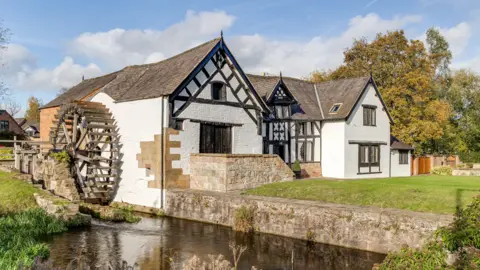
The watermill was "gloomy" and "uninhabitable" before Brendan and Celia Wilson began the renovation
Many people would like to say their home is beautiful, but Brendan and Celia Wilson can truly say theirs is a work of art.
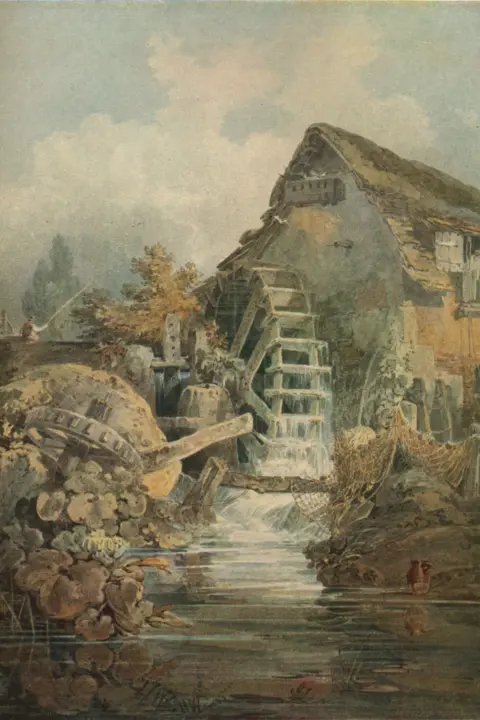
The couple's Grade II-listed watermill house dates back almost 450 years and was the inspiration for a painting by Joseph Mallord William Turner - widely considered to be one of the UK's greatest artists.
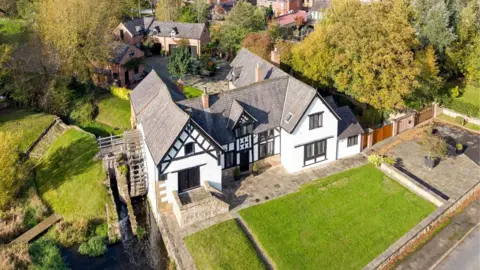
Rossett Mill in Wrexham was boarded up and uninhabitable 17 years ago, but Brendan and Celia were enchanted by it as soon as they laid eyes on it, bought it for £660,000 and set about renovating it into their dream home.
Now, the couple are reluctantly moving so they can be closer to their children and the property from 1588 is on the market for £1.5m.
 Getty Images
Titled Marford Mill, the painting by Turner is in the National Museum of Wales
In 2010, Brendan, Celia and their son Hal were living in Chester, near daughters Lauren and Alexi, when a newspaper ad caught their eye.
A dilapidated watermill was up for sale after its previous owner, who saved it from demolition in the 1970s, had gone bankrupt.
"I've always liked water mills, who doesn't? They're very picturesque and romantic," Brendan, 65, a former director of a commercial plant business, said.
"But we didn't pursue it, we had no intention of moving.
"But then, coincidentally, about a fortnight later, we happened to be driving through this area in Rossett, and we said 'wasn't that water mill round here somewhere?'
"Before we had finished the sentence, we came around the corner and saw it. We knew within five minutes that we wanted to buy it."
 Celia Wilson
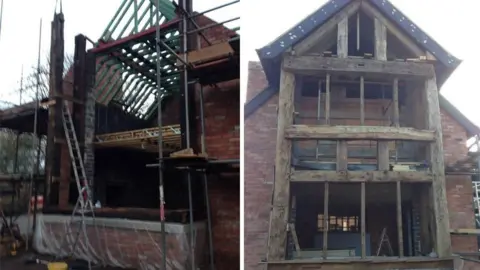
The renovation took two years and old timber had to be imported from France
While the previous owner had done a lot of structural work, "it wasn't habitable", Brendan said.
Two years and £250,000 later, the building was fitted with central heating, a kitchen, four bedrooms, four bathrooms, four reception rooms and an extension.
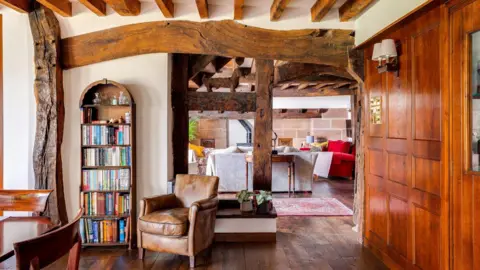
To maintain the look of the building, the couple imported old oak wooden beams from a barn set for demolition in France.
 Matt Elson
Celia and Brendan have lived in the house for 15 years and say it is great to host parties in
Brendan said he could not pick just one thing he loves about living there, because each season brings a different charm.
In the winter he said he loved sitting by the fire in the main living room, as it is "nice and cosy".
"The river in the summer is lovely, it's only six inches (15cm) deep, so you can go paddling and picnic by the river and it's surrounded by trees, so there's lots of dappled sunshine."
Celia, 71, a retired teacher, said she has loved hosting both friends and family at the house.
Not forgetting the mill itself, which is "fun to get going and very easy to operate", Brendan said, having taught himself using the internet and books.
The first time they tried he said "my heart was in my mouth" and he was worried "the whole thing was going to collapse or explode".
But all went well and the couple use it about 10 times a year - Brendan has even ground corn with it to bake bread.
 Brendan Wilson
Celia and Brendan have retired and want to move closer to their children in Chester
The history of the building also captivated Brendan - it is an undershot watermill, which means water flows underneath the waterwheel, striking the paddles at the bottom.
The current's energy turns the wheel and powers the mill to grind the corn.
It was built by the community after the King "charged too much for milling" at Marford Mill, "he had a monopoly on grinding corn," said Brendan.
So Rossett Mill, which was called Marford Mill in Turner's time, was built and continued working for 362 years.
Brendan said he had met several men who remembered working there when they were boys, with one specifically remembering an old man sitting by a fire darning sacks which they carried corn and flour in.
 Getty Images
Joseph Mallord William Turner was born in 1775 and died in 1851, this is a self portrait of him at age 24
The scene also inspired renowned landscape artist Turner to create his painting Marford Mill in 1795.
Nicola Moorby, curator of historic British art from 1790 to 1850 at Tate Britain, said Turner went on four tours of Wales in the 1790s.
"He was looking for picturesque subjects which were very popular with an antiquarian market at the time," she said.
Moorby said Turner made a huge impact by making the art world appreciate the sophistication of landscapes.
"One of the reasons he looks to Wales, actually, is because he's working in the tradition of somebody called Richard Wilson, who was an artist from the earlier 18th Century, who came from Wales."
She said Turner was "searching for his artistic hero" to "help cement his name as the up-and-coming star of the art world".
 Matt Elson
The renovation took two years and cost £250,000
Another factor which drew Turner was the history of tension between Wales and England.
Moorby said Turner's paintings were complicated and the "technical skill of it will stop you in your tracks", often presenting the idea that "nature endures, but man's time here is very fleeting".
While none of the experts we spoke to were able to put a value on the painting, other Turner paintings have sold for almost £25m.
 Matt Elson
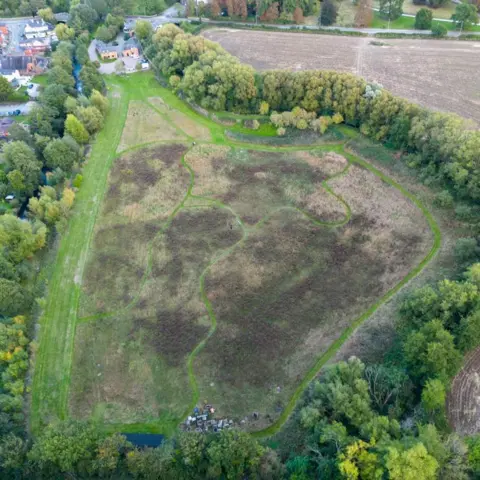
Brendan says the 9.6 acres of land that comes with the mill would make an excellent cricket crease or area for horses
The property also comes with an ancient agreement in the deeds - the owner is entitled to extract as much water from the River Alyn as they need to run the mill.
"It's not like the water is being wasted. It runs down the mill race, through the mill wheel and then it goes back down another stream and it ends up back in the river Alyn. So effectively, you're only borrowing," said Brendan.
While the couple have never opened it to the public due to their full-time jobs, Scout groups and primary school pupils have visited the building.
Now, after 15 years the couple are selling so they can move closer to their children.
Celia said: "We'll be very sad to leave, but it is quite big for us now. We want to move near our children to future-proof."
Brendan added: "We take it for granted, I suppose, living here, but there is history in every corner of this building. We were the first people to live in it."