3 months ago
25
3 months ago
25
Ex-South Korean president Yoon jailed for 5 years over failed martial law bid
We’re sorry, this feature is currently unavailable. We’re working to restore it. Please try again later.
Singapore: Former South Korean president Yoon Suk Yeol has been sentenced to five years in prison after being convicted in the first of eight criminal trials relating to his failed bid to impose martial law in 2024.
Yoon’s most consequential trial will be finalised next month when a court is due to return its verdict on charges that he masterminded an insurrection, for which prosecutors are seeking the death penalty.
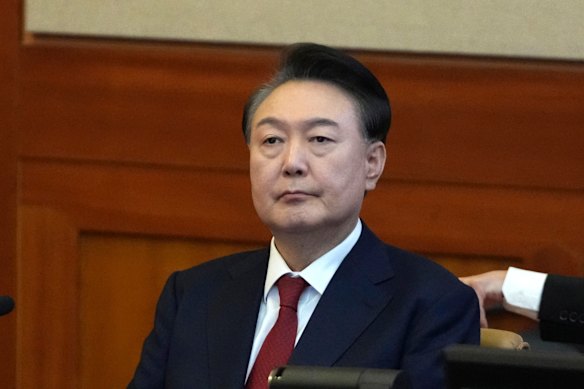
Former president Yoon Suk Yeol at an impeachment hearing in February.Credit: AP
Reaching its verdict in the first trial on Friday, a South Korean court found Yoon guilty of obstructing attempts by authorities to arrest him when he holed up in the presidential compound for weeks after he was forced to abandon his martial law decree.
He was also found guilty of charges that include fabricating official documents and failing to comply with legal processes required for martial law. Prosecutors had sought a 10-year sentence.
“The defendant abused his enormous influence as president to prevent the execution of legitimate warrants through officials from the Security Service, which effectively privatised officials ... loyal to the Republic of Korea for personal safety and personal gain,” the lead judge on the three-justice panel said in a ruling that was televised.
Speaking outside the court immediately after the decision, one of Yoon’s lawyers, Yoo Jung-hwa, said the former president would appeal the ruling.
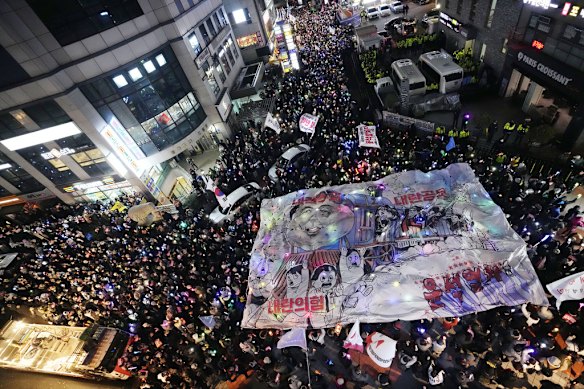
Thousands of protesters took to the streets of Seoul in December 2024 demanding then-president Yoon Suk Yeol’s impeachment after he attempted to impose martial law. Credit: AP
“We express regret that the decision was made in a politicised manner,” she said.
Yoon has always denied the allegations against him.
His criminal conviction is the latest step in a profound fall from grace for the former prosecutor turned conservative politician who became the first-ever sitting president in South Korea to be arrested.
On December 3, 2024, Yoon sent troops into the national parliament, claiming South Korea was under siege from the majority opposition and “anti-state” forces, sparking an immediate uproar across the country. At the time, his party was governing in minority and was struggling to get bills through the parliament.
Loading
Yoon withdrew the martial law decree six hours later after opposition MPs voted to reject it and later impeached him, suspending his powers. The move plunged South Korea into its worst political crisis in decades, as thousands of protesters rallied in the streets for weeks, calling for his ouster as he barricaded himself inside the residential compound.
The crisis exposed the deep political divisions between the country’s conservative and liberal flanks, as Yoon’s supporters also took to the streets, many channelling US President Donald Trump’s MAGA movement by waving “Stop the Steal” banners.
Yoon was eventually arrested more than a month later when police stormed his compound in a seizure effort that involved more than 3,000 officers.
He was formally removed from office in April last year after the country’s Constitutional Court upheld his impeachment in a unanimous decision.
South Korea last handed down a death sentence in 2016, but has not executed anyone since 1997, and is regarded as a de facto abolitionist state.
Yoon is not the first former president to face the death penalty on insurrection charges, and it is very unlikely he will be executed even if he is found guilty.
In a previous court case in 1995-1996, when former South Korean Presidents Chun Doo-hwan and Roh Tae-woo were accused of insurrection, prosecutors sought the death penalty and life in prison for Chun and Roh respectively.
Both were ultimately given lesser sentences on appeal and eventually received presidential pardons after spending about two years in jail.
With Reuters
Get a note directly from our foreign correspondents on what’s making headlines around the world. Sign up for our weekly What in the World newsletter.
Most Viewed in World
Loading