3 months ago
31
3 months ago
31
One of the many observations made amid the wreckage of England’s last tour of Australia in 2021-22 was that the tourists needed to consider getting away from so much hyper-focus on the Ashes.
Initially, it seemed that Bazball did indeed take that approach, emphasising the joy to be had in the journey rather than purely fixing on the destination of the next Ashes series or tour.
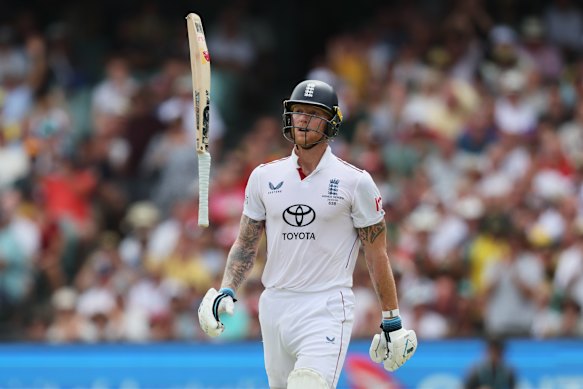
An unhappy Ben Stokes leaves Adelaide Oval.Credit: AP
But in the months and weeks before the series that ended on Sunday with Australia 3-0 in credit within 11 playing days, that old hyper-focus returned with much rhetorical flourish. Partly, this was a byproduct of England’s repeated failure to compete in or even respect the world Test championship, where all matches are played for points. It was also billed as part of the team’s evolution.
For Ben Stokes and Brendon McCullum, this was somewhat of a contradiction. Having worked so hard to take pressure out of the dressing room, England now leaned into that pressure, blowing more and more hot air into their Ashes balloon as if under the impression that enough huffing and puffing would get it airborne.
Take this from Stokes a couple of days before the Perth Test:
“I’ve come here absolutely desperate to get home on that plane in January as one of the lucky few captains from England who have come here and been successful. A lot has been spoken of about the history and how it has gone for England. This is our chance to create our own history and it is up to us how that looks.

Mitch Starc celebrates a wicket on day five as Australia closed in on victory.Credit: Getty Images
“Everyone in the world, everyone in Australia, everyone in England knows how big this series is. I think if we were to come out and not accept that and go on as if it’s just another series then we’d only be lying to ourselves and lying to the fact of what this series is.
“Looking it in the eyes, taking it on, not being afraid of the challenge that we have ahead of us. We know it’s a huge task coming to Australia and everything that comes with that away from the field, on the field. It is a huge 2½ months for us.”
McCullum, who in September called this "the biggest series of all our lives", did not speak as much immediately before the series, but he did one interview with the BBC's Phil Tufnell where he ran towards the rhetorical danger.
“There’s nothing bigger than what we’re about to come into,” he said. “This team has been together for a good couple of years and we have been building towards this moment. It is the biggest stage, it is the brightest lights and it is a series which could define teams and define people and players within it, and that’s OK.

Brendon McCullum speaks to the BBC in Brisbane.Credit: Getty Images
"You're going to feel nervous and anxious, but lean into it, you know you're ready, you know you've got the game, and stay together, play the style you've become accustomed to and keep moving towards the target. We've got our team to the start line and I feel like our horse is going to run well."
Even the eminently sensible Joe Root had laid it all on the line when speaking to this masthead a couple of weeks earlier.
“If we come away from this and I haven’t got a hundred, and we win the series, that would be probably the best achievement of my whole career,” he said. “That’s where it sits with me.”
Loading
One of the curious subplots of England's Ashes campaign has been the involvement of Gilbert Enoka, the well-regarded psychologist and mentor to many New Zealand teams and athletes, McCullum among them.
He too was interviewed before the series, and came out with some of the (literally) loftiest rhetoric of all.
“This is the Everest, the biggest,” he said in The Guardian. “To come over to Australia, this beautiful country, and to play in their backyard in a series that has this iconic history to it, what a privilege that is. This is probably the greatest test a cricketer will have in their lifetime, and who wouldn’t want that?”
England then were in no doubt about the size of the task and about positioning themselves as worthy to take it on. But in preparation terms, they took on Everest without much in the way of serious altitude training. Sir Edmund Hillary certainly never prepped for the summit by going to Noosa.
Loading
As the series played out, all this big talk came to look both premature and unhelpful to the touring side. So much so that during the Adelaide Test, assistant coach Jeetan Patel ran as far from it as he could. “I think the narrative of [the Ashes] being the series is everyone else’s story,” he told the BBC.
Funnily enough, that remark was closer to home Australia's players tried to look at it. Mitchell Starc, the outstanding bowler in the series, explained that by building a team environment where staying level was valued, Australia had been able to keep playing well even when thrown numerous injury problems.
“Over the last number of years it’s been a pretty level group, things have never got too high or too low,” Starc said. “If we haven’t had a good day it’s pretty easy to move on from and learn from. Absolutely a feature of our group and to guys who’ve come in less experienced or younger, the freedom to express themselves as players but also learn from it has been beneficial.
“Whether it’s playing the Gavaskar [series against India], playing the Ashes, playing West Indies, we’ve tried to go about it the same way, prepare the same way. So never get too high or too low, it’s just stay in your own lane and express yourselves as people and cricketers and enjoy our time together.”
Loading
This isn’t merely a hindsight judgment from Starc. Two days before the start of the series he was also interviewed, and steadfastly held to a view that this series, while important, was not the Holy Grail. His most quoted line was actually about the summer schedule putting Perth before Brisbane.
Australia’s players never truly tricked themselves into believing this was just another series. But by emphasising process over outcome, they have found the quality that Stokes was left to lament as lacking among his team: consistency. A puzzled McCullum was left to wax philosophical.
“I feel like, for the previous nine days, we were so caught up and so driven to achieve something, and succeed, that we almost got in our own way,” McCullum said. “We stymied our talent and our skill and our ability.”
Everest, then, got big on McCullum and his team.
News, results and expert analysis from the weekend of sport are sent every Monday. Sign up for our Sport newsletter.
Most Viewed in Sport
Loading