
 3 months ago
64
3 months ago
64

 BBC
BBC
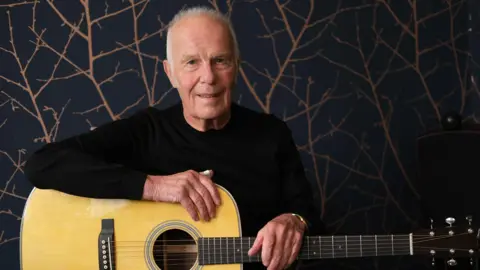
Allan Taylor spent 60 years on the folk scene before retiring earlier this year
When Ed Sheeran recently declared his love for an obscure album he had unearthed in a second-hand record shop in New York, it was big a surprise to the English singer who made it almost 50 years ago.
It was also a bit of welcome recognition as well.
After buying a copy of Allan Taylor's 1978 LP The Traveller, Ed Sheeran may have spotted something of a kindred spirit in his fellow singer-songwriter.
Taylor started out performing in pubs and bars, sleeping on floors and sofas with his guitar and little else, several decades before Sheeran began his career on a similar path.
Taylor toured the world and signed major record deals. But unlike Sheeran, mainstream success eluded him.
"Everything I did wrong, he did right," Taylor says ruefully.
That's not to say the 80-year-old hasn't had a fruitful and fulfilling career.
He performed at the Royal Albert Hall with Fairport Convention, hung out in New York with Bob Marley and has been covered by dozens of artists. He's highly respected on the folk scene, and has found recognition in Europe.
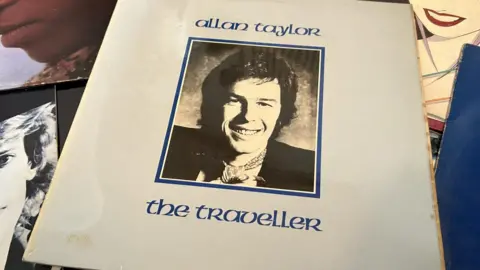
Ed Sheeran said Taylor's LP The Traveller "feels like a special vinyl in the collection"
At home, the Leeds-based singer had been due to bring the curtain down on his career with a string of farewell concerts at folk clubs this summer, but was forced to cancel them because of health problems.
Just as he was settling into retirement, he received some unexpected late attention when Sheeran posted a rave review for his long-forgotten LP.
"Allan Taylor - The Traveller I found in a record store in Williamsburg, and I love it. Can't find it anywhere online, so feels like a special vinyl in the collection."
Sheeran's post came out of the blue.
"I find it flattering that someone of his stature has seen something in what I do as being interesting," Taylor responds.
While The Traveller had been available unofficially on YouTube, it has just been released on Spotify for the first time following Sheeran's endorsement.
The pair have spoken at length on the phone. "I found him remarkably down-to-earth, friendly and very interesting as a songwriter," Taylor says.
"He says he wants to drop by for a cup of tea."
 Getty Images
Ed Sheeran has been in touch with Allan Taylor since discovering his album
During their conversations, Taylor has told Sheeran all about his eventful life.
He grew up in Brighton but left his family, girlfriend and apprenticeship as a telephone engineer behind to seek adventure in Europe in 1966 at the age of 21.
"I had that foreboding of what life was going to be, and I was getting pretty good on the guitar, so I sold my birthday presents to raise the money to go to Sweden."
The trip taught him how to rely on his musical talents and his wits to survive on the road.
"We were stuck once in Stockholm at 11 o'clock at night and the person we were staying with never showed up. There were nowhere to stay.
"If you sleep in the street you're going to die because it's freezing cold in Stockholm in November. So I just went into a bar and started playing.
"Eventually, someone said, 'Do you want a drink?' And you get talking. 'Do you need a place to stay?' 'Yeah.'"
After returning home, Taylor continued to pursue music. "I had a van, I used to sleep in the back of the van, wandered through Ireland, never had any money, just was living from day to day."
At one stop, he received a telegram from friends in Fairport Convention, one of the biggest bands on the folk scene. They wanted him to support them at the Royal Albert Hall the following week and join them on tour.
"That was bizarre, to be playing to a club of 25 people and then suddenly walking out alone on a stage in front of 5,000 at the Albert Hall."
 Yorkshire Television/BBC
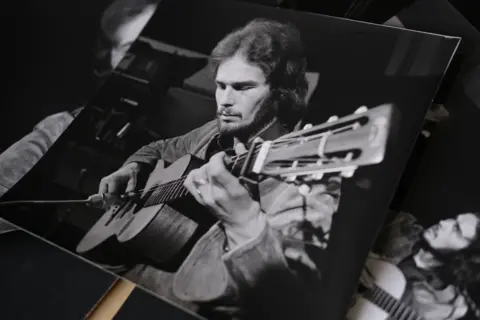
As his career went on, Allan Taylor drew bigger crowds in Europe than at home in the UK
Supporting Fairport Convention brought Taylor to the attention of a major US record label, which offered him a deal.
"I screwed that up," he reflects. "I didn't get a lawyer. I lost thousands. But it did open doors."
Taylor moved to New York and hung out in the Greenwich Village folk scene. But the LPs he released made little impact and he got out of the deal, before signing as a songwriter for Island Records.
While in the Big Apple, Island's boss asked Taylor to look after a reggae band who were coming to town.
"Bob Marley and the Wailers were smoking a lot of dope, so they weren't that organised, so Chris Blackwell asked me if I would look after them for a couple of weeks to make sure they'd get to the gigs, which I did."
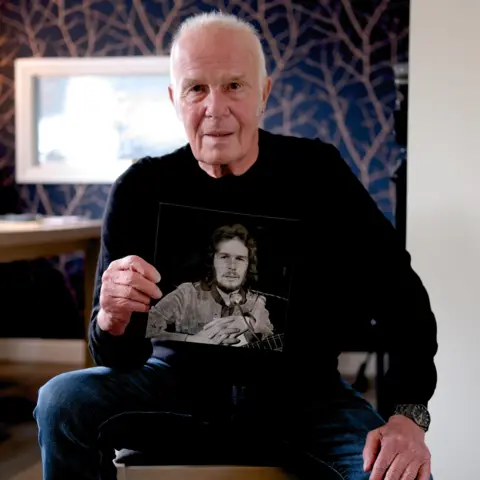
Taylor has recently retired from performing after having back surgery
Taylor then signed for another major label as frontman of a band called Cajun Moon. "I signed that contract under financial pressure because I was just running out of money. And again, I should have got a lawyer."
Both the deal and the band ended when Taylor developed nodes on his vocal cords, which required him to stay silent for three months.
He took stock of his journey when he came to write his next album - The Traveller.
The chorus of the title track reflects on his attempts to make it big: "Running for the money / Running for the fame / Lost where he was going / And forgot his name."
He says: "If the objective is money and fame, then if you lose, you lose your identity.
"Whereas if you stick to your beliefs, you fail on your terms but you don't fail on anyone else's terms. Which was what I decided to do."
The Traveller didn't trouble the charts but did win best folk album at the Montreux Jazz Festival's awards. Taylor began getting more bookings in Europe, including a tour of British army barracks in Germany.
Most of the gigs fell flat. "If you're a soldier and you're driving a tank all day, the last thing you wanted was some introspective soul-searching song that I was writing," he says.
However, one show was open to locals as well as soldiers. "They were really into what I was doing. I don't know how it clicked, but it did click with them."
Although he had been writing and performing for years by that point, Taylor's travels around Europe helped him truly find his voice in the early 1980s, he says. In fact, he can pinpoint the moment.
"I found my voice at about two o'clock in the morning in a bar in Brussels."
After a gig, he looked around at "the bartender just wiping the glasses, and the joker who's trying to get a drink out of everyone, and the street ladies".
"I just sat there and I thought, everyone's got a story here, and all I had to do is write it down. Which is what I did and called it Win or Lose, and that was the start of my own way."
Taylor's dramatic and poignant storytelling style combined European influences with folk and country. "It was my sound, and that started to make a big difference."
His tone of voice matured, too, gaining a depth and wisdom that at times put him in the same league as Leonard Cohen and Johnny Cash.
Taylor re-recorded the title track from The Traveller (and the LP's standout song Cold Hard Town) on his 1996 album Looking For You, with his now-signature style making the updated versions mellower and arguably better.
If Sheeran hasn't discovered Taylor's later catalogue yet, he should.
Perhaps a cover version could be on the cards. It's Good To See You, also from The Traveller, has been covered more than 100 times - including by US country star Don Williams, Greek singer Nana Mouskouri and German folk veteran Hannes Wader.
That helped raise Taylor's profile in northern Europe. Now, Warsaw, Bonn and Berlin are the cities with his most monthly listeners on Spotify.
Taylor says he is among the last of a generation of troubadours who experienced and wrote about the "romance of the road" from the 1960s, 70s and 80s.
"There's not many of us left who can remember what happened or what we did and what it was like, and I think young people are interested," Taylor says. "I think that's why Ed is interested."

















































