3 months ago
28
3 months ago
28
And the Black Summer of 2019-20, which destroyed more than 20 million hectares across south-east Australia, ignored state borders and killed 35 directly. Smoke choked cities from Melbourne to Canberra to Sydney and beyond, causing at least another 450 deaths.
Add to these horrifying black and ash days an untold number of smaller or localised fires, and argue all you like that none of them compare with Australia’s “worst” fires, those that burnt 117 million hectares throughout Australia’s inland in 1974-75, amounting to about 15 per cent of the nation’s landmass. Much of that was relatively uninhabited, but six people died.
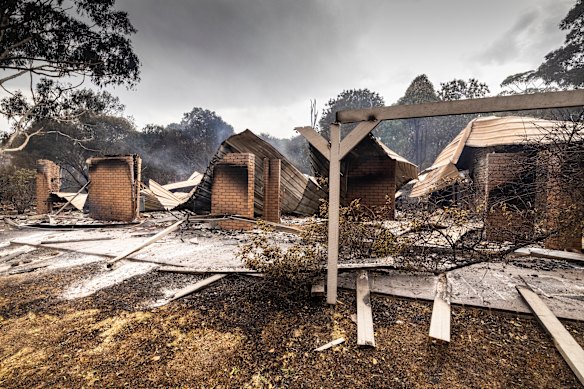
A house destroyed near Longwood East on Thursday.Credit: Jason South
And so, when fire, emergency and government agencies used the word “catastrophic” to describe what was expected on Friday, fearful memories came with the smoke.
Could this be a new Black Friday?
St Andrews resident James told ABC Radio Melbourne early on Friday morning that he could see a fire burning in the distance in Kinglake National Park, the scene of devastation in the Black Saturday fires of 2009.
James lost a house in those bushfires.
Watching the smoke, he said, brought back bad memories.
“It’s not the nicest feeling to see smoke only a few kilometres away,” James said. “We are nervous, but we’ve done everything [to prepare].”
Indeed. So fire-wary is he after the trauma of Black Saturday that he has rebuilt his home into the side of a mountain, complete with a bunker and sprinklers.
When Age reporter Marta Pascual Juanola visited Yea on Thursday, several people pointed out to her that these latest fires began on the anniversary, almost to the day, of fires in 1969 which wrought catastrophe in the Yea district and elsewhere in Victoria.
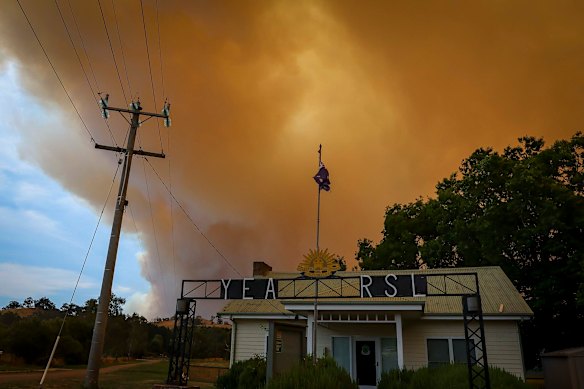
Rising smoke over the Yea RSL on Friday.Credit: Eddie Jim
The fires of Wednesday, January 8, 1969, killed 28 people: 17 of them fleeing their cars and trying to outrun the fire on the Geelong-Melbourne freeway at Lara.
Among the 280 fires that scorched Victoria that day, Lara and districts around Yea, Daylesford, Bulgana (near Ararat), Darraweit Guim in the Macedon Ranges, Kangaroo Flat and Korongvale recorded the combined loss of 230 houses, 21 other buildings and more than 12,000 stock.
And mercy, by mid-afternoon on Friday these long years later, a new grassfire was out of control around Lara, which prompted the following emergency and unwelcome memory-jogging warning to residents of Avalon, Corio and Lara: “You are in danger, act now to protect yourself. It is too late to leave. The safest option is to take shelter indoors immediately.”
On Friday, when Age reporter Melissa Cunningham made it north to Yea, she found a veritable ghost town under an eerie sky tinged orange. The vast majority of residents had paid heed to their memories, received and actual, and had fled to find reliable shelter wherever it beckoned.
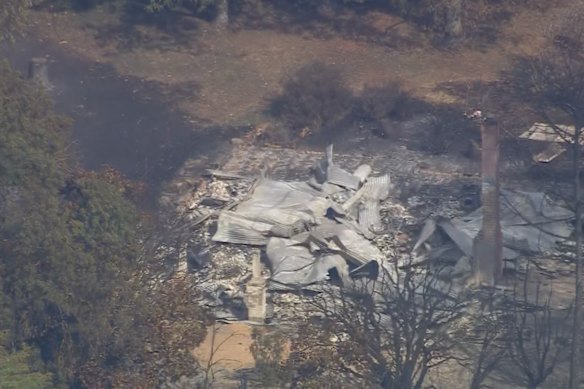
Fire destroyed at least 10 homes in Ruffy, about 100 kilometres north of Melbourne.Credit: Nine
Earlier came the confrontation of morning on the Longwood fire ground, direct from an exhausted and overwhelmed Country Fire Authority captain in the village of Ruffy, population 164, which straddles the shires of Strathbogie and Murrindindi, about 50 kilometres north of Yea by winding road.
“The main street looks like a bomb’s gone off,” said captain George Noye, struggling to maintain composure while speaking to ABC Radio.
Soon, he’d managed to survey some of the damage.
Loading
“[I’m] just down the main street at the moment, we’ve lost the old school, the old Ruffy produce store is gone, three houses on the main street. We’ve lost countless homes across the area. Ten of my firefighters that I know of have lost homes. There’s no power, a lot of power poles are burned out.”
Bottled water was running out, and the only fuel available was already in the fire trucks.
The unspeakable suffering of livestock was getting to Noye, too, as it always does to those unfortunate enough to witness such inevitable results of fast-running fires in farming districts.
“There’s stock unfortunately that have perished, there’s stock that need to be put down and buried. We need all the help we can get as soon as possible,” Noye said.
Even more unspeakable was the possible fate of three people, including a child, missing in the Longwood fire area.

Yea locals Tracy Hall and Maek Miller.Credit: Eddie Jim
Victoria Police Deputy Commissioner Robert Hill said CFA officers working in the area encountered three people – a man, a woman and a child – and advised them to take shelter because it was too late to leave.
“Later that afternoon, those CFA representatives re-attended that area to see the house that they saw those three people standing in front of had been completely destroyed,” Hill said, leaving much unsaid.
“At this point of time, we’re not suggesting [for] one moment we’ve seen three people perish. All I’m saying is that these people are unaccounted [for].”
By mid-afternoon on Friday, the missing were still missing. And evacuees in shelters, wearied firefighters, farmers trying to protect their livestock, land and homes, and Victorians everywhere sweltering in crushing heat, tens of thousands of them without power, were pinning their hopes on a cool change promised to arrive in the evening.
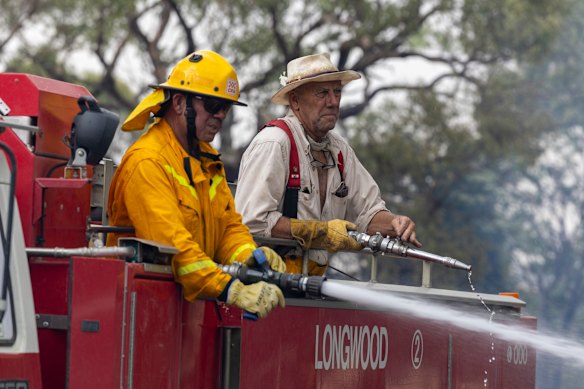
A fire crew battling the Longwood fire on Thursday.Credit: Jason South
But no silver lining was to be found there.
Jessica Roussel from the Bureau of Meteorology brought unwelcome news. The wind change accompanying the drop in temperature would cause a deterioration in conditions in fire grounds, she said.
The wind would move to the west, increasing its speed. It had already reached peak gusts of 90km/h through Melbourne earlier in the afternoon.
Meanwhile, pictures, reports and urgent warnings flooded in from across the state and into the foothills of the Victorian Alps. Out to the far west in the Wimmera, the wind was already blowing a gale, putting the townsfolk of Natimuk in the path of an uncontrolled grassfire and showering embers on Horsham.
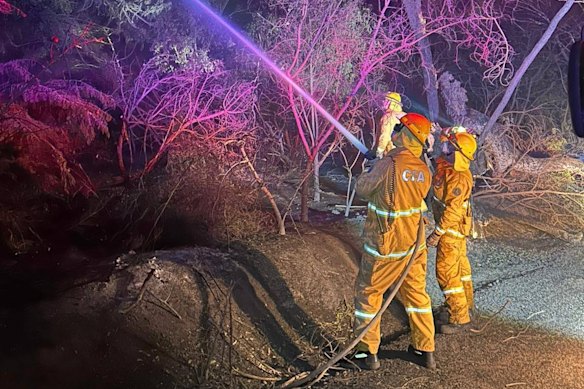
Firefighters battle the Longwood fire on Thursday night.Credit: Facebook
You’d need a good map to find a lot of the dozens of little places listed under “leave immediately”.
By mid-afternoon, residents of the following villages, towns and districts were given the chilling direction to “take shelter now”: Cathkin, Caveat, Ghin Ghin, Highlands, Kanumbra, Killingworth, Koriella, Molesworth, Whanregarwen and Yarck.
The people of Acheron, Devils River, Eildon, Taylor Bay, Thornton – all in the Longwood fire area, where flames were heading south-east towards Eildon – were delivered a particularly alarming message.
“A wind change is expected around 8pm tonight (Friday, 9 January). This will cause the fire to change direction to the north-east, heading back towards Strathbogie,” the emergency warning declared.
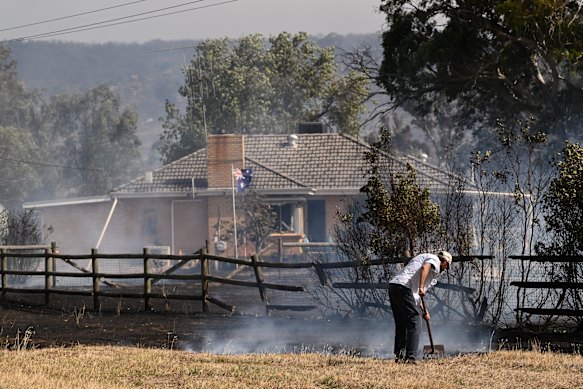
A property surrounded by burnt land in Longwood on Friday.Credit: AAP
“Conditions will become very dangerous and unpredictable.
“You are in danger and need to act immediately to survive. The safest option is to take shelter indoors immediately. It is too late to leave.”
Just how black – or how relatively muted compared with the horrors of the past – this new Friday has become will clearly not begin to be revealed until at least Saturday morning.
But if there is a measure of salvation to be found within the flames, much of it must be chalked up to the determined firefighters of the CFA, and a warning system that took heed of bad memories to educate the public and began in earnest days ago with the word “catastrophic” and galloped through the worst of the threats with chants of “leave now” and “take shelter” and “too late to leave”.
Be the first to know when major news happens. Sign up for breaking news alerts on email or turn on notifications in the app.