
 2 months ago
53
2 months ago
53
Ben Rich looks at the heatwave developing across the eastern United States bringing stifling heat and humidity
Millions of people across the US East Coast are enduring dangerous heat and humidity, with temperatures expected to reach and stay at 38C (100F) for several days.
The National Weather Service has warned that the heat index - a measure of how hot it feels based on temperature and humidity - could reach as high as 115F in cities such as Washington DC, Philadelphia and New York over the 4 July weekend.
The soaring temperatures are raising concerns as President Donald Trump hosts a celebration marking America's 250th birthday and multiple World cup matches take place outdoors.
The heatwave follows an unprecedented spell of early summer heat across Europe, with record highs across the continent.
The stifling heat that has been blasting the Midwest will intensify into the Northeast and mid-Atlantic states on Thursday and Friday. Extreme heat warnings continued on Thursday from the Midwest to the Northeast.
"This level of rare and long-duration heat, with little or no overnight relief, affects anyone without effective cooling and/or adequate hydration," the National Weather Service said in a warning.
By 9:00 EST (14:00 GMT) on Thursday, temperatures were already close to 90F in Washington and New York City.
Could a heatwave hit Taylor Swift's wedding?
Maximum temperatures could hit 100F in New York Central Park on Thursday and Friday. This would be the first time in 12 years that New York has been this hot.
"My recommendation to all New Yorkers is to stay inside and stay cool," New York City Mayor Zohran Mamdani warned at a press conference, "and if you happen to be getting married at Madison Square Garden, you will be staying inside and you will be staying cool, and I think it's a good example to set for the city at large."
Pop star Taylor Swift and NFL player Travis Kelce are reportedly celebrating their wedding on Friday at the New York arena on Friday.
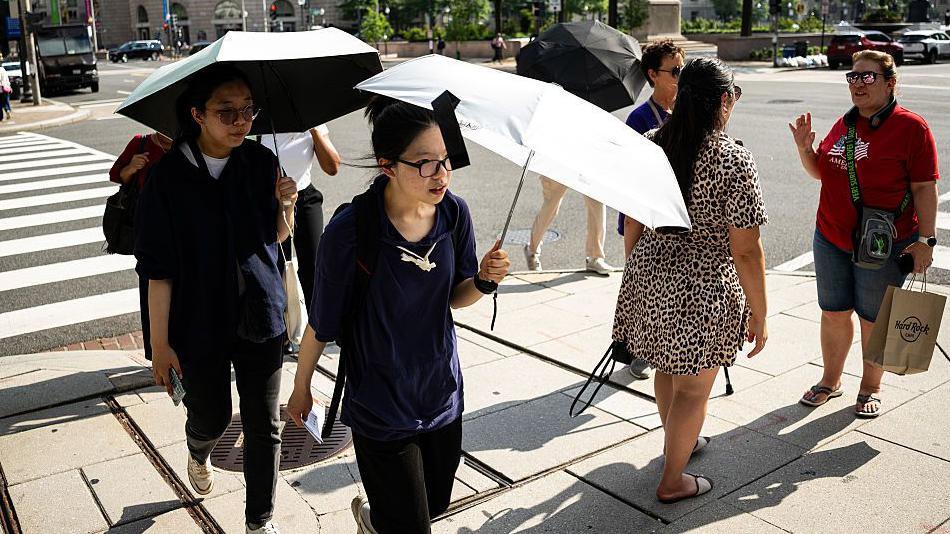 Image source, Bloomberg via Getty Images
Pedestrians carry umbrellas to shield themselves from the sun during high temperatures in Washington, DC
Further south in the nation's capital, the city could record four days in a row of 100F heat. This has only happened twice before.
On Thursday, the United States Capitol Police announced that only essential personnel would be allowed to attend a rehearsal for a 4 July concert in Washington, due to concerns about members of the public gathering amid the excessive heat.
Trump is expected to speak outside at a 4 July celebration on Saturday, despite the predicted high temperatures; the president has maintained he wants to gather outside for the celebration.
"By the way, on July 4th, it's going to be approximately 107 degrees out, and I'm gonna go and I'm gonna make a really long speech just to show that I can do anything," he said.
Watch: World Cup fans sweat through US 'heat dome'
America's northern neighbour, Canada, has also been seeing extreme heat this week, with temperatures up to 99F on the horizon in Ontario.
Those high temperatures have forced organisers of a public World Cup watch party in Toronto for the Portugal and Croatia match.
Heat warnings are also in place across much of Quebec, including Montreal and Quebec City.
Forecasters say high humidity levels will make conditions feel even more oppressive, with heat index values set to reach 115F in the coming days. The heat index is what the temperature feels like to the human body when relative humidity is combined with the air temperature.
The heat is building under a persistent area of high pressure in the central and eastern parts of the US – also known as a "heat dome".
As well as strong sunshine, dry soil is intensifying the heat - the coastal Northeast has been in drought this year. Without soil moisture to evaporate, solar energy goes entirely into baking the ground, thereby amplifying temperatures.
Heatwaves have become more frequent, more intense, and last longer because of human-induced climate change. The world has already warmed by about 1.1C since the industrial era began and temperatures will keep rising unless governments around the world make steep cuts to emissions.
Temperatures in the Northeast will drop a couple of degrees on 4 July with the threat of severe thunderstorms. Temperatures will still be well above average, though with a more significant drop on Sunday and Monday as cooler air moves down from the north.

















































