3 months ago
17
3 months ago
17
‘Dangerous and extremely regrettable’: Chinese fighter ‘locked on’ to Japanese jets
By Tim Kelly, Nobuhiro Kubo and Kiyoshi Takenaka
December 8, 2025 — 7.48am
Australia and Japan have sounded the alarm after a Chinese military plane locked its radar on Japanese fighter jets on the weekend, aggravating tensions between the Asian nations at loggerheads over Taiwan.
“We are deeply concerned by the actions of China in the last 24 hours,” Australian Defence Minister Richard Marles told a joint news conference on Sunday in Tokyo after holding talks with his counterpart, Japan’s Defence Minister Shinjuro Koizumi.
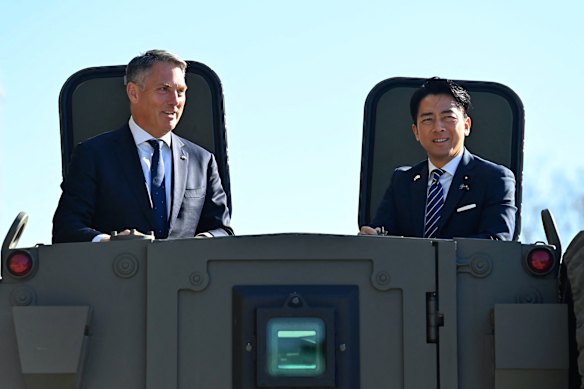
Defence Minister Richard Marles in a military vehicle with Japan’s Defence Minister Shinjiro Koizumi in Tokyo on Sunday.Credit: AFP
“We expect those interactions to be safe and professional. We continue to advocate to China about these issues in a very calm, sensible and moderate way.”
Radar is used by jets to lock on to targets, and for search and rescue operations. On Saturday, Japan reported that an aircraft launched from a Chinese carrier “intermittently” locked its radar on Japanese jets tracking the ship from a distance, once for 30 minutes.
The Chinese J-15 fighter jet directed fire-control radar at the Japanese military aircraft near Japan’s Okinawa islands in two incidents, Koizumi said.
A fire-control radar lock is one of the most threatening acts a military aircraft can take because it signals a potential attack, forcing the targeted aircraft to take evasive action.
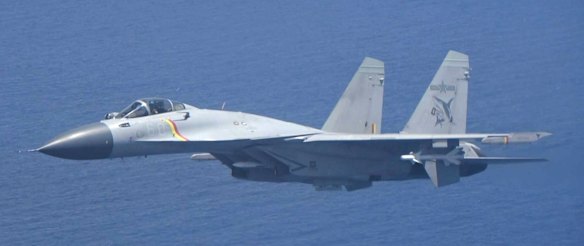
A Chinese J-15 fighter jet over the Pacific in June.Credit: AP/Japan’s Ministry of Defence
Koizumi said the incident was “dangerous and extremely regrettable,” saying Japan had lodged “a strong protest” with China.
The Chinese navy disputed the Japanese claim as “completely inconsistent with the facts” and told Japan to “immediately stop slandering and smearing”.
Marles, who is in Japan to inspect shipyards after Australia signed a $10 billion deal to buy 11 warships, expressed his concern about the incident just a week after he revealed the Australian Defence Force was tracking the course of a Chinese flotilla heading south in the Philippine Sea.
Loading
The defence minister is flying to Washington DC on Monday where he and Foreign Minister Penny Wong will have high-level security talks with US War Secretary Pete Hegseth and Secretary of State Marco Rubio.
The weekend encounters near islands close to territory claimed by both Japan and China are the most serious run-ins between the two militaries in years, and are likely to further escalate tension between the neighbours.
Relations have already soured after Prime Minister Sanae Takaichi warned that Japan could respond to any Chinese military action against Taiwan if it also threatened Japan’s security.
China claims democratically governed Taiwan, and has ramped up military and political pressure against the island whose government rejects Beijing’s territorial claims. Taiwan lies just 110 kilometres from Japan’s westernmost island, Yonaguni.
Japan hosts the biggest overseas concentration of U.S. military power, including warships, aircraft and troops, with much of that contingent, including thousands of U.S. Marines, based in Okinawa.
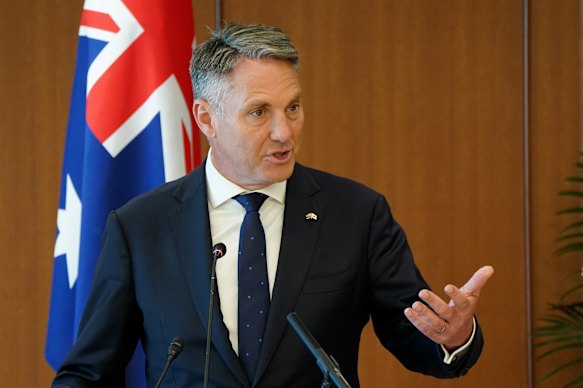
Marles speaks during a press conference in Tokyo on Sunday.Credit: AP
The US State Department and the US Embassy in Tokyo did not immediately respond to requests for comment on Japan’s claims about China’s use of radar.
Japan said the Chinese jets involved in the two incidents were launched from China’s Liaoning aircraft carrier, which was manoeuvring south of the Okinawan islands with three missile destroyers.
On Thursday, China was deploying a large number of naval and coast guard ships across East Asian waters, which at one point numbered more than 100, Reuters reported, citing sources and intelligence reports.
Loading
Taiwan’s government described that build-up as posing a threat to the Indo-Pacific region. Japan said it was monitoring Chinese activity closely.
On Sunday, Taiwan’s coast guard said it was monitoring drills by three Chinese maritime safety ships on the western side of the Taiwan Strait’s median line, but said the situation in the waters surrounding Taiwan was currently “normal”.
Chinese state media said the search-and-rescue drills were in the central waters of the strait, patrolling “high-traffic areas, and areas with frequent accidents”.
Taiwan’s coast guard said China was using “misleading and false wording” about what it was doing, with the aim of harassing Taiwan and carrying out psychological warfare.
Loading
China says it alone exercises sovereignty and jurisdiction over the strait, a major trade route for about half the world’s container ships. The US and Taiwan say the strait is an international waterway.
- With Michelle Griffin
Get a note directly from our foreign correspondents on what’s making headlines around the world. Sign up for our weekly What in the World newsletter.
Most Viewed in World
Loading