3 months ago
34
3 months ago
34
What will it take for policymakers to take this more seriously?
That’s the question a desperate-sounding Jeremy posed on local ABC talkback radio as he drove through central Victoria, which has been ravaged by bushfires for the past week, while his family was on the Great Ocean Road trapped by floodwaters.
It’s a question we should all be asking.
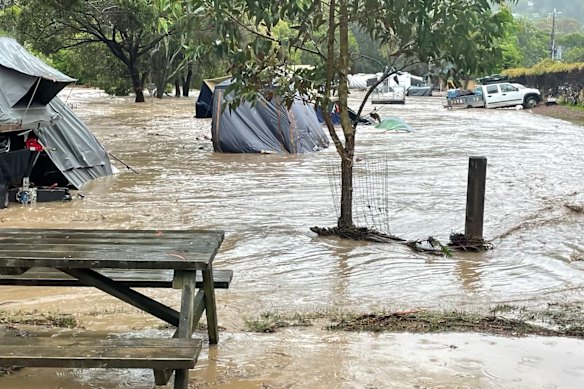
Flooding at Wye River on Thursday.Credit: Rebecca Scott
Queenslanders have been warned to brace for further flooding and heavy swells in coming days, as another cyclone threatens to form off the coast – even as recovery from ex-cyclone Koji continues.
In both NSW and Victoria, authorities on the weekend warned people to limit the time they spend outdoors to reduce exposure to bushfire smoke. That smoke, it should be remembered, contains toxic particles from everything incinerated in the fires – not just trees and grass, but buildings, factories, vehicles, and more.
Communities in southern New South Wales have been hit by fires. Communities in Queensland’s central highlands were urged to evacuate on Thursday morning as the Mackenzie River inched ever closer to its peak. Large areas of Western Australia remain gripped by severe heatwaves and fires.
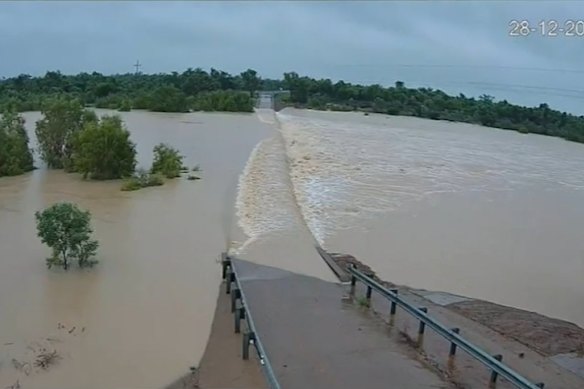
Devastating flooding in North Queensland in December.Credit: Nine
Hundreds have been made homeless by the Victorian bushfires. Many more are now homeless – tourists, thankfully temporarily – due to the flash flooding that swept through the Great Ocean Road and Gippsland on Thursday.
These are not just “weather events”, and it’s not like we haven’t been warned. Climate scientists have been sounding the alarm for decades about the devastation that unchecked fossil fuel production and consumption, and the resulting warming, will bring.
They have warned that a warmer atmosphere holds more moisture, which exacerbates sudden storms, just like the one that smashed through the Great Ocean Road.
And yet, there is a maddening tendency to treat each environmental crisis that climate change throws at us as another isolated incident.
Surely, that pretence must now fall.
The Intergovernmental Panel on Climate Change (IPCC) warns that 2 degrees of global warming would make extreme heat 2.6 times worse, raise sea levels by six centimetres, accelerate extinctions, reduce crop yields and global fisheries, and increase extreme weather events.
It is becoming increasingly likely this is the scenario our children will inherit.
Only this week, the Copernicus Climate Change Service and Copernicus Atmosphere Monitoring Service for the European Commission issued its latest report on how we’re tracking against the IPCC benchmark. Their findings rely on global climate monitoring from organisations including NASA, NOAA, the UK Met Office, Berkeley Earth, and the World Meteorological Organisation.
As this masthead reported, the data shows last year was officially the planet’s third-warmest year on record, behind 2024 and 2023.
The past 11 years have been the 11 warmest on record. Temperatures for 2023-25 averaged more than 1.5 degrees above pre-industrial levels – exceeding the goal set by the 2015 Paris Agreement over a three-year period for the first time, though the trend would need a decade of data to be considered permanent.
Victoria is a prime case study.
Even as multiple bushfires continued to rage out of control after a week of burning, flash flooding hit the Great Ocean Road with such intensity on Thursday that multiple cars and caravans were washed away at Wye River.
This is the same tiny tourist hotspot at which the campground and foreshore were closed, less than a week ago, due to the threat of bushfires.
About 10 kilometres away, the Bureau of Meteorology recorded 175 millimetres of rain – equivalent to three months’ rain – in six hours.
Loading
Also on Thursday, Environment Minister Murray Watt bestowed the Murray River downstream of the Darling River, and its associated floodplains, with a critically endangered status.
The news that these essential ecosystems will be given the highest levels of legal protections under the EPBC Act was criticised by the National Farmers’ Federation, whose Water Committee chair, Malcolm Holm, questioned the need for “more red tape”.
Watt’s listing was nonetheless welcomed by environment groups, and is recognition of the adage that doing the same thing and expecting a different outcome is an insanity.
But more must be done.
Loading
Australia has set a target to reach net zero carbon emissions by 2050. In November, the international university partnership Net Zero Australia calculated that, on current trends, we are tracking a decade behind that goal.
Two months earlier, the federal government accepted the Climate Change Authority’s advice and adopted a target to reduce greenhouse gas emissions by 62-70 per cent by 2035. That target, while setting Australia within the range of comparable industrialised countries, doesn’t go far or fast enough, according to almost every climate scientist in the country.
As events of the past week show, it is well beyond time their stark warnings were heeded.
Get to the heart of what’s happening with climate change and the environment. Sign up for our fortnightly Environment newsletter.
Most Viewed in Environment
Loading