3 months ago
29
3 months ago
29
Some of Australia’s most influential religious leaders have come together to urge Prime Minister Anthony Albanese to pause his hate speech reforms drawn up in response to the Bondi massacre, warning about unintended consequences for freedom of religious expression.
Echoing the concerns of Liberal MPs including Andrew Hastie, Catholic Archbishop of Sydney Anthony Fisher, Anglican Archbishop Kanishka Raffel, Anglican South Sydney Bishop Michael Stead and president of the Australian National Imams Council Shadi Alsuleiman co-signed a letter on Friday arguing the attempt to crack down on antisemitic Islamist hate preachers might also threaten reasonable religious discourse.
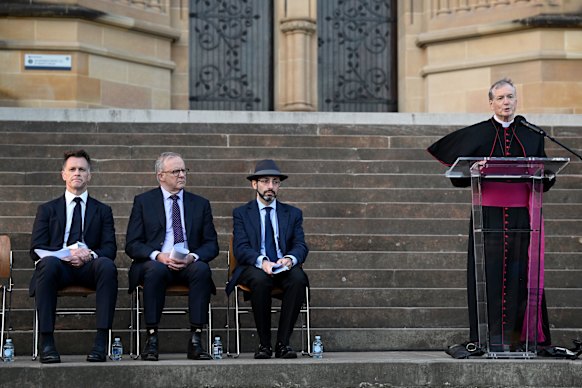
NSW Premier Chris Minns, Prime Minister Anthony Albanese and Rabbi Benjamin Elton listen to Sydney Catholic Archbishop Anthony Fisher at an interfaith ceremony in Sydney, days after the Bondi massacre.Credit: AAP
“Religious freedom includes the right of individuals and communities to teach, preach, and express their beliefs openly and publicly, including through sermons, religious education, pastoral guidance, and moral commentary, even where those beliefs may be contested, unpopular, or misunderstood,” said the letter, sent by Stead on behalf of Christian, Muslim, Sikh, Buddhist and Scientology groups.
“Provided such expression does not incite physical harm or violence, it must be protected as a legitimate exercise of religious practice.
Loading
“Legislation of this breadth and sensitivity requires careful deliberation and meaningful consultation. A rushed legislative process of this nature undermines confidence, increases the risk of unintended consequences, and does not assist community unity or social cohesion.“
The letter is the most substantial intervention into the debate about the hate speech laws from religious organisations, and gains extra heft from the contribution of Archbishop Fisher, a confidante of the prime minister.
No Jewish groups signed the letter, which acknowledged the need to act decisively after Bondi but warned against overreach.
In response to the Bondi massacre, the government developed new anti-vilification laws that would prohibit the promotion of hatred against a person because of their ethnic origin or race.
This was targeted at hate preachers’ abusive language directed at Jews, which has long fallen under the threshold for prosecution under old laws because it did not include direct threats and allowed the sermons to go on unchecked.
But civil liberties groups, Coalition MPs and legal experts have expressed worry that the new, lower threshold for criminal speech might capture debate on contentious topics such as migration or terrorism.
The faith leaders’ intervention might give some political cover for Opposition Leader Sussan Ley, who has found herself in an awkward position arguing the hate speech laws were rushed and flawed after spending weeks demanding Albanese return to parliament to fully enact all the recommendations from antisemitism envoy Jillian Seagal, who called for anti-vilification laws.
The prime minister has been accused of playing political games by pressuring the Coalition to support a complex and broad-ranging bill taking in a short timeframe. As a result, he now appears unlikely to have a pathway to working with the Coalition. The Greens, meanwhile, are seeking to protections for sexuality and religion, which will open up even more complex debates.
In the letter, the leaders said Albanese should go back to the drawing board and revamp the proposed laws on serious religious vilification that were shelved in 2024.
They also argued against calls to remove a defence in the draft laws that would create an exemption for religious leaders citing a religious text. Coalition MPs and the Executive Council of Australian Jewry want this defence removed, so that Muslim preachers cannot misuse passages from the Koran.
“It would be inconsistent with the prime minister’s pre-election promise to faith leaders that ‘legal
protections for people of faith will not go backwards under Labor’ as well as his commitment to
progress religious protections in a bipartisan manner with the Coalition,” the letter from religious leaders said.
Privately, some key Jewish leaders are dismayed that Albanese had only appeared to consult Peter Wertheim, co-chief executive of ECAJ, on the hate speech laws.
“We are ready to work with the government to improve the bill to remove unintended consequences and overreach while achieving the aims of combating antisemitism and racial and religious hatred. But we need more time,” the letter said.
“We therefore respectfully urge the government to delay the introduction of the bill to allow for an adequate consultation period, and to engage directly and meaningfully with faith communities to get the right balance in this legislation. Australia’s strength lies in its ability to protect both public safety and fundamental freedoms.
“Measures intended to combat hate should reinforce trust, fairness, and inclusion, not weaken
them.”
Cut through the noise of federal politics with news, views and expert analysis. Subscribers can sign up to our weekly Inside Politics newsletter.
Most Viewed in Politics
Loading