1 week ago
5
1 week ago
5
Opinion
September 30, 2025 — 5.00am
September 30, 2025 — 5.00am
Lenin was supposed to have been speaking about clearing landmines when he said: “Probe with bayonets. If you encounter mush, proceed; if you encounter steel, withdraw.”
He might never have spoken those words, but no matter. It’s an excellent metaphor for the strategy that Vladimir Putin and Xi Jinping are applying to the democratic West.
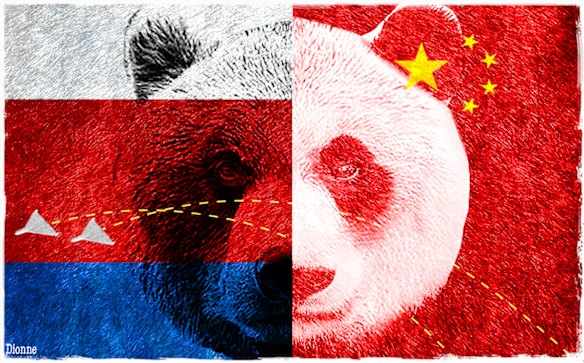
Illustration by Dionne GainCredit:
Both Moscow and Beijing are probing with the bayonet of “hybrid” or unconventional war – using flexible combinations of military and non-military methods, overt and covert, to test, destabilise and weaken rivals.
It’s aggressive, but the individual actions usually fall beneath the conventional definition of armed combat. This allows democracies to pretend that it’s not war, so let’s not worry. That’s called the “mush” response, and that’s why it works so well.
“This has been something they’ve been engaging in against the West – including Australia – for two decades,” observes Mick Ryan, the prominent strategist and retired Australian Army major general. He includes North Korea and Iran as practitioners.
The current showcase is Europe. On the weekend, Denmark reported that unidentified drones had appeared in the air above its major military bases. It announced a ban on all drone use this week, fearing risks to the two major summits it’s due to host.
It was Denmark’s third drone alarm in a week, and it was one of only five European countries in a month to suffer incursions from either the Russian air force or drones strongly suspected of Russian origin. The headline in The Economist magazine on the weekend summed it up: “Russia is violating Europe’s skies with impunity”.
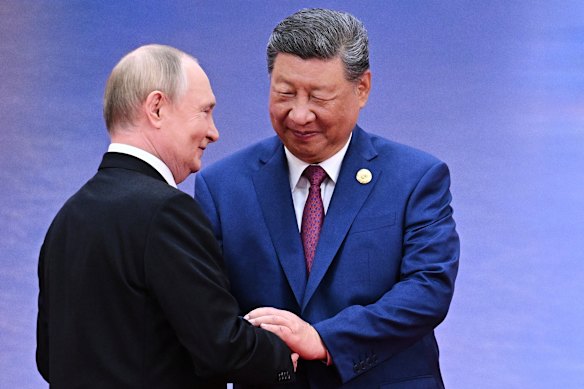
Vladimir Putin and Xi Jinping greet each other in Tianjin in August.Credit: AP
This is no coincidence. As a report by the Institute for International Strategic Studies reported last month, quite separately to the air incursions: “Russian sabotage operations in Europe have increased their range of targets and severity of attacks. The number of attacks almost quadrupled from 2023 to 2024.”
Putin started more than a decade ago. Remember his annexation of Crimea? Instead of deploying his army openly, he sent so-called “green men” – Russian troops dressed in unmarked uniforms. This is a hybrid tactic. The West’s response was so pathetic that he was encouraged to mount Russia’s full-scale invasion of Ukraine in 2022.
Since then, he has intensified his hybrid campaign against Europe. Tactics include assassinations, mass disinformation campaigns via social media, cyberattack, weaponised immigration movements, cutting of undersea fibre-optic cables in the Baltic Sea, and jamming or spoofing of European GPS systems, endangering civilian aircraft.
Sabotage targets have included energy systems, water facilities, banking networks, health systems. Lithuania this month charged 15 people with ties to Russian military intelligence with placing explosive parcels on cargo planes. The packages started ground fires in Germany, Poland and Britain last year.
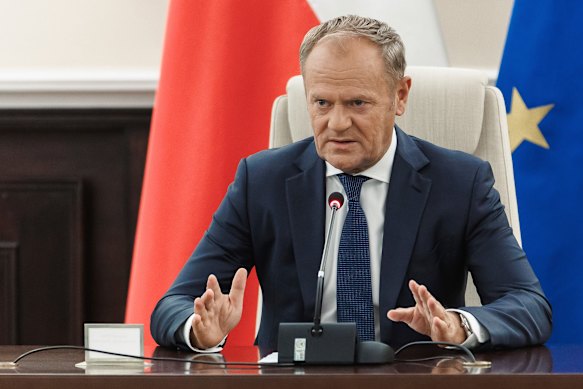
Polish Prime Minister Donald Tusk” This is “the closest we have been to open conflict since World War II.”Credit: AP
The leader with the greatest credibility in fighting Putin, Ukraine’s Volodymyr Zelensky, said on the weekend that Putin was preparing to launch armed warfare against a European nation: “Putin will not wait to finish his war in Ukraine. He will open up some other direction. Nobody knows where. He wants that.”
What he did not say is that Putin has been emboldened since US President Donald Trump rolled out the red carpet for him, welcoming the indicted war criminal to America last month. Zelensky is too diplomatic to say so; Bloomberg News, however, has reported Kremlin insiders as saying just that.
Ukraine this month spotted 92 drones flying towards Poland in a “choreographed” way. It intercepted most. Nineteen crossed into Polish territory, where the Poles shot four down. Poland is one of the most alarmed and best-armed countries of Europe.
Polish prime minister Donald Tusk said that “this situation brings us the closest we have been to open conflict since World War II”. The Europeans haven’t been entirely passive. But they have yet to find the “steel” to stop Putin. A senior Danish official remarked to me a couple of months ago that Europeans were the proverbial frog in the pot. “The water is boiling but when will we jump?”
How can Europeans have been so slow and hesitant to confront Putin’s aggression? A new report from the Netherlands contains the answer in its title: “Blinded by Bias”.
Policymakers failed to foresee Moscow’s full invasion of Ukraine because they “found it extremely hard to envisage an event that ran counter to deeply ingrained assumptions which, it turned out, affected their perceptions and clouded their judgment,” says the report by The Hague Centre for Strategic Studies.
It quotes a former Dutch official as saying that “it was just beyond imagination”. Now the Europeans are having their imaginations and biases challenged once more by Putin’s intensified hybrid aggression.
Loading
China’s program of hybrid war has been running for longer and has been more successful. It has enfolded large areas of the world’s most valuable commercial waterway, the South China Sea, and built new military bases on reclaimed land while intimidating the US out of any forceful response. It has subdued half a dozen nations and counts Russia itself as one of its vassal states. All without a shot fired.
Mick Ryan says that China is probing Australia with the bayonet of its hybrid warfare, too. After a spirited start at confronting this in 2017 under the Turnbull government with laws on foreign interference and espionage and the banning of a Chinese billionaire, Australia has fallen into a “deep complacency”, says Ryan.
“The Australian people will continue to be kept in the dark by the Australian government because it allows the government to keep domestic spending high and defence spending low. All we talk about is ‘stabilising’ the relationship, and the Chinese love to hear that.
“We have the same blind spots and biases in the Pacific” as in Europe, he says. “Having plain conversations and talking about the ‘w’ word” – war – “is very important”.
A precept of the ancient Chinese clan whose collective wisdom is published under the name of Sun Tzu says: “If one party is at war with another, and the other party does not realise it is at war, the party who knows it’s at war almost always has the advantage and usually wins.”
Peter Hartcher is international editor.
Most Viewed in World
Loading