1 month ago
12
1 month ago
12
By George Brandis
October 26, 2025 — 4.30pm
Scarcely a day goes by without a new headline proclaiming what a terrible mess the Liberal Party is in, invariably fed by Liberals reaching deep into the trove of cliches to dramatise the party’s problems: “train wreck”, “clown show”, “existential crisis”.
No wonder Sussan Ley – a decent and rational politician trying desperately to reconnect the party with mainstream Australia – is struggling to get clear air. While a period of introspection following the party’s worst electoral defeat is inevitable and necessary, as Senator James Paterson has wisely observed, it must not go on for too long.
Now, the contagion has spread to the National Party, with the latest twist in Barnaby Joyce’s picaresque career.
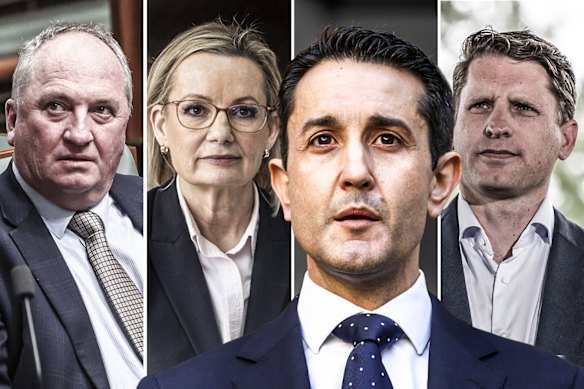
Queensland Premier David Crisafulli, Nationals defector Barnaby Joyce, Opposition Leader Sussan Ley and Liberal MP Andrew Hastie.Credit: Nine
Rather than indulge in endless self-laceration, a much more useful way for federal Liberals to address the party’s failure would be to learn from where it has succeeded. Because amid the generally bleak political landscape, there are success stories as well. The most obvious is the Queensland Premier David Crisafulli, elected a year ago yesterday.
Who would have thought that, at a time of such woe, the country’s most popular political leader would be a Liberal? (He is, strictly speaking, a Liberal National, under the merged structure in Queensland.) A Redbridge poll comparing the approval ratings of all premiers put Crisafulli in a strong first place, with a net favourability of +29, 10 points ahead of Labor’s perennially popular South Australian premier Peter Malinauskas (+19). His personal ratings are streets ahead of Anthony Albanese’s; although the prime minister has had a good few weeks, the most recent Newspoll has his net approval at -1.
Lately, the LNP’s numbers have fallen, no doubt as a result of electoral backwash from the federal coalition’s divisions; nevertheless Crisafulli personally remains in a commanding position. Why is he so successful?
Part of the reason is undoubtedly Crisafulli himself: young, articulate, whip-smart, straightforward, immensely hardworking and – a relatively rare quality among political leaders – humble. He doesn’t strike poses and he doesn’t play games. What you see is what you get, and the Queensland public very much likes what it sees.
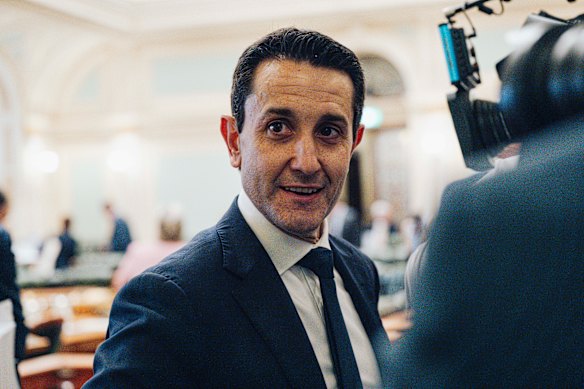
David Crisafulli is young, articulate, immensely hardworking and humble.Credit: Jamila Filippone
The timing worked for him. Labor had governed Queensland for all but seven of the past 35 years. It gave the state several strong premiers: Wayne Goss, Peter Beattie and Anna Bligh. Annastacia Palasczuk was likeable and decent. But eventually, Labor ran out of talent.
However, there is more to the LNP’s success in Queensland than just the personal qualities of its leader and the political cycle.
Crisafulli commands the middle ground of Queensland politics because he governs from the centre. He is a pragmatist who eschews the culture wars which so obsess Liberals in other states. He is alert to the peril of the party being dragged into the echo chamber of Sky After Dark, which has nothing to say to modern Australia. Its denizens, although a tiny sliver of the electorate, are well represented in the Liberal and National parties’ greying branch membership (average age 72). Crisafulli’s keynote speech to the party’s state convention in August - his first as premier - was a plea to the party to be sensible, centred and avoid ideological self-obsession.
Crisafulli has detoxified the Liberals’ brand in two key areas: energy policy and multiculturalism. By declaring his government’s support for net zero – despite the overwhelming opposition of branch members – he has steered the debate away from ideology to precisely where it should be: cost and reliability. Because he accepts the net zero target, his energy-agnostic approach has not led (except from the usual suspects) to cries that his government doesn’t take climate change seriously.
It is on the issue of multiculturalism that Crisafulli’s character and instincts are most evident. He is himself the embodiment of Australia’s multicultural success: the son of a family of Italian cane growers from north Queensland. It doesn’t get more iconic than that. Unlike some Liberal leaders, whose support for multiculturalism, though genuine, sometimes seems abstract, Crisafulli’s is passionate and personal. When he speaks about Australia as a successful multicultural society – and I have seen him do so with real emotion – he is telling his own life story.
Loading
Crisafulli is wise enough to appreciate that chasing the One Nation vote is a fool’s errand. Some federal Liberals such as Andrew Hastie are yet to appreciate the political folly of doing so. There are no seats to be won to the right of the Liberal Party (One Nation has zero seats in the House of Representatives), but many to be lost in the mainstream urban communities where multicultural Australia is a fact of life, and any party seen to be indulging it will rightly be punished.
One Nation is an overtly racist party and always has been: from the day nearly 30 years ago when Pauline Hanson used her maiden speech to decry Australia being “overrun by Asians” to the day she walked into the Senate in a burqa. Crisafulli won’t have a bar of them.
He is hardly woke. That is evident from his “adult crime, adult time” laws, to deal with the crime wave among juvenile offenders, and his government’s decision to pause the availability of puberty-blocking drugs. No political leader, Labor or Liberal, has come down harder on the CFMEU.
A shrewd, tough, pragmatic politician who knows how to win – by commanding the centre ground of politics, understanding the diversity of modern Australia and appreciating the dangers of being distracted by the obsessions of the political fringe – has emerged in Queensland to remind Liberals elsewhere of the path to success. But it remains unclear whether David Crisafulli’s federal colleagues are wise enough to follow it.
George Brandis is a former high commissioner to the UK and a former Liberal senator and federal attorney-general. He is a professor at the ANU’s National Security College.
Most Viewed in National
Loading